
POST BY PADDY JOHNSON
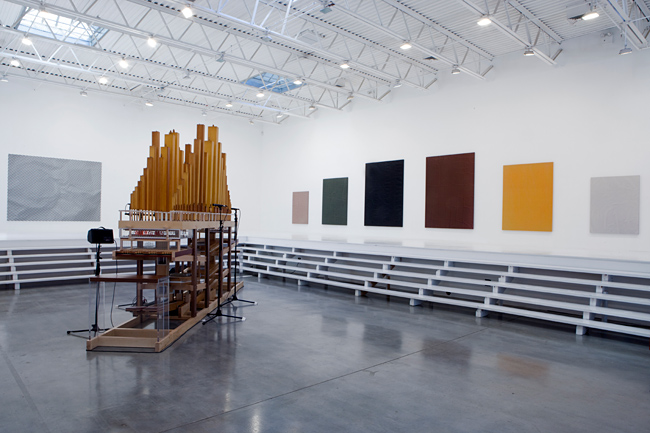
Tauba Auerbach, Here and Now/And Nowhere, 2009, Installation view, Crumple VII, Auerglass, Fold II, III, IV, V, VI, VII, Deitch Projects. Image via: Tauba Auerbach
TED Conference organizers responsible for their limp selection of artists working with technology could stand to take a look at Rhizome’s Seven on Seven at the New Museum April 17th. The event promises to pair seven great artists with seven technologists in teams of two, and challenge them to develop something new — be it an application, social media, artwork, product, or whatever they imagine — over the course of a single day. While I’m not expecting to see groundbreaking social media projects emerge from the conference (it’s possible just an awful lot to ask of any event), I’m sure the project will yield interesting results regardless. Challenges such as Seven on Seven, are really about developing ideas, discussion, and awareness, all of which is very much needed in the field.
Needless to say, I’m very much looking forward to covering this event. And in the spirit of collaboration I’m inviting Rocketboom’s Andrew Baron to join me that day for a little post-event commentary and reflection. Here’s hoping he takes me up on my offer.
Seven on Seven Participants include technologists Ayah Bdeir, Jeff Hammerbacher, David Karp, Andrew Kortina, Hilary Mason, Matt Mullenweg, and Josh Schachter, and artists Tauba Auerbach, Cao Fei, Aaron Koblin, Monica Narula, Marc Andre Robinson, Evan Roth and Ryan Trecartin.


{ 62 comments }
the selection of artists and technologists is what makes this concept work for me. great choices – especially interested in what comes out of whoever pairs with Matt Mullenweg – kudos to the Rhizome team.
the selection of artists and technologists is what makes this concept work for me. great choices – especially interested in what comes out of whoever pairs with Matt Mullenweg – kudos to the Rhizome team.
This is absolutely great idea and great pairings. the only pity is that the presentation day is VC priced at 350 dollars for non-students (??!!). You would need to do lots of reporting for the poor
This is absolutely great idea and great pairings. the only pity is that the presentation day is VC priced at 350 dollars for non-students (??!!). You would need to do lots of reporting for the poor
good idea, though i don’t know about the one day thing — wonder how much worthwhile interaction / collaboration / learning is going to happen in such a short amount of time. reminiscent of the art & technology program at LACMA — the chapter about robert irwin’s collaboration with edward wortz was my favorite part of the lawrence weschler bio.
good idea, though i don’t know about the one day thing — wonder how much worthwhile interaction / collaboration / learning is going to happen in such a short amount of time. reminiscent of the art & technology program at LACMA — the chapter about robert irwin’s collaboration with edward wortz was my favorite part of the lawrence weschler bio.
Looking forward to the show. Interested to see if the collaborations produce work that is not necessarily a grafting of technology and visual art but more an investigation and experiment into how technologies might completely change the the way we manifest arthink.
Looking forward to the show. Interested to see if the collaborations produce work that is not necessarily a grafting of technology and visual art but more an investigation and experiment into how technologies might completely change the the way we manifest arthink.
†the clashing point of two subjects, two disciplines, two cultures-of two galaxies, so far as that goes-ought to produce creative chances.†C.P Snow
†the clashing point of two subjects, two disciplines, two cultures-of two galaxies, so far as that goes-ought to produce creative chances.†C.P Snow
Paddy, I’ve been complaining lately about “precognitive” (predictive) articles and criticism and would have to include your “I’m sure the project will yield interesting results regardless” in there. And I’ll match your prediction with mine: it will be a confused mess that no one can get their head around. First of all, only one day for “art and technology”? That’s the best the NewMu can do? Then it’s back to great stuff like Urs Fischer. Second, when discussing formulaic “XYZ art” on my old blog (for example, at http://www.digitalmediatree.com/tommoody/comment/41330/), the topic came up of “artist and technologist teams.” In the thread I linked to spd said: “media art is rife with collaborative work (often it’s a cover for one person getting someone else to do technical stuff)” and “while i’m actually a fan of people working together, it seems underacknowledged so far and i wonder if the collaborative process of new media privileges talking a project through over actually doing stuff.” And I replied: “I…hadn’t thought about the issue of artist-tech person teams having any effect on content. It kind of makes sense–they have to talk to each other and some simplified middle ground (and thus middle of the road) art emerges out of that dialogue.” Just want to throw out here on AFC that teams are an old idea that hasn’t worked particularly well and the idea of “one day teams” almost assures that much confusion and little good art will result. You can prove me wrong when you liveblog it.
Paddy, I’ve been complaining lately about “precognitive” (predictive) articles and criticism and would have to include your “I’m sure the project will yield interesting results regardless” in there. And I’ll match your prediction with mine: it will be a confused mess that no one can get their head around. First of all, only one day for “art and technology”? That’s the best the NewMu can do? Then it’s back to great stuff like Urs Fischer. Second, when discussing formulaic “XYZ art” on my old blog (for example, at http://www.digitalmediatree.com/tommoody/comment/41330/), the topic came up of “artist and technologist teams.” In the thread I linked to spd said: “media art is rife with collaborative work (often it’s a cover for one person getting someone else to do technical stuff)” and “while i’m actually a fan of people working together, it seems underacknowledged so far and i wonder if the collaborative process of new media privileges talking a project through over actually doing stuff.” And I replied: “I…hadn’t thought about the issue of artist-tech person teams having any effect on content. It kind of makes sense–they have to talk to each other and some simplified middle ground (and thus middle of the road) art emerges out of that dialogue.” Just want to throw out here on AFC that teams are an old idea that hasn’t worked particularly well and the idea of “one day teams” almost assures that much confusion and little good art will result. You can prove me wrong when you liveblog it.
@tom moody @np: Yeah, one day isn’t enough to do much of anything, which is why I came out on the side on “interesting discussion”. But my issue isn’t that more talk than “doing” happens; in fact I think it’s just the opposite. Too much of the new media community will do anything to keep from discussing how art actually functions. Exhibit A: Eyebeam’s reblog. Eyelash LED lights? Zero commentary. They should be ashamed. Rhizome does much better, but it suffers from all the weaknesses of a museum blog.
I might have made this more clear, but I basically see this conference as an opportunity for artists to school technologists on how art actually functions. I pray it works, but you make a compelling “middle of the road” argument.
@tom moody @np: Yeah, one day isn’t enough to do much of anything, which is why I came out on the side on “interesting discussion”. But my issue isn’t that more talk than “doing” happens; in fact I think it’s just the opposite. Too much of the new media community will do anything to keep from discussing how art actually functions. Exhibit A: Eyebeam’s reblog. Eyelash LED lights? Zero commentary. They should be ashamed. Rhizome does much better, but it suffers from all the weaknesses of a museum blog.
I might have made this more clear, but I basically see this conference as an opportunity for artists to school technologists on how art actually functions. I pray it works, but you make a compelling “middle of the road” argument.
If you have the time can you please clarify this thought more
“but I basically see this conference as an opportunity for artists to school technologists on how art actually functions.”
thanks
If you have the time can you please clarify this thought more
“but I basically see this conference as an opportunity for artists to school technologists on how art actually functions.”
thanks
it’s a bit of an exercise in speculation for me to wonder what i meant 2 1/2 years ago quickly pecking away some comment – now i see why it’s so difficult to remember: just days before my daughter was born!
anyways, i am the last one to celebrate some anti-intellectual form of “doing” over “thinking,” so i do want to clarify that point. my take then (and more recently) has been a deep suspicion of how thoroughly academic so much media art is, bolstered by university departments that justify themselves as research. (this is a dual justification: for accreditation on the one hand and for attracting funding on the other). the work is highly project-based and often serves to illustrate some written thesis or lengthy project statement that explains all of the social and technological issues the work deals with (in case you missed it) and why it is different and better than what came before. i’m not arguing that artists shouldn’t think about, write about, or talk about their work and their practice; on the contrary, i’m concerned that the institutions, corporations, and universities that support media art often generate some pretty uninteresting forms of discourse and collaboration. from what i’ve seen, multi-disciplinary teams (that are created on the basis of representatives from specific disciplines) are one of those forms.
don’t get me wrong, i don’t think the structures absolutely determine the practices, and i think it’s great that this event is happening. (i don’t understand the price tag, but i trust it makes sense for someone). but at the same time, this is exactly the sort of thing we should be ruthlessly critical about, as opposed to celebratory. particularly since it is not some budding new idea that needs a little time to germinate without coming under scrutiny – the history of museums trying art/tech collaborations has already been noted, but i’d go further and say this is pretty widespread practice in media art generally.
at the end of this long-winded nonsense, i think i land right next to you guys in my conclusion. i think?
it’s a bit of an exercise in speculation for me to wonder what i meant 2 1/2 years ago quickly pecking away some comment – now i see why it’s so difficult to remember: just days before my daughter was born!
anyways, i am the last one to celebrate some anti-intellectual form of “doing” over “thinking,” so i do want to clarify that point. my take then (and more recently) has been a deep suspicion of how thoroughly academic so much media art is, bolstered by university departments that justify themselves as research. (this is a dual justification: for accreditation on the one hand and for attracting funding on the other). the work is highly project-based and often serves to illustrate some written thesis or lengthy project statement that explains all of the social and technological issues the work deals with (in case you missed it) and why it is different and better than what came before. i’m not arguing that artists shouldn’t think about, write about, or talk about their work and their practice; on the contrary, i’m concerned that the institutions, corporations, and universities that support media art often generate some pretty uninteresting forms of discourse and collaboration. from what i’ve seen, multi-disciplinary teams (that are created on the basis of representatives from specific disciplines) are one of those forms.
don’t get me wrong, i don’t think the structures absolutely determine the practices, and i think it’s great that this event is happening. (i don’t understand the price tag, but i trust it makes sense for someone). but at the same time, this is exactly the sort of thing we should be ruthlessly critical about, as opposed to celebratory. particularly since it is not some budding new idea that needs a little time to germinate without coming under scrutiny – the history of museums trying art/tech collaborations has already been noted, but i’d go further and say this is pretty widespread practice in media art generally.
at the end of this long-winded nonsense, i think i land right next to you guys in my conclusion. i think?
Hi, spd! On the topic of “time to germinate” and “schooling,” here’s some more thoughts: Like Paddy, I have doubts that LED eyelash lights can be eradicated in a day–even that “product” probably took more than a day to develop. I was wondering what qualifies as a “technologist” here so I googled the seven. Four are social media, Web 2.0 pioneers: Joshua Schachter is the founder of delicious (formerly del.icio.us); David Karp is the founder of tumblr; Jeff Hammerbacher conceived, built, and led the Data team at Facebook; and Matt Mullenweg is the founding developer of WordPress. All four of these platforms have been embraced by artists so it’s hard to know what the technologists can learn they haven’t already over months or years. Andrew Kortin developed Venmo and Bitly–again, I’m guessing that he spent more than a day assessing the need for those products and how to make them work. The sixth, Hilary Mason, is a computer science professor “with a background in machine learning, data mining, and web applications.” Possibly she could benefit from spending a day with an artist. And the seventh, Ayah Bdeir is already an artist, as well as an engineer and “interaction designer who mixes tools and materials, experimenting with animating static objects and putting technology where it typically doesn’t belong.” (If I were her I wouldn’t be too happy about being in the technologist column.) The problem is this isn’t just a day of discussion, they’re actually going to make a “product.” It almost seems like a bad joke. Only art could be taken so un-seriously.
Hi, spd! On the topic of “time to germinate” and “schooling,” here’s some more thoughts: Like Paddy, I have doubts that LED eyelash lights can be eradicated in a day–even that “product” probably took more than a day to develop. I was wondering what qualifies as a “technologist” here so I googled the seven. Four are social media, Web 2.0 pioneers: Joshua Schachter is the founder of delicious (formerly del.icio.us); David Karp is the founder of tumblr; Jeff Hammerbacher conceived, built, and led the Data team at Facebook; and Matt Mullenweg is the founding developer of WordPress. All four of these platforms have been embraced by artists so it’s hard to know what the technologists can learn they haven’t already over months or years. Andrew Kortin developed Venmo and Bitly–again, I’m guessing that he spent more than a day assessing the need for those products and how to make them work. The sixth, Hilary Mason, is a computer science professor “with a background in machine learning, data mining, and web applications.” Possibly she could benefit from spending a day with an artist. And the seventh, Ayah Bdeir is already an artist, as well as an engineer and “interaction designer who mixes tools and materials, experimenting with animating static objects and putting technology where it typically doesn’t belong.” (If I were her I wouldn’t be too happy about being in the technologist column.) The problem is this isn’t just a day of discussion, they’re actually going to make a “product.” It almost seems like a bad joke. Only art could be taken so un-seriously.
“I basically see this conference as an opportunity for artists to school technologists on how art actually functions…”
“The sixth, Hilary Mason, is a computer science professor… Possibly she could benefit from spending a day with an artist.”
i like how the focus seems to be on what artists can teach scientists. one would hope scientists would have something to teach artists too?
“I basically see this conference as an opportunity for artists to school technologists on how art actually functions…”
“The sixth, Hilary Mason, is a computer science professor… Possibly she could benefit from spending a day with an artist.”
i like how the focus seems to be on what artists can teach scientists. one would hope scientists would have something to teach artists too?
Sure, I’m just saying I don’t expect scientists to teach artists about art.
Sure, I’m just saying I don’t expect scientists to teach artists about art.
I could go through the list of artists and assess what they already know about technology.
I could go through the list of artists and assess what they already know about technology.
i apologize: that sounded snarky, which i didn’t mean. i guess my point was that it would be nice if this transcended just “artists teach scientists about art, scientists teach artists about science” and instead actually advocated a deeper, more truly interdisciplinary approach. or rather, i guess it doesn’t seem that crazy to me that a scientist might teach an artist something valuable about art, or vice versa.
i apologize: that sounded snarky, which i didn’t mean. i guess my point was that it would be nice if this transcended just “artists teach scientists about art, scientists teach artists about science” and instead actually advocated a deeper, more truly interdisciplinary approach. or rather, i guess it doesn’t seem that crazy to me that a scientist might teach an artist something valuable about art, or vice versa.
No one’s saying it’s crazy, only that it’s crazy in a day. We learn from snafus, clusterfucks, and the like but that’s not how this is set up. Artists learn about tech by using it, making mistakes, googling for answers, same as everybody else. Tech people learn about art from reading boingboing, I mean, Artforum.
No one’s saying it’s crazy, only that it’s crazy in a day. We learn from snafus, clusterfucks, and the like but that’s not how this is set up. Artists learn about tech by using it, making mistakes, googling for answers, same as everybody else. Tech people learn about art from reading boingboing, I mean, Artforum.
teach artist or critic?
The statement seems a bit myopic. Respectfully, I think your last opinion “I don’t expect scientists to teach artists about art.” to be false. I base that purely upon hearing a large number of artist say to the contrary. Maybe i should get out more. I believe it is very hard to find a magisteria that doesn’t overlap. I think that way of thinking helps give us job descriptions but is not useful in understanding the many reasons why art exist, is made, appreciated and sustained. Though, science can sometimes give us insight into these things. I believe it would be very hard to find an artist that wouldn’t be interested or affected by that way of thinking. How is that not art? I see them inexplicably tangled. Just my (maybe others) opinion though.
teach artist or critic?
The statement seems a bit myopic. Respectfully, I think your last opinion “I don’t expect scientists to teach artists about art.” to be false. I base that purely upon hearing a large number of artist say to the contrary. Maybe i should get out more. I believe it is very hard to find a magisteria that doesn’t overlap. I think that way of thinking helps give us job descriptions but is not useful in understanding the many reasons why art exist, is made, appreciated and sustained. Though, science can sometimes give us insight into these things. I believe it would be very hard to find an artist that wouldn’t be interested or affected by that way of thinking. How is that not art? I see them inexplicably tangled. Just my (maybe others) opinion though.
@Reed @np My statements are mostly practical and should be thought of as such: an artist who can’t write code isn’t the sort of developer most of us need. I’m not saying the kind of scenarios np cites don’t exist, they’re just difficult to manufacture. Tom thinks Rhizome’s attempt at this is challenged. I don’t think he’s wrong, but I do maintain a little more optimism. Judging by the website, the day spent making stuff occurs at an earlier date. April 17th is just the presentations. If I were involved you could count on me spending more than my 24 hour allotment of creative juices in development.
@Reed @np My statements are mostly practical and should be thought of as such: an artist who can’t write code isn’t the sort of developer most of us need. I’m not saying the kind of scenarios np cites don’t exist, they’re just difficult to manufacture. Tom thinks Rhizome’s attempt at this is challenged. I don’t think he’s wrong, but I do maintain a little more optimism. Judging by the website, the day spent making stuff occurs at an earlier date. April 17th is just the presentations. If I were involved you could count on me spending more than my 24 hour allotment of creative juices in development.
At first, I thought this event sounded really exciting (though I was incredibly surprised that none of the information cites Experiments in Art and Technology, a group of artists and engineers inc. Rauschenberg, Cage, Robert Whitman that got together to create works of art that utilized emerging technology, an obvious precedent for this event.) With that said, many of these artists already work with technology. It would perhaps be more interesting to take artists who work in more traditional media and see what they could come up with. And, as Tom pointed out, the majority of the technologists are web developers working in social media — nothing wrong with that, I think there’s a lot of potential there, but it would be nice to see a bit more diversity.
However, I was absolutely amazed by the cost. $250 for DISCOUNTED registration? Seriously? How is that possibly justifiable? Who is the intended audience for this event with ticket prices like that — surely not the public at large (not even the art world public: how many people you know who work in the arts could afford a $350 ticket?) I can understand when museums have expensive ticketed benefit events for fundraising purposes, but this is unbelievable. It’s always great to see the New Museum giving Rhizome more opportunities to shape programming, but couldn’t they have done it in a less exclusionary manner?
At first, I thought this event sounded really exciting (though I was incredibly surprised that none of the information cites Experiments in Art and Technology, a group of artists and engineers inc. Rauschenberg, Cage, Robert Whitman that got together to create works of art that utilized emerging technology, an obvious precedent for this event.) With that said, many of these artists already work with technology. It would perhaps be more interesting to take artists who work in more traditional media and see what they could come up with. And, as Tom pointed out, the majority of the technologists are web developers working in social media — nothing wrong with that, I think there’s a lot of potential there, but it would be nice to see a bit more diversity.
However, I was absolutely amazed by the cost. $250 for DISCOUNTED registration? Seriously? How is that possibly justifiable? Who is the intended audience for this event with ticket prices like that — surely not the public at large (not even the art world public: how many people you know who work in the arts could afford a $350 ticket?) I can understand when museums have expensive ticketed benefit events for fundraising purposes, but this is unbelievable. It’s always great to see the New Museum giving Rhizome more opportunities to shape programming, but couldn’t they have done it in a less exclusionary manner?
I thought the cost was absurd too, but then I checked around and saw that that’s about average for tech events like this. The problem of course, is that this is less likely to be interesting to tech people than it is artists.
I thought the cost was absurd too, but then I checked around and saw that that’s about average for tech events like this. The problem of course, is that this is less likely to be interesting to tech people than it is artists.
Yea, I mean, I know that’s pretty typical for most conferences, but this is an event organized by an art non-profit at an art museum. Unlike most tech events/conferences, which are hosted by/involve for-profit companies, a non-profit museum is supposed to serve the public. I’ve never heard of a museum event (other than benefits) that costs anywhere near as much. Even though it goes without saying that the New Museum has lost a lot of credibility lately, is it unreasonable to believe that museum programming should actually be within reach of the people it purportedly serves? For all the lip service the New Museum pays to diversity, accessibility, community, etc., it’s doing a terrible job of following through these days.
Yea, I mean, I know that’s pretty typical for most conferences, but this is an event organized by an art non-profit at an art museum. Unlike most tech events/conferences, which are hosted by/involve for-profit companies, a non-profit museum is supposed to serve the public. I’ve never heard of a museum event (other than benefits) that costs anywhere near as much. Even though it goes without saying that the New Museum has lost a lot of credibility lately, is it unreasonable to believe that museum programming should actually be within reach of the people it purportedly serves? For all the lip service the New Museum pays to diversity, accessibility, community, etc., it’s doing a terrible job of following through these days.
Good points
Good points
reading through the comments i wonder why folks assume that technologists can’t be artists themselves – it takes creativity, inspiration, new thinking and an odd way of looking at things to create the social tools that these 7 web gurus have built.
and maybe it doesn’t have to be about the end result – who cares what the ‘product’ will be at the end of 24 hours – what is curious to me is the ideation process when pairing these folks together. it may take more than a day to build a product but it can take minutes or hours (or longer, yes) to ideate one. and what i’d look forward to in the discussion is the PROCESS of how something new and inventive can come to life.
imagine how much pressure these artists – all 14 of them – are under to come up with something brilliant for this program.
kudos rhizome. very much looking forward to it!
reading through the comments i wonder why folks assume that technologists can’t be artists themselves – it takes creativity, inspiration, new thinking and an odd way of looking at things to create the social tools that these 7 web gurus have built.
and maybe it doesn’t have to be about the end result – who cares what the ‘product’ will be at the end of 24 hours – what is curious to me is the ideation process when pairing these folks together. it may take more than a day to build a product but it can take minutes or hours (or longer, yes) to ideate one. and what i’d look forward to in the discussion is the PROCESS of how something new and inventive can come to life.
imagine how much pressure these artists – all 14 of them – are under to come up with something brilliant for this program.
kudos rhizome. very much looking forward to it!
Janetti, I share your sentiment, but feel a bit more frustrated about it. If you read C.P. Snow (or Allan Bloom’s Closing of the American Mind), the ignorance in the “two cultures” rift has most often come from the art side, not the science side. Just as physicists were not considered “intellectuals” by the literary world in the 1920s and 30s, science-oriented people are today stupidly presumed to be less artistic than “artists”, while the word artist is pretty much a catchall that is almost always self-pronounced. All it means to be a visible “Artist” is to carry on trajectories of art history. Most science people work outside these trajectories (until artists began to co-opt science) and aren’t visible as being “creative”.
These technologists are wildly creative and ingenious people, some of their work impacting tens of millions of people a day, but here Paddy Johnson is on about not expecting the technologists to teach artists anything about art.
Janetti, I share your sentiment, but feel a bit more frustrated about it. If you read C.P. Snow (or Allan Bloom’s Closing of the American Mind), the ignorance in the “two cultures” rift has most often come from the art side, not the science side. Just as physicists were not considered “intellectuals” by the literary world in the 1920s and 30s, science-oriented people are today stupidly presumed to be less artistic than “artists”, while the word artist is pretty much a catchall that is almost always self-pronounced. All it means to be a visible “Artist” is to carry on trajectories of art history. Most science people work outside these trajectories (until artists began to co-opt science) and aren’t visible as being “creative”.
These technologists are wildly creative and ingenious people, some of their work impacting tens of millions of people a day, but here Paddy Johnson is on about not expecting the technologists to teach artists anything about art.
Just to be clear, I never said technologists aren’t wildly creative and ingenious people. Indeed, the ones invited are undoubtedly so. All I’ve said is that they don’t know as much about art as artists do. This point is only debatable if art is so broadly defined that it’s simply a synonym for creative acts. I don’t believe that to be true. Pigeonholing my statements into the binaries you’ve outlined is a willful misinterpretation of what I’ve said.
Just to be clear, I never said technologists aren’t wildly creative and ingenious people. Indeed, the ones invited are undoubtedly so. All I’ve said is that they don’t know as much about art as artists do. This point is only debatable if art is so broadly defined that it’s simply a synonym for creative acts. I don’t believe that to be true. Pigeonholing my statements into the binaries you’ve outlined is a willful misinterpretation of what I’ve said.
The fact that “art” means creative greatness as well as a lifetime discipline with its own mores and terminology drives some people completely bonkers. Chardonnay’s disappointed scientists could also be illustrators or chefs who feel they are excluded from being called “wildly creative” just because they don’t know who the Hairy Who are and why they are important. Or why Wols is considered better than Matthieu. Or whatever. It is not uncommon for these folks to lash out with shrieking insults such as “the word artist is pretty much a catchall that is almost always self-pronounced.”
The fact that “art” means creative greatness as well as a lifetime discipline with its own mores and terminology drives some people completely bonkers. Chardonnay’s disappointed scientists could also be illustrators or chefs who feel they are excluded from being called “wildly creative” just because they don’t know who the Hairy Who are and why they are important. Or why Wols is considered better than Matthieu. Or whatever. It is not uncommon for these folks to lash out with shrieking insults such as “the word artist is pretty much a catchall that is almost always self-pronounced.”
I think you’re mistaken, Tom. Art does not automatically mean creative greatness; most artists (just like most people in any field — field taken in the normal sense or the Pierre Bourdieu sense) are no more inherently special, bright, or insightful than anybody else in this world. They’re just people who have entered into to a particular field of interests (the art world) with an array of historical traditions. The problem is that this field has gotten away, in a sense, with the huge trick of inventing and advertising some kind of privileged type “creative greatness”, which must be of a more lofty breed than other types of creativity, basically through conceitedness and complicity with wealthy collectors. This is Baudrillard 101, and it is no wonder he was thrown out of the art world for having come out and stated this. I’m not saying art isn’t amazing, I’m just against the attitude of “oh look at the nerdy little computer geeks getting their feet wet in the cool sexy art world of creativity”. Get real; people like Matt Mullenweg make the world go round for the blogging generation of artists and art enthusiasts.
I think you’re mistaken, Tom. Art does not automatically mean creative greatness; most artists (just like most people in any field — field taken in the normal sense or the Pierre Bourdieu sense) are no more inherently special, bright, or insightful than anybody else in this world. They’re just people who have entered into to a particular field of interests (the art world) with an array of historical traditions. The problem is that this field has gotten away, in a sense, with the huge trick of inventing and advertising some kind of privileged type “creative greatness”, which must be of a more lofty breed than other types of creativity, basically through conceitedness and complicity with wealthy collectors. This is Baudrillard 101, and it is no wonder he was thrown out of the art world for having come out and stated this. I’m not saying art isn’t amazing, I’m just against the attitude of “oh look at the nerdy little computer geeks getting their feet wet in the cool sexy art world of creativity”. Get real; people like Matt Mullenweg make the world go round for the blogging generation of artists and art enthusiasts.
Chardonnay, I didn’t say art automatically means creative greatness. The term art is used to convey creative achievement in fields outside visual art, e.g. “Al Pacino is a true artist.” This creates confusion when Pacino shows up at the museum wanting to know why they won’t show his “performance art.” (Not that this ever happened–I’ll think of a better fr’instance.) In some cases, the non-artist has enough clout in his own industry to get the coveted stamp of art approval, e.g. Tim Burton. Your “conspiracy of art” line of argument is familiar to me from the Rhizome.org comment boards. Resentment about lack of inclusion in the art world is bread and butter over there. In a nutshell, the argument is “coding is an art; we are artists working in code; why won’t the art world recognize us? must be because of conceitedness and complicity with wealthy collectors.” As for your Mullenweg example, speaking as an artist who moved from custom software to a Word Press blog, don’t even get me started about how much he doesn’t understand about my field. Word Press may be great for journalists but as a non-verbal platform it’s pretty constipated.
Chardonnay, I didn’t say art automatically means creative greatness. The term art is used to convey creative achievement in fields outside visual art, e.g. “Al Pacino is a true artist.” This creates confusion when Pacino shows up at the museum wanting to know why they won’t show his “performance art.” (Not that this ever happened–I’ll think of a better fr’instance.) In some cases, the non-artist has enough clout in his own industry to get the coveted stamp of art approval, e.g. Tim Burton. Your “conspiracy of art” line of argument is familiar to me from the Rhizome.org comment boards. Resentment about lack of inclusion in the art world is bread and butter over there. In a nutshell, the argument is “coding is an art; we are artists working in code; why won’t the art world recognize us? must be because of conceitedness and complicity with wealthy collectors.” As for your Mullenweg example, speaking as an artist who moved from custom software to a Word Press blog, don’t even get me started about how much he doesn’t understand about my field. Word Press may be great for journalists but as a non-verbal platform it’s pretty constipated.
A note to those waiting to have their comments approved: Those who knowingly fabricated information and presented it as though it were fact in the past, will not have their comments posted.
A note to those waiting to have their comments approved: Those who knowingly fabricated information and presented it as though it were fact in the past, will not have their comments posted.
Thought I would contribute this article “When Science & Poetry Were Friends” by the controversial Freeman Dyson:
http://www.nybooks.com/articles/22955
Thought I would contribute this article “When Science & Poetry Were Friends” by the controversial Freeman Dyson:
http://www.nybooks.com/articles/22955
I’d like some of whatever Freeman Dyson is smoking, with this fantasy of early 18th Century collegial romantics. When Blake said “Newton killed the cosmos” he wasn’t exactly expressing an abiding love for science.
I’d like some of whatever Freeman Dyson is smoking, with this fantasy of early 18th Century collegial romantics. When Blake said “Newton killed the cosmos” he wasn’t exactly expressing an abiding love for science.
Whoops, I meant late 18th Century.
Whoops, I meant late 18th Century.
Comments on this entry are closed.