
POST BY PADDY JOHNSON
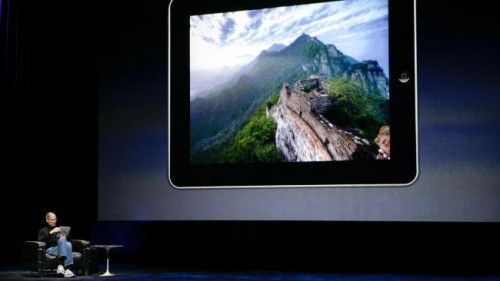
Apple chief executive Steve Jobs displays the new iPad in San Francisco. The iPad can display full web pages and has a near-full size touch-screenkeyboard / AFP
It’s a stretch at best to call the Apple iPad launch art related, but it falls under the hood of cultural production, so we’re posting about it. Our main interest is a discussion summarized by i09’s Annalee Newitz on the iPad’s core creative limitations:
Apple is marketing the iPad as a computer, when really it’s nothing more than a media-consumption device – a convergence television, if you will. Think of it this way: One of the fundamental attributes of computers is that they are interactive and reconfigurable. You can change the way a computer behaves at a very deep level. Interactivity on the iPad consists of touching icons on the screen to change which application you’re using. Hardly more interactive than changing channels on a TV. Sure, you can compose a short email or text message; you can use the Brushes app to draw a sketch. But those activities are not the same thing as programming the device to do something new. Unlike a computer, the iPad is simply not reconfigurable.
The iPad emulates television in another way, too: You can channel surf through the Apps Store, but you can’t change what’s playing. Every single app that’s available for the iPad has to be approved by Apple first, just like apps for iPhones. That means censorship of “offensive” apps, no apps that compete with Apple (i.e., no Google Voice), and no random app somebody wrote to do whatever obscure shit you want to do. So you’ve got thousands of channels and nothing on. You can only keep flipping through the channels, hoping in vain to see something other than reruns of Cheaters and Alf.
If you want something new, there are very limited ways of getting it. You can write an app, and it might be accepted to the Apps Store. Or you can write your own (unacceptable) app and hand it out to a few friends, if you and they are technically savvy enough. But most users won’t be in that position.
It’s also, as Newitz goes on to mention later, just a fancy e-book reader. Think of it as the television you always wanted to read books on. And buy shoes with. It’s slicker than this, of course, but I don’t need another digital device to help me spend money.
The real issue here though is the restrictions Apple puts on creative endeavors as a means of controlling and growing its market. And the more people who actively voice their discontent, the better.
Editor’s Note: Newitz’s discussion is one of many spinning within a growing community of creatives dissatisfied with Apple. Author and scholar Jonathan Zittrain is probably the most well known. His lastest book, The Future of The Internet and How to Stop It (The book is available to download in its entirety on the author’s site discusses, amongst other things, the creative limitations of the iPhone.
Just tech: Has Jobs Lost His Sparkle?


{ 10 comments }
A disturbing thing about this workable-keypad-amputating tech trend is that everyone who “writes” is basically discouraged to do so forever, with all these tap screen, one way, media consumption devices peddled to us. And who can afford to repeatedly satisfy the gadget lust every time they think of something newer and shinier?
A disturbing thing about this workable-keypad-amputating tech trend is that everyone who “writes” is basically discouraged to do so forever, with all these tap screen, one way, media consumption devices peddled to us. And who can afford to repeatedly satisfy the gadget lust every time they think of something newer and shinier?
The keyboard is the part of the physical design most revealing that it was never meant to be used as a computer. I mean, who wants to use anything where you have to type like that? It’s ridiculous.
The keyboard is the part of the physical design most revealing that it was never meant to be used as a computer. I mean, who wants to use anything where you have to type like that? It’s ridiculous.
So frustrating, the whole thing. People keep telling me “well, it’s not made for you, you’re not the target audience.”
I know that. That’s obvious. What we’re hoping for is a better product for the target audience (and ourselves, of course). Just a better product in general. One that encourages creativity and ingenious production instead of streamlined consumption.
So frustrating, the whole thing. People keep telling me “well, it’s not made for you, you’re not the target audience.”
I know that. That’s obvious. What we’re hoping for is a better product for the target audience (and ourselves, of course). Just a better product in general. One that encourages creativity and ingenious production instead of streamlined consumption.
The iPad is useless. I’m much more excited about the Courier.
http://www.youtube.com/watch?v=pFQWc79TYcU
If (and it’s a big if) it works as smoothly as these software demo videos, I’ll replace my sketchbook with one of these.
The iPad is useless. I’m much more excited about the Courier.
http://www.youtube.com/watch?v=pFQWc79TYcU
If (and it’s a big if) it works as smoothly as these software demo videos, I’ll replace my sketchbook with one of these.
Somewhere between functionality and commodity fetish, but u don’t have to buy anything. An aside point made above, Apple’s exclusion of Google, it brings to light the control of the info gateway these company’s have, not unlike the Oprah effect. Google has become THE clearinghouse of information and if u can’t get on board u can’t exist.
Somewhere between functionality and commodity fetish, but u don’t have to buy anything. An aside point made above, Apple’s exclusion of Google, it brings to light the control of the info gateway these company’s have, not unlike the Oprah effect. Google has become THE clearinghouse of information and if u can’t get on board u can’t exist.
Comments on this entry are closed.