
POST BY PADDY JOHNSON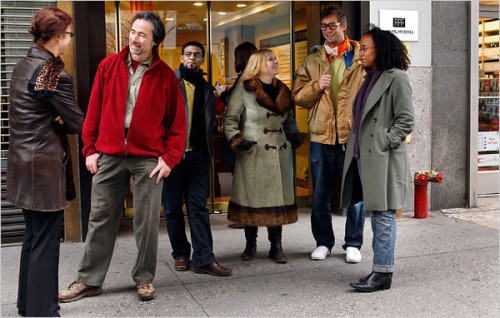
Six of the 30 people in the rotating cast of Tino Sehgal's “This Situation.” They perform at the Marian Goodman Gallery. Caption via: NYTimes. Photograph: Chris Wiley
Why do I get the feeling I’m supposed to like conceptual artist Tino Sehgal? With Sehgal slated for the Guggenheim’s upcoming exhibition at the end of the month, the current pre-show press reminds me of the 2007 hype for “This Situation” at Marian Goodman. Three years ago, by the time I got to the exhibition, careful study of Claire Bishop’s write-up in ArtForum and broadsheet press identifying Sehgal as the conceptual art’s new “It” artist told me I should, at least, pay very close attention. I spent about 45 minutes in a room full of gallery visitors, paid participants, and Sehgal, each standing against the gallery walls and discussing topics such as economics, politics, and philosophy. When someone new stepped into the space, Tino Sehgal and clan clap and the conversation starts anew.
To be clear, I didn’t leave “This Situation” that enthralled. I felt ambivalent and wrote nothing of the experience. But if the press for Sehgal’s upcoming show at the Guggenheim is any indication, perhaps I should put a few of my accomplished-art-school-seminar reservations away. According to New York Times Arthur Lubow, all two categories of art lookers — the unschooled and the cognoscenti — loved it (or, at least, felt passionately about it):
If the overall response to “This Situation” at the Marian Goodman Gallery is any guide, even some who expect to hate Sehgal's work will leave enthralled. “I often see shows I don't like, but this was the only show I've ever seen that didn't like me,” wrote New York magazine's art critic, Jerry Saltz, judging “This Situation” to be the best exhibition he encountered in 2008. Unlike so much of contemporary art, Sehgal's art evokes passionate reactions among the unschooled as well as the cognoscenti. Anyone who has seen the onlookers trudging passively through an art museum (all too often the Guggenheim ramp resembles the humane cattle slaughterhouses designed by Temple Grandin) can appreciate the achievement.
Lubow closes his effusive paragraph with the cliché praise that Sehgal, by merely using “human clay” has been able to evoke the same feelings those poor artists who had to resort to using paint and canvas managed to solicit. A true achievement.
To my mind, the most interesting aspect of Sehgal’s work is how it’s sold. No performance is photographed, nor explained by wall labels or press releases (though presumably different rules apply to museums such as the Guggenheim, which has pimped a press release for the exhibition). And yet, his work commands six figure prices. This may represent an embrace of the commercial system — he says it does — but it’s hard not to interpret his success as needling a system which places value on documentation before all else.
Interestingly, the most compelling incident evidencing this cultural value presented itself in an unrelated exchange over New Year’s. “My friend takes hundreds of pictures, but doesn’t post them to facebook,” a colleague complained. “I mean, why bother?” Immediately I recalled the philosophical riddle if a tree falls in a forest, does anybody hear it? Although slightly cliché, the exchange and riddle seem particularly relevant to the work of Sehgal. After all, if my friend’s sentiments are any indication, it may be a dubious proposition that we’ll remember too much without a digital footprint 100 years from now. Even if Sehgal’s embrace of the market pushes forward the work of late 60’s and 70’s conceptual artists seeking to evade the commercial system — and I think it does — statements such as my friend’s make me wonder if his values are just as idealistic.


{ 20 comments }
I guess this question goes back to Sven Lutticken’s point in ‘Secrecy and Publicity: Reactivating the Avant-Garde,’ where he considers what it mean mean to have artists now re-using gestures from the era of radical politics. Seghal’s work doesn’t seem idealistic at all. It seems to be about being able to widen the scope of what can enter the art market.
So pop indeed, when I hear ‘The Situation,’ I can’t help but think of that douchebag with the really hot abs from that MTV show Jersey Shore
I guess this question goes back to Sven Lutticken’s point in ‘Secrecy and Publicity: Reactivating the Avant-Garde,’ where he considers what it mean mean to have artists now re-using gestures from the era of radical politics. Seghal’s work doesn’t seem idealistic at all. It seems to be about being able to widen the scope of what can enter the art market.
So pop indeed, when I hear ‘The Situation,’ I can’t help but think of that douchebag with the really hot abs from that MTV show Jersey Shore
I was thinking about this apparent conundrum of not photographing the work (or that it’s brought up as conundrum), and the best compliment i can pay this gesture is it is an extremely savvy bit of marketing/mode of valuating the product.
The strictness of the documentation policies in place really serve to fetishise this work something crazy, and is perhaps an attempt to recreate ‘aura’??? This circles back to the Facebook anecdote in that all people do is take photos and spread them around with little concern.
His refusal to document his work is the part of it I appreciate most. It is part of the hype machine to be sure, but it raises the most interesting questions for me.
As for being enthralled by the product in and of itself, i do have my doubts.
I was thinking about this apparent conundrum of not photographing the work (or that it’s brought up as conundrum), and the best compliment i can pay this gesture is it is an extremely savvy bit of marketing/mode of valuating the product.
The strictness of the documentation policies in place really serve to fetishise this work something crazy, and is perhaps an attempt to recreate ‘aura’??? This circles back to the Facebook anecdote in that all people do is take photos and spread them around with little concern.
His refusal to document his work is the part of it I appreciate most. It is part of the hype machine to be sure, but it raises the most interesting questions for me.
As for being enthralled by the product in and of itself, i do have my doubts.
I agree with TM on the fetishized non-documentation. It’s a conceit at best.
It seems the idealized effect of Seghal works entering the marketplace–and institutions in particular–is the creation of a priesthood of sorts, people charged–or compelled by economic or preservationist motives–to pass along the work as intended.
The practical reality, of course, is that the work will be documented, either quietly, against the artist’s wishes, by conservative belt-&-suspenders institutions; in unauthorized recordings and photos; and secondhand, in the retellings, reviews, and discussions of it.
I agree with TM on the fetishized non-documentation. It’s a conceit at best.
It seems the idealized effect of Seghal works entering the marketplace–and institutions in particular–is the creation of a priesthood of sorts, people charged–or compelled by economic or preservationist motives–to pass along the work as intended.
The practical reality, of course, is that the work will be documented, either quietly, against the artist’s wishes, by conservative belt-&-suspenders institutions; in unauthorized recordings and photos; and secondhand, in the retellings, reviews, and discussions of it.
well if he’s employing some actors, I say bless him ;~D
I wonder what the impact would have been if he had added some choreography to it? I often feel that performance art could be much more visceral.
well if he’s employing some actors, I say bless him ;~D
I wonder what the impact would have been if he had added some choreography to it? I often feel that performance art could be much more visceral.
The no-photographing move strikes me as very reactionary, like museums which obsessively police the same policy despite (or maybe because of) the fact that most of their works are old enough to be in the public domain.
We need to be dialectical about the role of documentation–it isn’t just a negative “need” that creates objects for commodification, it’s also a positive ambition that helps create material that can be recirculated productively in the art world, whether it be through education or new derivative forms of artistic production (Seghal couldn’t even cop the gestures of Kaprow, etc. if they hadn’t been documented)
By not allowing documentation Seghal severely limits the ways in which his art can be propagated and shared, its existence in the artistic commons. Even if the implications of this seem limited for this specific work (what would be the point of pirating/disseminating a photograph of this performance piece?), the strategy comes from a very conservative ideology of maintaining market control over a creative product instead of letting it flourish freely. Seghal can be as ironically smug as he wants about his “embrace of the commercial system” but he still ought to be taken to task for the objective appearance of his work and the backwards model of artistic production it condones.
The no-photographing move strikes me as very reactionary, like museums which obsessively police the same policy despite (or maybe because of) the fact that most of their works are old enough to be in the public domain.
We need to be dialectical about the role of documentation–it isn’t just a negative “need” that creates objects for commodification, it’s also a positive ambition that helps create material that can be recirculated productively in the art world, whether it be through education or new derivative forms of artistic production (Seghal couldn’t even cop the gestures of Kaprow, etc. if they hadn’t been documented)
By not allowing documentation Seghal severely limits the ways in which his art can be propagated and shared, its existence in the artistic commons. Even if the implications of this seem limited for this specific work (what would be the point of pirating/disseminating a photograph of this performance piece?), the strategy comes from a very conservative ideology of maintaining market control over a creative product instead of letting it flourish freely. Seghal can be as ironically smug as he wants about his “embrace of the commercial system” but he still ought to be taken to task for the objective appearance of his work and the backwards model of artistic production it condones.
There’s a feature on Tino Sehgal that deals specifically with the buying and selling of his work in Art Asia Pacific magazine this month.
There’s a feature on Tino Sehgal that deals specifically with the buying and selling of his work in Art Asia Pacific magazine this month.
He’s trying to put the focus back on the experience of art, which I think is great, and his refusal to document his actions/performances forces his art to exist in either memory, if one is able to go to the show, or in language, through articles, blogs or stories such as these. Or, of course, with the photos that people inevitably are going to sneak. I wonder how much those are going to cost some day?
The best part of his work, for me, although I know it only through language, is the element of surprise. Unfortunately, his growing fame and the anticipation of his work/actions will most certainly squash any possibility of this. It will be interesting to see how he gets out of this corner he’s painting himself into.
He’s trying to put the focus back on the experience of art, which I think is great, and his refusal to document his actions/performances forces his art to exist in either memory, if one is able to go to the show, or in language, through articles, blogs or stories such as these. Or, of course, with the photos that people inevitably are going to sneak. I wonder how much those are going to cost some day?
The best part of his work, for me, although I know it only through language, is the element of surprise. Unfortunately, his growing fame and the anticipation of his work/actions will most certainly squash any possibility of this. It will be interesting to see how he gets out of this corner he’s painting himself into.
I think that the best staged situations that Sehgal have done is the Kiss from 2002, precisely because it is also taking place without an audience present or interacting.
I think that the best staged situations that Sehgal have done is the Kiss from 2002, precisely because it is also taking place without an audience present or interacting.
I honestly like his no-documentation approach. It emphasizes the spontaneity of the work, at least in the case of his interactive piece at the Guggenheim right now. I had a fantastic experience, and went through the piece twice, which I recommend anyone who visits it to do. No two conversations are the same, at least not after you depart the young child for the teenaged youth. From then on it is lively improvisation, a genuine conversation with the three generations. Highly suggested.
I honestly like his no-documentation approach. It emphasizes the spontaneity of the work, at least in the case of his interactive piece at the Guggenheim right now. I had a fantastic experience, and went through the piece twice, which I recommend anyone who visits it to do. No two conversations are the same, at least not after you depart the young child for the teenaged youth. From then on it is lively improvisation, a genuine conversation with the three generations. Highly suggested.
Please explain the no-documentation. Isn’t this work (hocus pocus)blogged and photographed to death online? The only difference seems to be is Sehgal doesn’t do it himself. Why bother when everyone does it for you seems to be the issue there. That he’s unwilling to take responsibility for the passive accumulation speaks volume. It’s a reverse spectacle not unlike 80s tele-evangalism. Still if people can’t start a conversation in an elevator it will always be unique in a museum.
Please explain the no-documentation. Isn’t this work (hocus pocus)blogged and photographed to death online? The only difference seems to be is Sehgal doesn’t do it himself. Why bother when everyone does it for you seems to be the issue there. That he’s unwilling to take responsibility for the passive accumulation speaks volume. It’s a reverse spectacle not unlike 80s tele-evangalism. Still if people can’t start a conversation in an elevator it will always be unique in a museum.
Comments on this entry are closed.