
POST BY: PADDY JOHNSON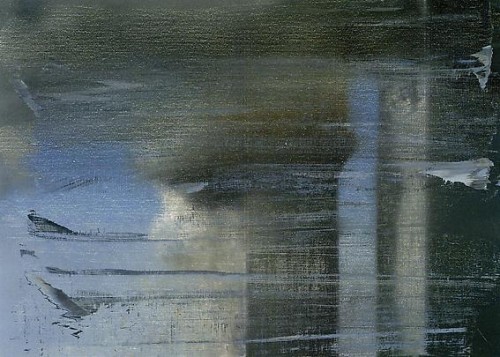
Gerhard Richter, September, 2009, 26 x 35 3/8 in. ( 66.04 x 89.85 cm ). Image via: Marian Goodman
Here’s a lead generating a fair bit of talk for all the wrong reasons: “It's a widely held belief in the art world that painting is dead…” Time Out critic Howard Halle penned this line as a means of discussing how Gerhard Richter’s latest show at Marian Goodman challenges the notion that photographic reproduction neutralizes art’s powerful aura. It’s a worthy topic of discussion, though it prompted Jerry Saltz’ $10,000 Facebook challenge to prove painting dead, which has since derailed any talk of the actual work. The meat of Halle’s review below:
It's the familiar scene of the Twin Towers on September 11, 2001, just after the second plane has struck. Both buildings are ablaze, with smoke billowing from their upper floors. Cropped into vertical bars of gray, they take up half of a composition in which an azure background struggles to emerge from an obfuscating haze and Richter's own squeegeed marks.
It's almost too much: Richter finding beauty in terror by yoking his signature blur to one of history's most stupefying calamities—shocking not because of its scale (which, while impressive, pales next to Auschwitz, Hiroshima and the firebombing of Richter's hometown Dresden), but because of the way it's been seared into collective memory through endless replay. Whatever else 9/11 represents, the artist seems to suggest, it was also the day that Bin Laden schooled Benjamin on the meaning of aura.
However, he has one further complicating trick up his sleeve. September isn't a painting; it's an offset reproduction of one, and small at that. An apparent trompe l'oeil joke, it hangs near the doorway into the next gallery, commanding our attention away from the other “real” and far more imposing compositions in the space, which only seems to prove that painting is a waste of time, and that quantity always subsumes quality. Or does it? As a photo of a painting of a photo, it presents a chicken-or-egg conundrum that turns Benjamin's thinking on its ear: The piece possesses undeniable power, but where does it come from? Your answer depends on your willingness to see.


{ 6 comments }
Halle says Richter has been squeegeeing/dragging paint for a decade. I hope that’s a typo because it’s more like four decades.
Halle says Richter has been squeegeeing/dragging paint for a decade. I hope that’s a typo because it’s more like four decades.
Speaking to the question of whether or not painting is dead or dying consider this:
Isaac Bashevis Singer, the only author to win a Nobel Prize in literature for stories written in Yiddish, was often asked why he wrote in a dying language. His reply: “Yiddish has been dying for a thousand years, and I’m sure it will go on dying for another thousand.”
Speaking to the question of whether or not painting is dead or dying consider this:
Isaac Bashevis Singer, the only author to win a Nobel Prize in literature for stories written in Yiddish, was often asked why he wrote in a dying language. His reply: “Yiddish has been dying for a thousand years, and I’m sure it will go on dying for another thousand.”
To say something is dead is rhetorical, especially in painting. I think Halle knows that, but it’s an easy way into Richter’s work, a way to start a review of painting show. But once in, there is no clear way out…
“[…] I’d argue that his process rehearses the weighing of actions and their consequences: Do you paint a clear picture for yourself? Do you rely on abstractions? Do you make up your mind before changing it again? In this respect, his work rediscovers the moral center for a relativistic age: a metaphor for what we all go through when faced with the judgements that history compels us to make.”
Here, I think is the gristle of Halle’s review.
To say something is dead is rhetorical, especially in painting. I think Halle knows that, but it’s an easy way into Richter’s work, a way to start a review of painting show. But once in, there is no clear way out…
“[…] I’d argue that his process rehearses the weighing of actions and their consequences: Do you paint a clear picture for yourself? Do you rely on abstractions? Do you make up your mind before changing it again? In this respect, his work rediscovers the moral center for a relativistic age: a metaphor for what we all go through when faced with the judgements that history compels us to make.”
Here, I think is the gristle of Halle’s review.
Comments on this entry are closed.
{ 1 trackback }