
POST BY PADDY JOHNSON

Petra Cortright, Tropical Net Shades, 2009, Screengrab AFC
In 2006, the reflection that net art used to be about technology was made during Rhizome’s Net Aesthetics 2.0 panel discussion. Three years later, The New York Times runs a report by Alice Pfieffer describing hacking, subverting and critiquing software as a global movement. What happened over the course of three years that so significantly brought hacking culture back into the fold?
For one thing, history isn’t quite as linear as I’ve painted it above. Though art about technology wasn’t a dominant concern in 2006, there were artists working in this vein. For the most part, these were artists such as the two person collective Jodi, who began creating websites with the appearance of fucking up one’s browser in the mid 90’s. A couple years after 2006, those in the net art community aren’t only hackers and software subverters. For example, the well known net artist Petra Cortright hosts several new landscape drawings on her website, which primarily focuses on building a net specific aesthetic sensibility.
In other words, net art practice is more diverse than a New York Times Special Report will likely convey. The artist collective BEIGE, the two person collaborative team and net art pioneers Jodi are worth mentioning in the context of hackers. Their early web pages appeared to make user browsers code only, which brought their work to the attention of larger audiences. In the 90’s it was still possible for innovative artists without huge financial backers to be nominated for the Webby Awards. When they won the arts category, they gave a then famous five-word acceptance speech exclaiming, “Ugly corporate sons of bitches!”
Pfieffer’s focus tends towards different artists, citing YouTube and Google as the inspiration for current net art, and going on to discuss glitch art. Paul Pieroni of SEVENTEEN Gallery aptly describes glitch art as “the aesthetization of a computer fault.” Though unlike the article suggests, as he defines it, the practice doesn’t begin with BEIGE. Joseph Nechvatal “unleashed” computer viruses on images as early as 1992-3 — a rather trite concept, but certainly one that marks an earlier work made in that vein. Additionally, in an email exchange yesterday morning, artist Tom Moody told me musicians helped bring glitch to the forefront as a term of artistic practice in the late 90’s: “A group or producer called Oval in Germany scratched CDs and used digital errors.” He adds in the comments, “I think artists started referring to what they did as “glitch” art after it was in more widespread use as a musical genre name.”
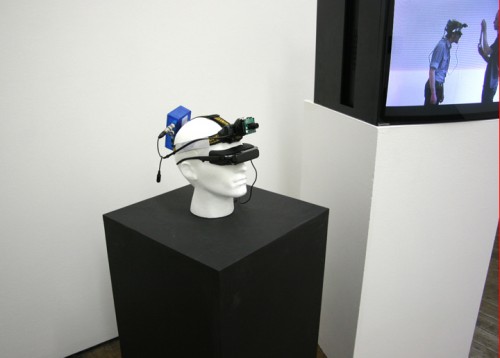
Paul B. Davis, Critical Space Headgear, 2009
Probably the most interesting work to come out of Datamoshing — a developed form of glitch art pixelizing video frames — isn’t discussed in the article. Frustrated with the fact that his disintegrating videos began with the flawed premise that pop culture content didn’t matter, artist Paul B. Davis put together “Define Your Terms” for SEVENTEEN Gallery — a show interrogating Internet use and ephemera. Of my favorite works in the exhibition, Critical Space Headgear (a collaboration with Liam Fogerty) takes video from a head mounted camera and runs it through a system that overlays text onto a live video image seen through goggles. “What does this tell me that isn’t already obvious?” asks Critical Text Mode. The text appears over the center of the images a user sees while surfing and concisely describes the question users should be asking. The second mode, YouTube Emulation, overlays the YouTube logo in the bottom right hand corner of the image before sending the new video image back to the viewing goggles. Notably, it is not easy to figure out how to direct one’s gaze while wearing the head gear. I have yet to try the piece out myself, but I would expect this would force awareness upon a type of viewing we typically take for granted.
Of all the work by artists critiquing software and developing aesthetics inspired by youtube and google, to my mind, this show best demonstrates the kind of criticality Pfeiffer describes. While the Times article may only aim to provide a superficial survey of hacker net art made over the last nine years, readers might be better served if a few holes in the telling of that history were patched up.


{ 42 comments }
The Glitch Dozen
Markus Popp interview
Oval, Textuell
Oval, LIVE
The Glitch Dozen
Markus Popp interview
Oval, Textuell
Oval, LIVE
The Glitch Dozen
Markus Popp interview
Oval, Textuell
Oval, LIVE
Oh no, the Times is historicizing again! A couple of points of clarification: I knew the term glitch before Oval, but Oval helped bring it to the forefront as a term of artistic practice–I think artists took it from musicians. Yet BEIGE, in an early, great (2000-ish) interview, were making fun of Markus Popp for not being hacker enough! Also, your text could be clearer that when you say Petra did something “2 years later” you mean 2 years after the 2006 panel, not 2 years after jodi.
Oh no, the Times is historicizing again! A couple of points of clarification: I knew the term glitch before Oval, but Oval helped bring it to the forefront as a term of artistic practice–I think artists took it from musicians. Yet BEIGE, in an early, great (2000-ish) interview, were making fun of Markus Popp for not being hacker enough! Also, your text could be clearer that when you say Petra did something “2 years later” you mean 2 years after the 2006 panel, not 2 years after jodi.
Thanks for that — I updated the post to make those two clarifications. The BEIGE anecdote is pretty choice.
Thanks for that — I updated the post to make those two clarifications. The BEIGE anecdote is pretty choice.
Considering the rather narrowly sourced article and the immediately apparent omissions, it’d seem like the easiest thing is to just take the headline out back and shoot it.
Considering the rather narrowly sourced article and the immediately apparent omissions, it’d seem like the easiest thing is to just take the headline out back and shoot it.
Considering the rather narrowly sourced article and the immediately apparent omissions, it’d seem like the easiest thing is to just take the headline out back and shoot it.
Considering the rather narrowly sourced article and the immediately apparent omissions, it’d seem like the easiest thing is to just take the headline out back and shoot it.
Sorry to keep clarifying but lest the zealots in this field come down on my head: I meant that artists started referring to what they did as “glitch” art after it was in more widespread use as a musical genre name. As you noted the practice had been around in the visual field at least since Nechvatal and jodi (and I’m sure some would tell us since the ’60s). It’s mostly new media artists, too. If you walked into a New York gallery today and said “Can you show me some glitch art?” you’d get a blank look. Whereas if you went into a music store and asked for glitch music they’d take you to the bin.
Sorry to keep clarifying but lest the zealots in this field come down on my head: I meant that artists started referring to what they did as “glitch” art after it was in more widespread use as a musical genre name. As you noted the practice had been around in the visual field at least since Nechvatal and jodi (and I’m sure some would tell us since the ’60s). It’s mostly new media artists, too. If you walked into a New York gallery today and said “Can you show me some glitch art?” you’d get a blank look. Whereas if you went into a music store and asked for glitch music they’d take you to the bin.
This Rhizome thread has some discussion of a glitch aesthetic in the new media context:
http://rhizome.org/editorial/2380
This Rhizome thread has some discussion of a glitch aesthetic in the new media context:
http://rhizome.org/editorial/2380
When they won the arts category, they gave a then famous five-word acceptance speech exclaiming, “Ugly corporate sons of bitches!â€
I was at that Webby Award ceremony (a game of mine was a nominee). The event did have a slightly annoying corporate gloss to it (all the drinks were sponsored by Absolut vodka). But I think the general feeling at the time was that the speech wasn’t a very effective protest. A better one would have been to either ignore the 5 word speech limit (which was mandated by the Webby organization) or simply ignore the event altogether.
After the BEIGE representative threw the trophy to the ground and stalked off, it was picked up by someone in the audience and passed around. A person sitting next to one of my collaborators slipped it under his coat and (I presume) stole it. For me, that that was the most transgressive act of the night.
When they won the arts category, they gave a then famous five-word acceptance speech exclaiming, “Ugly corporate sons of bitches!â€
I was at that Webby Award ceremony (a game of mine was a nominee). The event did have a slightly annoying corporate gloss to it (all the drinks were sponsored by Absolut vodka). But I think the general feeling at the time was that the speech wasn’t a very effective protest. A better one would have been to either ignore the 5 word speech limit (which was mandated by the Webby organization) or simply ignore the event altogether.
After the BEIGE representative threw the trophy to the ground and stalked off, it was picked up by someone in the audience and passed around. A person sitting next to one of my collaborators slipped it under his coat and (I presume) stole it. For me, that that was the most transgressive act of the night.
When they won the arts category, they gave a then famous five-word acceptance speech exclaiming, “Ugly corporate sons of bitches!â€
I was at that Webby Award ceremony (a game of mine was a nominee). The event did have a slightly annoying corporate gloss to it (all the drinks were sponsored by Absolut vodka). But I think the general feeling at the time was that the speech wasn’t a very effective protest. A better one would have been to either ignore the 5 word speech limit (which was mandated by the Webby organization) or simply ignore the event altogether.
After the BEIGE representative threw the trophy to the ground and stalked off, it was picked up by someone in the audience and passed around. A person sitting next to one of my collaborators slipped it under his coat and (I presume) stole it. For me, that that was the most transgressive act of the night.
(“BEIGE representative”: you meant jodi, I think.) Paul Davis’s career arc should be noted here: 2000 (hacker making fun of Oval for not doing his own programming); mid 2000s (datamoshing pop culture on YouTube); 2009 (making fun of new media “headgear art” as well as the Net Aesthetic 2.0 fascination with all things social media). This is someone clearly unharnessing the Web.
(“BEIGE representative”: you meant jodi, I think.) Paul Davis’s career arc should be noted here: 2000 (hacker making fun of Oval for not doing his own programming); mid 2000s (datamoshing pop culture on YouTube); 2009 (making fun of new media “headgear art” as well as the Net Aesthetic 2.0 fascination with all things social media). This is someone clearly unharnessing the Web.
It is stimulating to read something a bit non a-historical on this fresh history of the hack, yet still I feel compelled to address a glaring glitch in the way my work with computer viruses is defined and characterized here (also a tad superficial I’m afraid).
If the concept of attacking a body of image files with a custom virus in the early 90s appears “trite†(stale/ hackneyed) then you forget that computers were not yet a household appliance and the internet existed only in the institutional realm (and functioned poorly). Simultaneously, friends and lovers were dying from some new, untreatable infectious viral illness.
Also I need to point out that my early virus work has been taken into artificial life this century – as viral issues have hardly dissipated. A better link on this viral history is here: http://www.eyewithwings.net/nechvatal/virusfor.html
So keep filling those holes – and making new ones. 😉
It is stimulating to read something a bit non a-historical on this fresh history of the hack, yet still I feel compelled to address a glaring glitch in the way my work with computer viruses is defined and characterized here (also a tad superficial I’m afraid).
If the concept of attacking a body of image files with a custom virus in the early 90s appears “trite†(stale/ hackneyed) then you forget that computers were not yet a household appliance and the internet existed only in the institutional realm (and functioned poorly). Simultaneously, friends and lovers were dying from some new, untreatable infectious viral illness.
Also I need to point out that my early virus work has been taken into artificial life this century – as viral issues have hardly dissipated. A better link on this viral history is here: http://www.eyewithwings.net/nechvatal/virusfor.html
So keep filling those holes – and making new ones. 😉
It is stimulating to read something a bit non a-historical on this fresh history of the hack, yet still I feel compelled to address a glaring glitch in the way my work with computer viruses is defined and characterized here (also a tad superficial I’m afraid).
If the concept of attacking a body of image files with a custom virus in the early 90s appears “trite†(stale/ hackneyed) then you forget that computers were not yet a household appliance and the internet existed only in the institutional realm (and functioned poorly). Simultaneously, friends and lovers were dying from some new, untreatable infectious viral illness.
Also I need to point out that my early virus work has been taken into artificial life this century – as viral issues have hardly dissipated. A better link on this viral history is here: http://www.eyewithwings.net/nechvatal/virusfor.html
So keep filling those holes – and making new ones. 😉
It is stimulating to read something a bit non a-historical on this fresh history of the hack, yet still I feel compelled to address a glaring glitch in the way my work with computer viruses is defined and characterized here (also a tad superficial I’m afraid).
If the concept of attacking a body of image files with a custom virus in the early 90s appears “trite†(stale/ hackneyed) then you forget that computers were not yet a household appliance and the internet existed only in the institutional realm (and functioned poorly). Simultaneously, friends and lovers were dying from some new, untreatable infectious viral illness.
Also I need to point out that my early virus work has been taken into artificial life this century – as viral issues have hardly dissipated. A better link on this viral history is here: http://www.eyewithwings.net/nechvatal/virusfor.html
So keep filling those holes – and making new ones. 😉
I think it’s a bit of a stretch to say that a new hole was introduced because the post doesn’t mention the political climate at the time those virus works were made. I also didn’t contextualize Jodi’s work with the sensibility of the 90s, but no complaint was made about that, presumably because the work was discussed in a more positive light.
In any event, as the artist, understandably, you’ll not only have a different take on the work than me, but should defend the work. Unfortunately, the context the work was made in doesn’t change my opinion. I acknowledge that the work might have been better at the time, but its flaws remain essentially the same. The concept just isn’t that robust. I saw the virus work in an exhibition in 2000 and identified the same flaws at that time.
I think it’s a bit of a stretch to say that a new hole was introduced because the post doesn’t mention the political climate at the time those virus works were made. I also didn’t contextualize Jodi’s work with the sensibility of the 90s, but no complaint was made about that, presumably because the work was discussed in a more positive light.
In any event, as the artist, understandably, you’ll not only have a different take on the work than me, but should defend the work. Unfortunately, the context the work was made in doesn’t change my opinion. I acknowledge that the work might have been better at the time, but its flaws remain essentially the same. The concept just isn’t that robust. I saw the virus work in an exhibition in 2000 and identified the same flaws at that time.
I think it’s a bit of a stretch to say that a new hole was introduced because the post doesn’t mention the political climate at the time those virus works were made. I also didn’t contextualize Jodi’s work with the sensibility of the 90s, but no complaint was made about that, presumably because the work was discussed in a more positive light.
In any event, as the artist, understandably, you’ll not only have a different take on the work than me, but should defend the work. Unfortunately, the context the work was made in doesn’t change my opinion. I acknowledge that the work might have been better at the time, but its flaws remain essentially the same. The concept just isn’t that robust. I saw the virus work in an exhibition in 2000 and identified the same flaws at that time.
I think it’s a bit of a stretch to say that a new hole was introduced because the post doesn’t mention the political climate at the time those virus works were made. I also didn’t contextualize Jodi’s work with the sensibility of the 90s, but no complaint was made about that, presumably because the work was discussed in a more positive light.
In any event, as the artist, understandably, you’ll not only have a different take on the work than me, but should defend the work. Unfortunately, the context the work was made in doesn’t change my opinion. I acknowledge that the work might have been better at the time, but its flaws remain essentially the same. The concept just isn’t that robust. I saw the virus work in an exhibition in 2000 and identified the same flaws at that time.
I respect your opinion. That said, even as I dig it, it is difficult to see where datamoshing can go from here. However noise music does seem to continue to flower out of a long history. I have written most of this history of noise music: http://en.wikipedia.org/wiki/Noise_musicnand FYI: I’m writing a book on noise culture that encompasses both the audio and visual sides of hack/noise.nnBTW, there is a nice overview of glitch music here with samples: http://besser.tsoa.nyu.edu/impact/f01/Papers/Hildebrand/glitch.ht
I respect your opinion. That said, even as I dig it, it is difficult to see where datamoshing can go from here. However noise music does seem to continue to flower out of a long history. I have written most of this history of noise music: http://en.wikipedia.org/wiki/Noise_music\nand FYI: I’m writing a book on noise culture that encompasses both the audio and visual sides of hack/noise.\n\nBTW, there is a nice overview of glitch music here with samples: http://besser.tsoa.nyu.edu/impact/f01/Papers/Hildebrand/glitch.ht
“An unpredictable progressive virus operates on a degradation/transformation of an image” is an example of what I’ve been calling “XYZ” art (see links below). A huge percentage of new media art works like this: Cool algorithm Y changes input X into output Z, and there must be a socially useful goal as the result. Nechvatal invoking the AIDs crisis as the background for his coding project is a perfect example of this. A lot of journalism about computer viruses will need to be rewritten because it didn’t mention AIDS, based on this criticism. I wouldn’t have included Nechvatal’s project in any glitch timeline because it is so formulaic. Paddy Johnson was being generous to include it. Glitch music was interesting in the 90s–Glitch art wasn’t interesting until the ’00s, with artists like Karl Klomp. BEIGE was interesting because it made fun of coding-as-art while doing it at the same time. (See http://www.digitalmediatree.com/tommoody/?41204 and http://www.digitalmediatree.com/tommoody/?40531 and http://www.karlklomp.nl/index.html)
“An unpredictable progressive virus operates on a degradation/transformation of an image” is an example of what I’ve been calling “XYZ” art (see links below). A huge percentage of new media art works like this: Cool algorithm Y changes input X into output Z, and there must be a socially useful goal as the result. Nechvatal invoking the AIDs crisis as the background for his coding project is a perfect example of this. A lot of journalism about computer viruses will need to be rewritten because it didn’t mention AIDS, based on this criticism. I wouldn’t have included Nechvatal’s project in any glitch timeline because it is so formulaic. Paddy Johnson was being generous to include it. Glitch music was interesting in the 90s–Glitch art wasn’t interesting until the ’00s, with artists like Karl Klomp. BEIGE was interesting because it made fun of coding-as-art while doing it at the same time. (See http://www.digitalmediatree.com/tommoody/?41204 and http://www.digitalmediatree.com/tommoody/?40531 and http://www.karlklomp.nl/index.html)
“An unpredictable progressive virus operates on a degradation/transformation of an image” is an example of what I’ve been calling “XYZ” art (see links below). A huge percentage of new media art works like this: Cool algorithm Y changes input X into output Z, and there must be a socially useful goal as the result. Nechvatal invoking the AIDs crisis as the background for his coding project is a perfect example of this. A lot of journalism about computer viruses will need to be rewritten because it didn’t mention AIDS, based on this criticism. I wouldn’t have included Nechvatal’s project in any glitch timeline because it is so formulaic. Paddy Johnson was being generous to include it. Glitch music was interesting in the 90s–Glitch art wasn’t interesting until the ’00s, with artists like Karl Klomp. BEIGE was interesting because it made fun of coding-as-art while doing it at the same time. (See http://www.digitalmediatree.com/tommoody/?41204 and http://www.digitalmediatree.com/tommoody/?40531 and http://www.karlklomp.nl/index.html)
glitch music here: http://besser.tsoa.nyu.edu/impact/f01/Papers/Hildebrand/glitch.htm
glitch music here: http://besser.tsoa.nyu.edu/impact/f01/Papers/Hildebrand/glitch.htm
glitch music here: http://besser.tsoa.nyu.edu/impact/f01/Papers/Hildebrand/glitch.htm
Tom. If by applying the term “formulaic” to my work you mean I use a “set form or method allowing little room for originality” (your XYZ tendency) then you forget the random chance factors that are programmed into the behavior of my program.
In that I construct the program from scratch I am not hacking into or bending some ready made electronics – so you might be right about Karl Klomp.
A lot of writing about computer viruses has already been done and it does not leave out the HIV situation. See: http://post.thing.net/node/1755
Whether art has a socially useful function or not is a personal intention (or goal) for some artists – but to take issue with the social conditions in which art is made seems a big gaping hole to me.
Tom. If by applying the term “formulaic” to my work you mean I use a “set form or method allowing little room for originality” (your XYZ tendency) then you forget the random chance factors that are programmed into the behavior of my program.
In that I construct the program from scratch I am not hacking into or bending some ready made electronics – so you might be right about Karl Klomp.
A lot of writing about computer viruses has already been done and it does not leave out the HIV situation. See: http://post.thing.net/node/1755
Whether art has a socially useful function or not is a personal intention (or goal) for some artists – but to take issue with the social conditions in which art is made seems a big gaping hole to me.
Tom. If by applying the term “formulaic” to my work you mean I use a “set form or method allowing little room for originality” (your XYZ tendency) then you forget the random chance factors that are programmed into the behavior of my program.
In that I construct the program from scratch I am not hacking into or bending some ready made electronics – so you might be right about Karl Klomp.
A lot of writing about computer viruses has already been done and it does not leave out the HIV situation. See: http://post.thing.net/node/1755
Whether art has a socially useful function or not is a personal intention (or goal) for some artists – but to take issue with the social conditions in which art is made seems a big gaping hole to me.
Thanks for the correction, Tom… You’re right, it was jodi, not BEIGE.
Thanks for the correction, Tom… You’re right, it was jodi, not BEIGE.
Thanks for the correction, Tom… You’re right, it was jodi, not BEIGE.
Comments on this entry are closed.