
POST BY PADDY JOHNSON
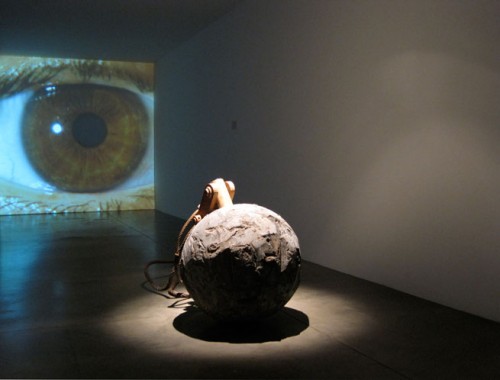
Janine Antoni, Tear, 2008, Lead, steel, HD video projection with surround sound. Image via: Luhring Augustine.
What’s the worst show in Chelsea right now? Critic Peter Plagens told The Chronicle of Higher Education he didn’t want to pick on individual artists, which probably makes him a better person than me. As I hinted earlier in the week, Janine Antoni’s “Up Against” at Luhring Augustine easily offered up the poorest blue chip contemporary show I saw Saturday.
To be fair, her exhibition explores the body as a metaphor for the world, a rather out of vogue subject matter these days. Even her most compelling photographs — Mortar and Pestal, a 1999 work documenting a tongue licking an eyeball amongst them — might have trouble in this climate. But so does first wave feminism, Frida Kahlo inspired self portraits, and eyeball art, which creates more than a few challenges for the show. There’s only so much work a viewer will dedicate to the overly familiar.
Undoubtedly the most problematic aspect of this show stems from Antoni’s melding of earnestness with cliché subject matter and aesthetics. I fail to see how a bronze gargoyle designed to allow a woman to pee standing up will empower her, but the solemness of Antoni’s pose in context with a political driven show suggests she believes it will. Given the art-with-a-message tone of her work it wouldn’t be such a bad idea to make the point a little more interesting then reclaiming a largely male interest in peeing off the sides of high buildings.
Lack of conceptual rigor proves to be an issue in every piece exhibited. Tear marks the highest point in a series of lows by pairing the sound of a crashing wrecking ball with a projection of a blinking eye. Sure, it tells us everything we already know about eyeballs, but at least the dramatic lighting is effective. First conceived for the New Orleans biennial Prospect One, the installation fared a little better in its original humble environment. Though flawed, it felt more sincere than calculated.
The final nail in the Antoni’s coffin consists of a large colorful photographic self portrait picturing the artist suspended from the ceiling with a dollhouse around her torso. The chest straps holding Antoni up recall Frida Kahlo’s Broken Column, and the wearable miniature, Laurie Simmons. But unlike these artists, Antoni brings very little compelling to the table. A few detail shots of the leg inside a dining room, and an undefined fleshy form near a bed provide more compelling imagery and compositions, but are ultimately undermined by an almost uniformly shallow show.


{ 12 comments }
The problem is no one wants to actually be critical anymore. I can’t stand the woman’s installations or whatever you call them. Who wants to sit and watch a naked woman NOT do anything for a few hours. Not Me.nnWhere are the good shows one can talk about.
The problem is no one wants to actually be critical anymore. I can’t stand the woman’s installations or whatever you call them. Who wants to sit and watch a naked woman NOT do anything for a few hours. Not Me.\n\nWhere are the good shows one can talk about.
You are too kind.
You are too kind.
HA! What a breath of fresh air this is. Sure, Antoni’s got her fans, and she’s really a nice person, but her work from Skowhegan on has been such a boner. I mean, I’m lookin’ at these pictures and I’m feeling embarrassed for her.
HA! What a breath of fresh air this is. Sure, Antoni’s got her fans, and she’s really a nice person, but her work from Skowhegan on has been such a boner. I mean, I’m lookin’ at these pictures and I’m feeling embarrassed for her.
Not all shows are good. I haven’t seen this one, but it doesn’t sound good. One of the most frustrating things about the “art world” is that there is so little criticism of art. “Criticism” meaning to make a reasoned and fair argument for or against work being successful, and most likely a combination of the two. Generally it’s only silence or praise or ambivalence. It’s pretty frustrating. And it contributes to the art world being an uncritical environment, or at least appearing to be one, which from most vantage points is the same thing–an elitist scene that is difficult to take too seriously. Creativity/art is extremely interesting and can be quite exhilarating. It’s unfortunate to remove or ignore the critical portion of it, because when the majority of a community is complicit in not communicating and not saying anything “negative,” then there is a sickness, where there is willful avoidance. What other discipline can remain healthy if everything* is accepted uncritically? Or, more precisely, if all critical discourse* is only concerned with what is successful? [*Exaggeration for effect.] Basically what Jeffrey said. Minus the appeal for talking about good shows, just because there is plenty. And also, most times, if something is really good, talking about, writing about it, actually gets you further away from it. It’s too good to write anything meaningful. Sometimes. It’s easy to be critically make a case against an institution or “the art market” or the “art world” (see above), and this is often the best critics can come up with. AFC does a very good job. I’m sure other people I don’t know about do a good job too. But it’s in the minority of art discourse. Not all art is good.
Not all shows are good. I haven’t seen this one, but it doesn’t sound good. One of the most frustrating things about the “art world” is that there is so little criticism of art. “Criticism” meaning to make a reasoned and fair argument for or against work being successful, and most likely a combination of the two. Generally it’s only silence or praise or ambivalence. It’s pretty frustrating. And it contributes to the art world being an uncritical environment, or at least appearing to be one, which from most vantage points is the same thing–an elitist scene that is difficult to take too seriously. Creativity/art is extremely interesting and can be quite exhilarating. It’s unfortunate to remove or ignore the critical portion of it, because when the majority of a community is complicit in not communicating and not saying anything “negative,” then there is a sickness, where there is willful avoidance. What other discipline can remain healthy if everything* is accepted uncritically? Or, more precisely, if all critical discourse* is only concerned with what is successful? [*Exaggeration for effect.] Basically what Jeffrey said. Minus the appeal for talking about good shows, just because there is plenty. And also, most times, if something is really good, talking about, writing about it, actually gets you further away from it. It’s too good to write anything meaningful. Sometimes. It’s easy to be critically make a case against an institution or “the art market” or the “art world” (see above), and this is often the best critics can come up with. AFC does a very good job. I’m sure other people I don’t know about do a good job too. But it’s in the minority of art discourse. Not all art is good.
i thought the luc tuymans interview was good if anyone cares
i thought the luc tuymans interview was good if anyone cares
“reclaiming a largely male interest in peeing off the sides of high buildings.”nnLargely male? C’mon, it isn’t just males, actually I can;t remember the last time I peed off of anything. I had a dream once I was peeing off a bridge. I woke up relieved I hadn’t peed my bed. It was so real, you see.nnAnne Hamilton can be bad too doncha think? Its not them, though, its the esthetic – poesis or something like that.
“reclaiming a largely male interest in peeing off the sides of high buildings.”\n\nLargely male? C’mon, it isn’t just males, actually I can;t remember the last time I peed off of anything. I had a dream once I was peeing off a bridge. I woke up relieved I hadn’t peed my bed. It was so real, you see.\n\nAnne Hamilton can be bad too doncha think? Its not them, though, its the esthetic – poesis or something like that.
Comments on this entry are closed.