
POST BY PADDY JOHNSON
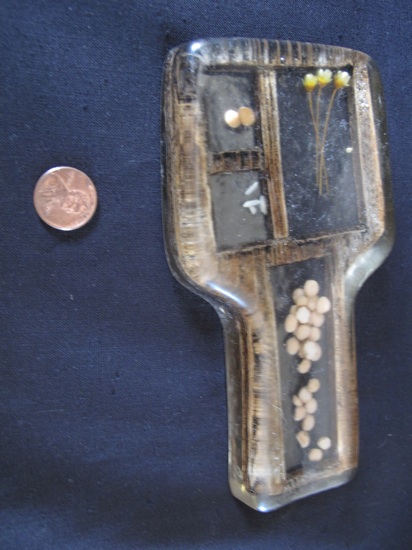
[Bid on this Significant Object, with story by Joanne McNeil, here.]
Does good photographic documentation effect sales? What about venue? Any art dealer will answer “yes” to this question, though the breakdown of what creates Significant Objects — Murketing blogger Rob Walker and author Joshua Glenn‘s valuation experiment — seems to challenge this notion. Explicitly locating the value of an object in its textual documentation, the project asks writers to create a story based on an assigned thrift store object worth no more than a few dollars. Using that text, a photograph of the object, and eBay’s website, the pieces are then sold, typically for more then their original worth.
For the most part Significant Objects has found willing buyers for these items, the pieces typically going for between $15 and $30 dollars, though some for much more. Are buyers interested in the story, the object or both? I’m not an expert on the minds of collectors, but I’m guessing good photographic documentation and venue-appropriateness play a more significant role in the project than Walker or Glenn acknowledge. After all, what else could explain the poor auction performance of Joanne McNeil’s Grain Thing? Here the author offers up a superior provenance connecting the object to Joseph Cornell, but saddled with poor documentation has thus far only solicited $1.00 in bids. Meanwhile, a well photographed Russian figure with a magical history of lighting things on fire is going for $200. Sure it’s got a good story, but is it worth 200% more? I doubt it, but I get the feeling the object is a little better suited to eBay than McNeil’s. It seems that audience just doesn’t respond to the aura of Joseph Cornell.


{ 4 comments }
Yeap, i used to blog on ebay with stuff i would find ,or i would make it, i would retell a story or narrate an white trash event of my life, i loved doing it and and it is addictive cause in a night drunken ebay art making, it would pay for the night and then some, its the lowest of the low in the art world , but if you like to gamble and wonder who is curious to buy letters to your exgirlfriend or paintings of!!$# or crap i found at this and hot gluesd to this cause somebody said this, or i like to make art with left over chickenbones, its the best, and if the story is real, then , one goes seeking the gutters for something unique to the area you live, its location based i suspect and story drive and cheep, real cheep,. Great site by the way! gz
Yeap, i used to blog on ebay with stuff i would find ,or i would make it, i would retell a story or narrate an white trash event of my life, i loved doing it and and it is addictive cause in a night drunken ebay art making, it would pay for the night and then some, its the lowest of the low in the art world , but if you like to gamble and wonder who is curious to buy letters to your exgirlfriend or paintings of!!$# or crap i found at this and hot gluesd to this cause somebody said this, or i like to make art with left over chickenbones, its the best, and if the story is real, then , one goes seeking the gutters for something unique to the area you live, its location based i suspect and story drive and cheep, real cheep,. Great site by the way! gz
That would be 19,900% more (200% more would be $3).
That would be 19,900% more (200% more would be $3).
Comments on this entry are closed.
{ 1 trackback }