
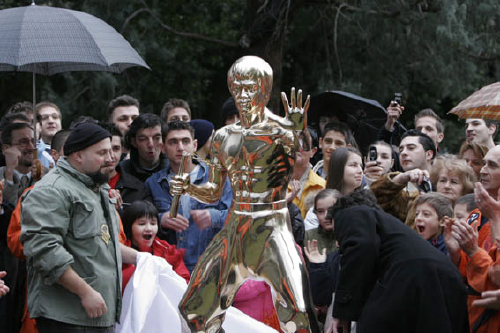
Unveiling of the Bruce Lee statue in Mostar, Bosnia and Herzegovina
(Editors note: IMG MGMT is an annual image-based artist essay series. Today’s invited artists are VVORK, a daily art journal run by Aleksandra Domanović, Georg Schnitzer, Christoph Priglinger and Oliver Laric. Vvork has curated shows at Galerie West in The Hague, MU in Eindhoven, Platform3 in Munich, and part of the Foto Biennale Mannheim Ludwigshafen Heidelberg, and is currently planning an evening at the New Museum in New York in October.)
After the highly publicized Bruce Lee monument was erected in Mostar, a city and municipality in Bosnia and Herzegovina in 2005, a series of similar ventures were initiated in rural Serbia. Some sociologists describe the glorification of nonpolitical celebrity figures as the result of an identity crisis caused by the Yugoslav wars of the 1990s, a period when a once-functioning multi-ethnic unity collapsed. Serbian artist Milica Tomić, for one, is concerned. She calls the statues “a dangerous joke in which history is being erased and replaced by Mickey Mouse.”
Although she does not say it, the development of Turbo-folk, a musical genre originating in Serbia and emerging from pop-folk, is emblematic of the 90s crisis in the former Yugoslavia. The term was coined by singer-songwriter Rambo Amadeus in the late 1980s, who sang, “Folk is the people. Turbo is a system of injecting fuel under pressure into the motor cylinder with internal combustion. Turbo-folk is a burning of a nation. Turbo-folk is not music. Turbo-folk is the beloved of the masses. Awakening of the lowest human desires. I did not invent Turbo-folk, I gave it its name.”
At the time, the term was nothing more than an intentionally humorous combination of two contradictory concepts – “turbo,” evoking an image of modern industrial progress, and “folk,” a symbol of tradition and rural conservatism. But the political and economic turmoil of early 90s Yugoslavia rendered the society labile enough for the concept “Turbo-culture” to gain momentum. With all its exaggerations, inordinateness and random amalgamations of both local and global ornamentations, “Turbo” eventually became a prefix for social and media phenomena of the war and post-war period. As a result, terms such as Turbo-politics, Turbo-TV, Turbo-architecture, Turbo-urbanism, etc. developed. Turbo-sculpture describes the recent rise of interest and popularity in public monuments dedicated to nonpolitical celebrity figures.
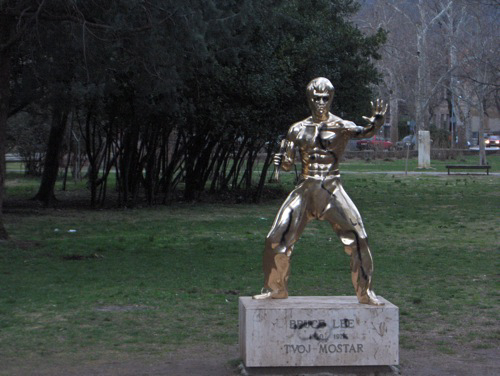
Bruce Lee in Mostar, vandalised only hours after being unveiled
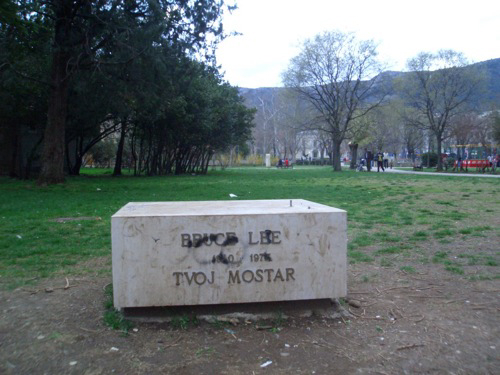
The Bruce Lee sculpture taken away for reparation
On Saturday, November 26, 2005, Mostar unveiled a bronze statue of Bruce Lee. Located in the city park Zrinjski, the life-sized monument stands 1.68 meters tall and is a symbol of solidarity in the ethnically-divided city. The first of its kind in the world, another statue was revealed one day later in Hong Kong marking what would have been the Chinese star’s 65th birthday. Spearheaded by the youth group Mostar Urban Movement, the collective saw the Bruce Lee project as a means of questioning iconic celebrity figures by mixing high grandeur with pop culture and kung fu. The group described Bruce Lee as “far enough away from us that nobody can ask what he did during World War II” and “part of our idea of universal justice–that the good guys can win.” Bruce Lee was chosen by organizers as a symbol of the fight against ethnic divisions. For the dysfunctional community of Croats, Serbs, and Muslims living in Mostar, Lee, an American of Chinese descent and a famous martial arts actor, represented a bridging of cultures. The unveiling ceremony of the statue saw the attendance of local Bruce Lee fans, representatives of Germany which had bankrolled the project, as well as Chinese officials.
Only a few hours after the unveiling, the monument was vandalized. A group of teenagers defaced the statue and stole the nunchucks, leaving the site littered with wine bottles. It is now in storage awaiting reparation.
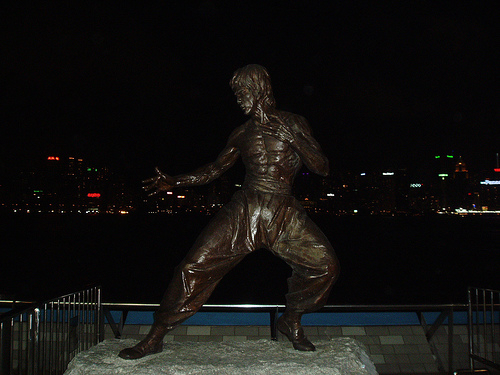
Bruce Lee in Hong Kong
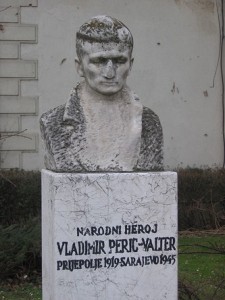
Monument to Valter Perić in Sarajevo
The general enthusiasm about the Bruce Lee project led the weekly newspaper Slobodna Bosna to publish a suggestion for building a monument to the local partisan hero Vladimir “Valter” Perić in Beijing. The role of Valter was portrayed in the 1972 film Valter Defends Sarajevo. A huge success in China, Valter’s name and picture were even printed on Chinese beer stickers.
Next Page: Rocky Balboa in ŽitiÅ¡te and Samantha Fox in ÄŒaÄak


{ 15 comments }
I am interested in the ambivalence exhibited towards using Hollywood icons as substitutes for local (former) Yugoslav figures. On one hand it is a explicit refusal to recognize soldiers and partisans of the turmoil of the 90s as honourable figures, and Hollywood characters/caricatures index this exaggerated tendency towards hero worship and idolization. On the other hand, it can be interpreted as a display of juvenile ignorance of the distinction between real people with real struggles and sufferings from fictionalized representatives of optimism and idealism–in other words–a repression of traumatic truths for easy narratives and happy endings (Hollywood).
What concerns me is not the ‘either/or’ of both interpretations but the ‘both/and.’ While the intention and intellectualization of this phenomena lies with the conscious awareness of its parodic devices, the subversive element can all too easily be lost on the very people who need to come to terms with their (lack of) heroes and role models. The danger here is the ever widening gap between history and happy ending.
If Turbo-Culture also implies an accelerated rush towards newer and more progressive ideas of societal organization, let’s hope it doesn’t leave history in the dust, lost in the fog of Hollywood’s exhaust fumes.
I am interested in the ambivalence exhibited towards using Hollywood icons as substitutes for local (former) Yugoslav figures. On one hand it is a explicit refusal to recognize soldiers and partisans of the turmoil of the 90s as honourable figures, and Hollywood characters/caricatures index this exaggerated tendency towards hero worship and idolization. On the other hand, it can be interpreted as a display of juvenile ignorance of the distinction between real people with real struggles and sufferings from fictionalized representatives of optimism and idealism–in other words–a repression of traumatic truths for easy narratives and happy endings (Hollywood).
What concerns me is not the ‘either/or’ of both interpretations but the ‘both/and.’ While the intention and intellectualization of this phenomena lies with the conscious awareness of its parodic devices, the subversive element can all too easily be lost on the very people who need to come to terms with their (lack of) heroes and role models. The danger here is the ever widening gap between history and happy ending.
If Turbo-Culture also implies an accelerated rush towards newer and more progressive ideas of societal organization, let’s hope it doesn’t leave history in the dust, lost in the fog of Hollywood’s exhaust fumes.
I am interested in the ambivalence exhibited towards using Hollywood icons as substitutes for local (former) Yugoslav figures. On one hand it is a explicit refusal to recognize soldiers and partisans of the turmoil of the 90s as honourable figures, and Hollywood characters/caricatures index this exaggerated tendency towards hero worship and idolization. On the other hand, it can be interpreted as a display of juvenile ignorance of the distinction between real people with real struggles and sufferings from fictionalized representatives of optimism and idealism–in other words–a repression of traumatic truths for easy narratives and happy endings (Hollywood).
What concerns me is not the ‘either/or’ of both interpretations but the ‘both/and.’ While the intention and intellectualization of this phenomena lies with the conscious awareness of its parodic devices, the subversive element can all too easily be lost on the very people who need to come to terms with their (lack of) heroes and role models. The danger here is the ever widening gap between history and happy ending.
If Turbo-Culture also implies an accelerated rush towards newer and more progressive ideas of societal organization, let’s hope it doesn’t leave history in the dust, lost in the fog of Hollywood’s exhaust fumes.
A very interesting and informative essay with striking and well-documented examples. Within the essay, the artist Milica Tomic is cited, who desires that ways be found to represent the grief, the responsibility and despair of the 90s wars other than through these Hollywood idols or other artists not related to these wars, which may represent more the avoidance of facing up to history. I would be very interested in knowing how the various artists of VVork situate themselves with regard to this comment. Sandra
A very interesting and informative essay with striking and well-documented examples. Within the essay, the artist Milica Tomic is cited, who desires that ways be found to represent the grief, the responsibility and despair of the 90s wars other than through these Hollywood idols or other artists not related to these wars, which may represent more the avoidance of facing up to history. I would be very interested in knowing how the various artists of VVork situate themselves with regard to this comment. Sandra
A very interesting and informative essay with striking and well-documented examples. Within the essay, the artist Milica Tomic is cited, who desires that ways be found to represent the grief, the responsibility and despair of the 90s wars other than through these Hollywood idols or other artists not related to these wars, which may represent more the avoidance of facing up to history. I would be very interested in knowing how the various artists of VVork situate themselves with regard to this comment. Sandra
my next project will now be a large sculptural super-collider that will create fusion while sculpting animated copulations of a young Nikola Tesla and Milla Jovovich with hot plasma and light. Thanks VVORK.
my next project will now be a large sculptural super-collider that will create fusion while sculpting animated copulations of a young Nikola Tesla and Milla Jovovich with hot plasma and light. Thanks VVORK.
Great read, thanks.
Snapped this picture
http://www.flickr.com/photos/olofw/2257377117/
in a gallery in berlin feb 2k8. Looks like the exact same mold.
Great read, thanks.
Snapped this picture
http://www.flickr.com/photos/olofw/2257377117/
in a gallery in berlin feb 2k8. Looks like the exact same mold.
turbo ground zero
turbo ground zero
turbo ground zero
the Bruce Lee sculpture is a work by famous Croatian artist Ivan Fijolic http://fijolic.blogspot.com/. He made the golden statue in Mostar first, but after it was destroyed, he made a new pink plastic version from the same mold. the new version is placed on a rotating basis.
the Bruce Lee sculpture is a work by famous Croatian artist Ivan Fijolic http://fijolic.blogspot.com/. He made the golden statue in Mostar first, but after it was destroyed, he made a new pink plastic version from the same mold. the new version is placed on a rotating basis.
Comments on this entry are closed.
{ 2 trackbacks }