
POST BY PADDY JOHNSON
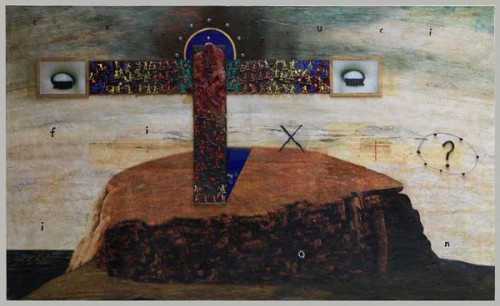
David Lynch’s exhibition “New Painting”, opens September 12th at Griffin and runs through December 12th.
Can we fault art for movie director David Lynch’s impenetrable Twin Peaks: Fire Walk With Me? Contemporary art likes to avoid linear narrative in the language of paint, and since The LA Times Culture Monster reports the expert of creep will exhibit his first solo show of paintings in nearly a decade this fall, one medium might be informing the other. And not in a good way. I don’t want to sound like a jerk, but just as a few too many of the great director’s films indulge in cliche nonsensical weirdness for the sake of nonsensical weirdness, the painting pictured above employs iconography typical of the macabre Sunday painter. But perhaps Lynch’s latest body of work should be seen as a challenge to Contemporary artists. Who will be the first artist to successfully employ a question mark and cross like structure in their work while avoiding cliche? I’m not convinced this is a challenge I necessarily want to get behind, but surely positive results would be a feat. Lynch’s exhibition is launched in conjuction with James Corcoran Gallery, a commercial space with out a website.


{ 65 comments }
The most damning thing in this post is this line:
“a commercial space without a website”
Wow! Seriously?
The most damning thing in this post is this line:
“a commercial space without a website”
Wow! Seriously?
I think it is a weak and cliched criticism on your behalf to claim that Fire Walk With Me is impenetrable. His work is academic and like much of the work featured on your blog it often can only be understood by art students and those within the industry. Seems a bit silly of this blog to dismiss something as impenetrable or indulgent when so much of the work on here is just the same. I think by now the lazy critique of ‘nonsense for nonsense sake’ is irrelevant when talking about Lynch. Jus sayin’.
I think it is a weak and cliched criticism on your behalf to claim that Fire Walk With Me is impenetrable. His work is academic and like much of the work featured on your blog it often can only be understood by art students and those within the industry. Seems a bit silly of this blog to dismiss something as impenetrable or indulgent when so much of the work on here is just the same. I think by now the lazy critique of ‘nonsense for nonsense sake’ is irrelevant when talking about Lynch. Jus sayin’.
I think it is a weak and cliched criticism on your behalf to claim that Fire Walk With Me is impenetrable. His work is academic and like much of the work featured on your blog it often can only be understood by art students and those within the industry. Seems a bit silly of this blog to dismiss something as impenetrable or indulgent when so much of the work on here is just the same. I think by now the lazy critique of ‘nonsense for nonsense sake’ is irrelevant when talking about Lynch. Jus sayin’.
@white beard. I think that might have been true if I had used Mulholland Drive as an example, but that’s not the case with Fire Walk With Me. Past my own feelings on the subject, that film was UNIVERSALLY PANNED. Personally, I have the same dislike for Lost Highway, but I’m more hesitant to attach that criticism specifically to that film due to the fact that it’s become such a cult classic.
In any event, while nonsense for nonsense sake often does represent a lazy critique, in this case I find it more suitable than not. When Lynch uses film to indulge in art cliches he’s at his worst.
@white beard. I think that might have been true if I had used Mulholland Drive as an example, but that’s not the case with Fire Walk With Me. Past my own feelings on the subject, that film was UNIVERSALLY PANNED. Personally, I have the same dislike for Lost Highway, but I’m more hesitant to attach that criticism specifically to that film due to the fact that it’s become such a cult classic.
In any event, while nonsense for nonsense sake often does represent a lazy critique, in this case I find it more suitable than not. When Lynch uses film to indulge in art cliches he’s at his worst.
@white beard. I think that might have been true if I had used Mulholland Drive as an example, but that’s not the case with Fire Walk With Me. Past my own feelings on the subject, that film was UNIVERSALLY PANNED. Personally, I have the same dislike for Lost Highway, but I’m more hesitant to attach that criticism specifically to that film due to the fact that it’s become such a cult classic.
In any event, while nonsense for nonsense sake often does represent a lazy critique, in this case I find it more suitable than not. When Lynch uses film to indulge in art cliches he’s at his worst.
do not ever, ever, spout “_____ for ______’s sake” anywhere near a piece of criticism that is meant to be taken seriously.
absolute red flag.
and to say lynch uses film to indulge in art cliches sort of sounds good on paper but ends up being meaningless and shallow. lastly, FWWM has had a pretty substantial comeback from that initial reaction, for anyone keeping score.
get with it, man. blegh.
do not ever, ever, spout “_____ for ______’s sake” anywhere near a piece of criticism that is meant to be taken seriously.
absolute red flag.
and to say lynch uses film to indulge in art cliches sort of sounds good on paper but ends up being meaningless and shallow. lastly, FWWM has had a pretty substantial comeback from that initial reaction, for anyone keeping score.
get with it, man. blegh.
do not ever, ever, spout “_____ for ______’s sake” anywhere near a piece of criticism that is meant to be taken seriously.
absolute red flag.
and to say lynch uses film to indulge in art cliches sort of sounds good on paper but ends up being meaningless and shallow. lastly, FWWM has had a pretty substantial comeback from that initial reaction, for anyone keeping score.
get with it, man. blegh.
Listen Lynch fans,
I’m sorry you don’t like the criticism, but I’m not the first to say it, and I’m not wrong. How many creepy dwarfs and shrunken men do you have to see in a life’s body of work before you call a trope a trope?
Non-linear narratives are the ultimate art video/film cliche! That’s not a sound bite without meaning. It’s a fact.
Listen Lynch fans,
I’m sorry you don’t like the criticism, but I’m not the first to say it, and I’m not wrong. How many creepy dwarfs and shrunken men do you have to see in a life’s body of work before you call a trope a trope?
Non-linear narratives are the ultimate art video/film cliche! That’s not a sound bite without meaning. It’s a fact.
Listen Lynch fans,
I’m sorry you don’t like the criticism, but I’m not the first to say it, and I’m not wrong. How many creepy dwarfs and shrunken men do you have to see in a life’s body of work before you call a trope a trope?
Non-linear narratives are the ultimate art video/film cliche! That’s not a sound bite without meaning. It’s a fact.
this is actually about weak criticism, not about the validity of lynch’s work. it’s a fact! pfftt.
this is actually about weak criticism, not about the validity of lynch’s work. it’s a fact! pfftt.
this is actually about weak criticism, not about the validity of lynch’s work. it’s a fact! pfftt.
My criticism specifically responded to the work — how could it not be about its value? That argument makes no sense at all.
My criticism specifically responded to the work — how could it not be about its value? That argument makes no sense at all.
This is why I heart the internet.
This is why I heart the internet.
This is why I heart the internet.
To me, the criticism AFC makes sounds valid…
…Of the few Lynch paintings I have seen (and in all fairness–I’ve never seen one in person) they would probably seem more relevant if they were painted 80-100 years ago.
To me, the criticism AFC makes sounds valid…
…Of the few Lynch paintings I have seen (and in all fairness–I’ve never seen one in person) they would probably seem more relevant if they were painted 80-100 years ago.
It is interesting how much faith you place in mainstream film criticism. FWWM has had a resurgence of interest in the last few years as someone already mentioned. I am not sure backing up your statement with uppercase ‘universally panned’ supports your argument. Non-linear narratives were not cliched in American cinema back when it was made. To use your phrase, it’s a fact.
It should also be mentioned that I never said I was a Lynch fan. I have just studied his work extensively so I thought I’d write a comment. Your tone is aggressive and strange to me. You are not wrong and you have the facts. Well I guess that’s settled then.
It is interesting how much faith you place in mainstream film criticism. FWWM has had a resurgence of interest in the last few years as someone already mentioned. I am not sure backing up your statement with uppercase ‘universally panned’ supports your argument. Non-linear narratives were not cliched in American cinema back when it was made. To use your phrase, it’s a fact.
It should also be mentioned that I never said I was a Lynch fan. I have just studied his work extensively so I thought I’d write a comment. Your tone is aggressive and strange to me. You are not wrong and you have the facts. Well I guess that’s settled then.
It is interesting how much faith you place in mainstream film criticism. FWWM has had a resurgence of interest in the last few years as someone already mentioned. I am not sure backing up your statement with uppercase ‘universally panned’ supports your argument. Non-linear narratives were not cliched in American cinema back when it was made. To use your phrase, it’s a fact.
It should also be mentioned that I never said I was a Lynch fan. I have just studied his work extensively so I thought I’d write a comment. Your tone is aggressive and strange to me. You are not wrong and you have the facts. Well I guess that’s settled then.
@white beard.
I apologize for the aggressive tone. Using non-linear narratives in American cinema when it was made was not cliched, this is true. My point is that it’s a huge cliche in the art world, and it doesn’t translate well in my opinion.
As it’s probably quite apparent, I’m not so familiar with Lynch’s work that I know which films are being reevaluated. But all of this seems a little off topic, given that I really meant to discuss the paintings. And those don’t look good.
@white beard.
I apologize for the aggressive tone. Using non-linear narratives in American cinema when it was made was not cliched, this is true. My point is that it’s a huge cliche in the art world, and it doesn’t translate well in my opinion.
As it’s probably quite apparent, I’m not so familiar with Lynch’s work that I know which films are being reevaluated. But all of this seems a little off topic, given that I really meant to discuss the paintings. And those don’t look good.
I agree with AFC’s comments abot the paintings. To me Lynch’s paintings are like an elaborate sketchbook for his visual ideas and thoughts, and then his films are his finished works.
Or maybe it’s his gucci ad?
keep up the discussions ARTFAG!
I agree with AFC’s comments abot the paintings. To me Lynch’s paintings are like an elaborate sketchbook for his visual ideas and thoughts, and then his films are his finished works.
Or maybe it’s his gucci ad?
keep up the discussions ARTFAG!
I agree with AFC’s comments abot the paintings. To me Lynch’s paintings are like an elaborate sketchbook for his visual ideas and thoughts, and then his films are his finished works.
Or maybe it’s his gucci ad?
keep up the discussions ARTFAG!
Actually, he is not showing at James Corcoran, but at Griffin, in Santa Monica. And they are a commercial art gallery with a website. Look here:
http://www.griffinla.com/Gallery/Statement/tabid/58/Default.aspx
For my money, Lynch’s paintings sit with the best personal and raw work, with a uniquely American twist. It is supposed to be raw, it is supposed to be personal. It isn’t like most of the junk out there these days that is simply a play on commercial design impulses with slick designer selling points. Whatever happened to the love of Dubuffet or Guston?
Actually, he is not showing at James Corcoran, but at Griffin, in Santa Monica. And they are a commercial art gallery with a website. Look here:
http://www.griffinla.com/Gallery/Statement/tabid/58/Default.aspx
For my money, Lynch’s paintings sit with the best personal and raw work, with a uniquely American twist. It is supposed to be raw, it is supposed to be personal. It isn’t like most of the junk out there these days that is simply a play on commercial design impulses with slick designer selling points. Whatever happened to the love of Dubuffet or Guston?
Actually, he is not showing at James Corcoran, but at Griffin, in Santa Monica. And they are a commercial art gallery with a website. Look here:
http://www.griffinla.com/Gallery/Statement/tabid/58/Default.aspx
For my money, Lynch’s paintings sit with the best personal and raw work, with a uniquely American twist. It is supposed to be raw, it is supposed to be personal. It isn’t like most of the junk out there these days that is simply a play on commercial design impulses with slick designer selling points. Whatever happened to the love of Dubuffet or Guston?
it’d be nice if we had more paintings on which to judge his style.
any links to the rest of the collection?
the question mark is kind of horrendous in my opinion.
it’d be nice if we had more paintings on which to judge his style.
any links to the rest of the collection?
the question mark is kind of horrendous in my opinion.
@shedbilder This is noted in the first line of the caption credit with a link to the site. As noted in the last line of the piece, this show is being launched in conjunction with James Corcoran.
@shedbilder This is noted in the first line of the caption credit with a link to the site. As noted in the last line of the piece, this show is being launched in conjunction with James Corcoran.
@shedbilder This is noted in the first line of the caption credit with a link to the site. As noted in the last line of the piece, this show is being launched in conjunction with James Corcoran.
I am simply pointing out that making reference to James Corcoran not having a website is irrelevant to the issue at hand. I also wonder why the presence of a question mark seems to be so taboo or considered unacceptable on this post. I also get the impression that most of the commentary is directed at the single work posted above, without any prior knowledge of Lynch’s almost 50-year body of non-cinema related artwork, in which one can see the development of his interest in child-like forms, in naive art, as well as the simplest expressions in text and symbol form. This is a conscious decision that is independent from discussions of what is “relevant” or “not relevant” in the art world today. “Timeliness/fashion” is also a moot point. What may appear to be weirdness for weirdness’ sake to one, is grounded in truth for another. The very subject of “weirdness,” a relative and subjective adjective applied by the viewer, is here also considered off limits as a potential subject in art? What is “weird” to one, may not be to another. Any discussion of “weirdness for weirdness’ sake” in contemporary art, seems also to be a moot point argued on a slippery slope. Focus on what is the language of the work itself, rather than engaging in comparing it with an established language outside of itself, and perhaps a new conversation could generate as to the successes and failures of what Lynch is attempting to do. In a word– some real criticism.
I am simply pointing out that making reference to James Corcoran not having a website is irrelevant to the issue at hand. I also wonder why the presence of a question mark seems to be so taboo or considered unacceptable on this post. I also get the impression that most of the commentary is directed at the single work posted above, without any prior knowledge of Lynch’s almost 50-year body of non-cinema related artwork, in which one can see the development of his interest in child-like forms, in naive art, as well as the simplest expressions in text and symbol form. This is a conscious decision that is independent from discussions of what is “relevant” or “not relevant” in the art world today. “Timeliness/fashion” is also a moot point. What may appear to be weirdness for weirdness’ sake to one, is grounded in truth for another. The very subject of “weirdness,” a relative and subjective adjective applied by the viewer, is here also considered off limits as a potential subject in art? What is “weird” to one, may not be to another. Any discussion of “weirdness for weirdness’ sake” in contemporary art, seems also to be a moot point argued on a slippery slope. Focus on what is the language of the work itself, rather than engaging in comparing it with an established language outside of itself, and perhaps a new conversation could generate as to the successes and failures of what Lynch is attempting to do. In a word– some real criticism.
I am simply pointing out that making reference to James Corcoran not having a website is irrelevant to the issue at hand. I also wonder why the presence of a question mark seems to be so taboo or considered unacceptable on this post. I also get the impression that most of the commentary is directed at the single work posted above, without any prior knowledge of Lynch’s almost 50-year body of non-cinema related artwork, in which one can see the development of his interest in child-like forms, in naive art, as well as the simplest expressions in text and symbol form. This is a conscious decision that is independent from discussions of what is “relevant” or “not relevant” in the art world today. “Timeliness/fashion” is also a moot point. What may appear to be weirdness for weirdness’ sake to one, is grounded in truth for another. The very subject of “weirdness,” a relative and subjective adjective applied by the viewer, is here also considered off limits as a potential subject in art? What is “weird” to one, may not be to another. Any discussion of “weirdness for weirdness’ sake” in contemporary art, seems also to be a moot point argued on a slippery slope. Focus on what is the language of the work itself, rather than engaging in comparing it with an established language outside of itself, and perhaps a new conversation could generate as to the successes and failures of what Lynch is attempting to do. In a word– some real criticism.
@shedbilder If you wanted to point out that making reference to James Corcoran was not relevant to the issue at hand you should has said so. Also, this is a web publication, which frequently addresses the web presence of commercial and non commercial spaces. It is not irrelevant.
Anyway, I don’t understand what’s prompting this call for language about the work itself rather than an established language outside itself, (whatever that means). I assume it all boils down to feeling a 150 word post on the subject lacked sufficient critical merit. To be clear: In this work Lynch shows he has a poor sense of color and composition. It’s impossible to know from the reproduction, but the paint handling doesn’t seem that impressive either. There’s not much more to say about this work. I didn’t write very much about it, because the painting simply isn’t worth discussing at length – certainly not the degree to which has been seen on this thread.
@shedbilder If you wanted to point out that making reference to James Corcoran was not relevant to the issue at hand you should has said so. Also, this is a web publication, which frequently addresses the web presence of commercial and non commercial spaces. It is not irrelevant.
Anyway, I don’t understand what’s prompting this call for language about the work itself rather than an established language outside itself, (whatever that means). I assume it all boils down to feeling a 150 word post on the subject lacked sufficient critical merit. To be clear: In this work Lynch shows he has a poor sense of color and composition. It’s impossible to know from the reproduction, but the paint handling doesn’t seem that impressive either. There’s not much more to say about this work. I didn’t write very much about it, because the painting simply isn’t worth discussing at length – certainly not the degree to which has been seen on this thread.
To be fair, criticism– wether negative or positive, needs to be informed by engagement with the work in question. Otherwise, it isn’t criticism, but a lazy, one-shot sound-bite meant to elicit titters. If one doesn’t want to engage with the work, then why write about it at all? If you are going to make a judgement– no matter how off the cuff, then it needs to be supported, no matter how briefly, with informed reasoning. To take a single, small reproduction of a work, issue a judgement about it, which is then buttressed by an opinion of the artists’ work in other media, is haphazard at best. No discussion of the artist’s 40-year body of non-cinema work, no mention that what you are seeing is primarily a construction and not even a painting. The ground of this work in fact, is a photographic reproduction of a “Sunday school” painting, on top of which Lynch has collaged a variety of media, with the crucifix and the text. The power of this piece, which I admit is not the best of the group for reasons of poor use of subject matter, does lie however in Lynch’s use of raw materials that, when viewed in person is supremely tactile and “handled” very well. This is indeed his strength, as his work has been approaching “combine” territory as of late. This is primarily the subject of his work, along with an intentional, clumsy humor (evidenced with the question mark) rather than a traditional handling of paint and composition– criticisms that were also frequently leveled at Dubuffet. Alas, that was not what those works, nor Lynch’s works, are about. If one were to trace Lynch’s trajectory in painting, printmaking and drawing, the development of this can be seen as being very intentional, as he began shaving off traditional, more refined forms in the early 80’s. He knows what he is doing.
Also, there is no such thing as art that isn’t worth writing about. All work is grist for a valid, thoughtful conversation.
To be fair, criticism– wether negative or positive, needs to be informed by engagement with the work in question. Otherwise, it isn’t criticism, but a lazy, one-shot sound-bite meant to elicit titters. If one doesn’t want to engage with the work, then why write about it at all? If you are going to make a judgement– no matter how off the cuff, then it needs to be supported, no matter how briefly, with informed reasoning. To take a single, small reproduction of a work, issue a judgement about it, which is then buttressed by an opinion of the artists’ work in other media, is haphazard at best. No discussion of the artist’s 40-year body of non-cinema work, no mention that what you are seeing is primarily a construction and not even a painting. The ground of this work in fact, is a photographic reproduction of a “Sunday school” painting, on top of which Lynch has collaged a variety of media, with the crucifix and the text. The power of this piece, which I admit is not the best of the group for reasons of poor use of subject matter, does lie however in Lynch’s use of raw materials that, when viewed in person is supremely tactile and “handled” very well. This is indeed his strength, as his work has been approaching “combine” territory as of late. This is primarily the subject of his work, along with an intentional, clumsy humor (evidenced with the question mark) rather than a traditional handling of paint and composition– criticisms that were also frequently leveled at Dubuffet. Alas, that was not what those works, nor Lynch’s works, are about. If one were to trace Lynch’s trajectory in painting, printmaking and drawing, the development of this can be seen as being very intentional, as he began shaving off traditional, more refined forms in the early 80’s. He knows what he is doing.
Also, there is no such thing as art that isn’t worth writing about. All work is grist for a valid, thoughtful conversation.
I think Lynch has made mostly great films. Yes he has made two duff ones as well. Dune and the Twin Peaks movie. I think he is a very good fine artist and film maker. His paintings and photographs are very intersting and he has alot of so called ‘artists’ who rip him off. Just Eraserhead by it self is a monument to the man who created the film when he was a postman. Certainly not a man who had a silver spoon in his mouth in his life unlike the spoilt ego artists out there who couldn’t do anything without rich mummy and daddy.
I think Lynch has made mostly great films. Yes he has made two duff ones as well. Dune and the Twin Peaks movie. I think he is a very good fine artist and film maker. His paintings and photographs are very intersting and he has alot of so called ‘artists’ who rip him off. Just Eraserhead by it self is a monument to the man who created the film when he was a postman. Certainly not a man who had a silver spoon in his mouth in his life unlike the spoilt ego artists out there who couldn’t do anything without rich mummy and daddy.
I think Lynch has made mostly great films. Yes he has made two duff ones as well. Dune and the Twin Peaks movie. I think he is a very good fine artist and film maker. His paintings and photographs are very intersting and he has alot of so called ‘artists’ who rip him off. Just Eraserhead by it self is a monument to the man who created the film when he was a postman. Certainly not a man who had a silver spoon in his mouth in his life unlike the spoilt ego artists out there who couldn’t do anything without rich mummy and daddy.
I am still hoping for a thoughtful rebuttal or continuation of this conversation. Perhaps a definition/understanding of “employs iconography typical of the macabre Sunday painter,” would help. Additionally, what exactly is the fault of the dread question mark pictured in the above work? Is the criticism the result of viewing that single work, and no others, by Mr. Lynch? The lack of “handling,” that was part of the criticism– was this mistakenly directed at what was pointed out to be photographic?
Lastly, I have been accused of condescension on this blog, for expressing my reaction to what I deem poor criticism. It has been mentioned by another blogger that criticism is something issued “straight from the gut,”– I couldn’t disagree more. That which is straight from the gut, is what is mostly clogging up the ability for an informed discourse on this beast we call the internet. Rather, criticism should always be aimed not at the pure dispersal of “gut-sourced opinion,” but rather driven by a need to educate and then initiate an informed, civil debate. I find that this statement by AFC is not free of an attitude of condescension itself :
“I’m sorry you don’t like the criticism, but I’m not the first to say it, and I’m not wrong. ” Along with the mention that what is stated by AFC is “a fact.” A critic should never come out and plainly announce that something is “a fact,” simply because of the consensus of unmentioned others, without explaining the critic’s own position clearly, or perhaps quoting the aforementioned consensus.
Nor this:
“…I really meant to discuss the paintings. And those don’t look good,” without making mention of which “paintings” are being referred to, or why they don’t “look good.”
What I am trying to do here, is not to simply force my opinion of the work out into the open air, but to illicit a response that follows up on what AFC put forth in the opening salvo. Is this not the role of the blog– to engage in an intelligent call-and-response dialogue? Is it a fault to question and seek more from the initial call? What I seek here is a follow-up that answers the issues raised by your own writing. Is there an expectation not to question the opinion of AFC?
I certainly do not believe that this is a valid response to a reader query of your writing:
“I didn’t write very much about it, because the painting simply isn’t worth discussing at length – certainly not the degree to which has been seen on this thread.” Take note, that the criticism switches back to a single painting, although the criticism was once aimed at painting(s) in the plural, and by suggestion, the dismissal of an entire body of work. Additionally, why is it necessary to dismiss out-of-hand, the opinions posited on this thread, as not worthy?
So to be clear– what is being criticized here, on what specific grounds, and does such criticism apply to a reading of a reproduction of a single work, or more than that work? Is it a criticism of film, or of painting? Is it criticism of paint that isn’t even paint?
I am still hoping for a thoughtful rebuttal or continuation of this conversation. Perhaps a definition/understanding of “employs iconography typical of the macabre Sunday painter,” would help. Additionally, what exactly is the fault of the dread question mark pictured in the above work? Is the criticism the result of viewing that single work, and no others, by Mr. Lynch? The lack of “handling,” that was part of the criticism– was this mistakenly directed at what was pointed out to be photographic?
Lastly, I have been accused of condescension on this blog, for expressing my reaction to what I deem poor criticism. It has been mentioned by another blogger that criticism is something issued “straight from the gut,”– I couldn’t disagree more. That which is straight from the gut, is what is mostly clogging up the ability for an informed discourse on this beast we call the internet. Rather, criticism should always be aimed not at the pure dispersal of “gut-sourced opinion,” but rather driven by a need to educate and then initiate an informed, civil debate. I find that this statement by AFC is not free of an attitude of condescension itself :
“I’m sorry you don’t like the criticism, but I’m not the first to say it, and I’m not wrong. ” Along with the mention that what is stated by AFC is “a fact.” A critic should never come out and plainly announce that something is “a fact,” simply because of the consensus of unmentioned others, without explaining the critic’s own position clearly, or perhaps quoting the aforementioned consensus.
Nor this:
“…I really meant to discuss the paintings. And those don’t look good,” without making mention of which “paintings” are being referred to, or why they don’t “look good.”
What I am trying to do here, is not to simply force my opinion of the work out into the open air, but to illicit a response that follows up on what AFC put forth in the opening salvo. Is this not the role of the blog– to engage in an intelligent call-and-response dialogue? Is it a fault to question and seek more from the initial call? What I seek here is a follow-up that answers the issues raised by your own writing. Is there an expectation not to question the opinion of AFC?
I certainly do not believe that this is a valid response to a reader query of your writing:
“I didn’t write very much about it, because the painting simply isn’t worth discussing at length – certainly not the degree to which has been seen on this thread.” Take note, that the criticism switches back to a single painting, although the criticism was once aimed at painting(s) in the plural, and by suggestion, the dismissal of an entire body of work. Additionally, why is it necessary to dismiss out-of-hand, the opinions posited on this thread, as not worthy?
So to be clear– what is being criticized here, on what specific grounds, and does such criticism apply to a reading of a reproduction of a single work, or more than that work? Is it a criticism of film, or of painting? Is it criticism of paint that isn’t even paint?
I am still hoping for a thoughtful rebuttal or continuation of this conversation. Perhaps a definition/understanding of “employs iconography typical of the macabre Sunday painter,” would help. Additionally, what exactly is the fault of the dread question mark pictured in the above work? Is the criticism the result of viewing that single work, and no others, by Mr. Lynch? The lack of “handling,” that was part of the criticism– was this mistakenly directed at what was pointed out to be photographic?
Lastly, I have been accused of condescension on this blog, for expressing my reaction to what I deem poor criticism. It has been mentioned by another blogger that criticism is something issued “straight from the gut,”– I couldn’t disagree more. That which is straight from the gut, is what is mostly clogging up the ability for an informed discourse on this beast we call the internet. Rather, criticism should always be aimed not at the pure dispersal of “gut-sourced opinion,” but rather driven by a need to educate and then initiate an informed, civil debate. I find that this statement by AFC is not free of an attitude of condescension itself :
“I’m sorry you don’t like the criticism, but I’m not the first to say it, and I’m not wrong. ” Along with the mention that what is stated by AFC is “a fact.” A critic should never come out and plainly announce that something is “a fact,” simply because of the consensus of unmentioned others, without explaining the critic’s own position clearly, or perhaps quoting the aforementioned consensus.
Nor this:
“…I really meant to discuss the paintings. And those don’t look good,” without making mention of which “paintings” are being referred to, or why they don’t “look good.”
What I am trying to do here, is not to simply force my opinion of the work out into the open air, but to illicit a response that follows up on what AFC put forth in the opening salvo. Is this not the role of the blog– to engage in an intelligent call-and-response dialogue? Is it a fault to question and seek more from the initial call? What I seek here is a follow-up that answers the issues raised by your own writing. Is there an expectation not to question the opinion of AFC?
I certainly do not believe that this is a valid response to a reader query of your writing:
“I didn’t write very much about it, because the painting simply isn’t worth discussing at length – certainly not the degree to which has been seen on this thread.” Take note, that the criticism switches back to a single painting, although the criticism was once aimed at painting(s) in the plural, and by suggestion, the dismissal of an entire body of work. Additionally, why is it necessary to dismiss out-of-hand, the opinions posited on this thread, as not worthy?
So to be clear– what is being criticized here, on what specific grounds, and does such criticism apply to a reading of a reproduction of a single work, or more than that work? Is it a criticism of film, or of painting? Is it criticism of paint that isn’t even paint?
@Shedbilder: I really don’t think this post evokes all the questions you’re asking. I connected David Lynch’s background in art and his movies as an entry point to discussing a single reproduction. We’re not looking at an either or scenario, so I’m not sure why it’s being broken down in such binary terms.
I don’t want to flog this horse, but I probably spent 150 words talking about both. There was no attempt to offer an in depth study of the work, and it’s unfair to ask a post that size to offer up 1000 words worth of criticism. Criticism takes many different forms, and a reader who insists it only takes the form they enjoy most will insure they will be disappointed by the blog.
To answer your question about the question mark: The problem with using this punctuation as iconography in art is that both says too much and not enough. What is the question here? If the artist doesn’t know the answer to this, then they either don’t have anything to say or aren’t saying it. Either way, it places an unfair burden on the viewer. In part, that’s the problem I see here, but popular art world ideology tells us the more open to interpretation the art is, the better.
Simultaneously, the question mark also directs the viewer in a way that seems too didactic for it’s own good. The mysteries of the world! What don’t we see? The closed eyeballs on either side of the painting tell me that already — why do I need a question mark there as well. It seems needlessly redundant.
Finally, while I’m fine with being told a tone or statement seems out of line — a commentor did so earlier in this thread and I appreciated it and retracted the statement — it’s unnecessary to drudge this up again as though it had not been addressed, or offer instructions on how I should be doing my job. I find this advice condescending and disingenuous in its supposed end to help the blog. It is also completely lacking in consideration of the work that gets put into AFC and other outlets on a daily basis.
@Shedbilder: I really don’t think this post evokes all the questions you’re asking. I connected David Lynch’s background in art and his movies as an entry point to discussing a single reproduction. We’re not looking at an either or scenario, so I’m not sure why it’s being broken down in such binary terms.
I don’t want to flog this horse, but I probably spent 150 words talking about both. There was no attempt to offer an in depth study of the work, and it’s unfair to ask a post that size to offer up 1000 words worth of criticism. Criticism takes many different forms, and a reader who insists it only takes the form they enjoy most will insure they will be disappointed by the blog.
To answer your question about the question mark: The problem with using this punctuation as iconography in art is that both says too much and not enough. What is the question here? If the artist doesn’t know the answer to this, then they either don’t have anything to say or aren’t saying it. Either way, it places an unfair burden on the viewer. In part, that’s the problem I see here, but popular art world ideology tells us the more open to interpretation the art is, the better.
Simultaneously, the question mark also directs the viewer in a way that seems too didactic for it’s own good. The mysteries of the world! What don’t we see? The closed eyeballs on either side of the painting tell me that already — why do I need a question mark there as well. It seems needlessly redundant.
Finally, while I’m fine with being told a tone or statement seems out of line — a commentor did so earlier in this thread and I appreciated it and retracted the statement — it’s unnecessary to drudge this up again as though it had not been addressed, or offer instructions on how I should be doing my job. I find this advice condescending and disingenuous in its supposed end to help the blog. It is also completely lacking in consideration of the work that gets put into AFC and other outlets on a daily basis.
@Shedbilder: I really don’t think this post evokes all the questions you’re asking. I connected David Lynch’s background in art and his movies as an entry point to discussing a single reproduction. We’re not looking at an either or scenario, so I’m not sure why it’s being broken down in such binary terms.
I don’t want to flog this horse, but I probably spent 150 words talking about both. There was no attempt to offer an in depth study of the work, and it’s unfair to ask a post that size to offer up 1000 words worth of criticism. Criticism takes many different forms, and a reader who insists it only takes the form they enjoy most will insure they will be disappointed by the blog.
To answer your question about the question mark: The problem with using this punctuation as iconography in art is that both says too much and not enough. What is the question here? If the artist doesn’t know the answer to this, then they either don’t have anything to say or aren’t saying it. Either way, it places an unfair burden on the viewer. In part, that’s the problem I see here, but popular art world ideology tells us the more open to interpretation the art is, the better.
Simultaneously, the question mark also directs the viewer in a way that seems too didactic for it’s own good. The mysteries of the world! What don’t we see? The closed eyeballs on either side of the painting tell me that already — why do I need a question mark there as well. It seems needlessly redundant.
Finally, while I’m fine with being told a tone or statement seems out of line — a commentor did so earlier in this thread and I appreciated it and retracted the statement — it’s unnecessary to drudge this up again as though it had not been addressed, or offer instructions on how I should be doing my job. I find this advice condescending and disingenuous in its supposed end to help the blog. It is also completely lacking in consideration of the work that gets put into AFC and other outlets on a daily basis.
AFC– Thank you for your response. I feel that many of the points I was/am concerned with have been clarified. A great deal of my confusion, arises out of what I see to be a confusion of form on the internet– between that of critical inquiry/evaluation, and that of the bite-size opinion. I, like many others, am struggling to find definition for the platform of the blog– something which seems to be replacing traditional critical journalism. You are correct in indicating that alot of work goes into AFC, which is in part why I was taken aback by a post of this size that raises numerous questions without there seeming to be the necessary balance of analysis and inquiry.
Point taken about the question mark. My own reading: the importance of what is surrounding the question mark– that is, a circle/oval containing seven points. I don’t think this is by chance, as there are also seven points within the halo at the top of the crucifix; seven also being an important number in the Book of Revelation. Dare I suggest what appears simple at first, may be misleading. The question may have everything to do with the question of seven.
AFC– Thank you for your response. I feel that many of the points I was/am concerned with have been clarified. A great deal of my confusion, arises out of what I see to be a confusion of form on the internet– between that of critical inquiry/evaluation, and that of the bite-size opinion. I, like many others, am struggling to find definition for the platform of the blog– something which seems to be replacing traditional critical journalism. You are correct in indicating that alot of work goes into AFC, which is in part why I was taken aback by a post of this size that raises numerous questions without there seeming to be the necessary balance of analysis and inquiry.
Point taken about the question mark. My own reading: the importance of what is surrounding the question mark– that is, a circle/oval containing seven points. I don’t think this is by chance, as there are also seven points within the halo at the top of the crucifix; seven also being an important number in the Book of Revelation. Dare I suggest what appears simple at first, may be misleading. The question may have everything to do with the question of seven.
AFC– Thank you for your response. I feel that many of the points I was/am concerned with have been clarified. A great deal of my confusion, arises out of what I see to be a confusion of form on the internet– between that of critical inquiry/evaluation, and that of the bite-size opinion. I, like many others, am struggling to find definition for the platform of the blog– something which seems to be replacing traditional critical journalism. You are correct in indicating that alot of work goes into AFC, which is in part why I was taken aback by a post of this size that raises numerous questions without there seeming to be the necessary balance of analysis and inquiry.
Point taken about the question mark. My own reading: the importance of what is surrounding the question mark– that is, a circle/oval containing seven points. I don’t think this is by chance, as there are also seven points within the halo at the top of the crucifix; seven also being an important number in the Book of Revelation. Dare I suggest what appears simple at first, may be misleading. The question may have everything to do with the question of seven.
Everyone’s struggling with making sense of the blog medium I think. It’s hard to present a cohesive body of content when you have so much different stuff all landing in the same spot. It’s a problem I think about a lot.
Anyway, I think a well moderated comment section can really enrich content that can be inconsistent in quality. Over the last couple of weeks I’ve seen a lot of that here. For example, I hadn’t read the question mark as relating to the Book of Seven. That’s something I missed.
Everyone’s struggling with making sense of the blog medium I think. It’s hard to present a cohesive body of content when you have so much different stuff all landing in the same spot. It’s a problem I think about a lot.
Anyway, I think a well moderated comment section can really enrich content that can be inconsistent in quality. Over the last couple of weeks I’ve seen a lot of that here. For example, I hadn’t read the question mark as relating to the Book of Seven. That’s something I missed.
Everyone’s struggling with making sense of the blog medium I think. It’s hard to present a cohesive body of content when you have so much different stuff all landing in the same spot. It’s a problem I think about a lot.
Anyway, I think a well moderated comment section can really enrich content that can be inconsistent in quality. Over the last couple of weeks I’ve seen a lot of that here. For example, I hadn’t read the question mark as relating to the Book of Seven. That’s something I missed.
I’m late to this one, but perhaps that’s good. All I want to say is that the most relevant comment was made by the story’s author, AFC:
“I really meant to discuss the paintings. And those don’t look good.”
It isn’t wrong or shallow to call a bad visual move a bad visual move. This is visual art. It looks bad. It’s crossover credit and that’s all. We’re looking at them because he made them, had anyone else made them, we wouldn’t look at them. Please to continue to call spades spades.
I’m late to this one, but perhaps that’s good. All I want to say is that the most relevant comment was made by the story’s author, AFC:
“I really meant to discuss the paintings. And those don’t look good.”
It isn’t wrong or shallow to call a bad visual move a bad visual move. This is visual art. It looks bad. It’s crossover credit and that’s all. We’re looking at them because he made them, had anyone else made them, we wouldn’t look at them. Please to continue to call spades spades.
I’m late to this one, but perhaps that’s good. All I want to say is that the most relevant comment was made by the story’s author, AFC:
“I really meant to discuss the paintings. And those don’t look good.”
It isn’t wrong or shallow to call a bad visual move a bad visual move. This is visual art. It looks bad. It’s crossover credit and that’s all. We’re looking at them because he made them, had anyone else made them, we wouldn’t look at them. Please to continue to call spades spades.
Comments on this entry are closed.