
[Editor’s Note: IMG MGMT is an annual image-based artist essay series. Today’s invited artist, Jon Rafman, lives and works in Montreal, Canada. His work will be featured next month in the exhibition POKE! Artists and Social Media in Houston, Texas, and he is currently working on an experimental narrative about pro fighting game culture. His Kool-Aid Man in Second Life project was featured as AFC’s Best Link Ever on May 15.]
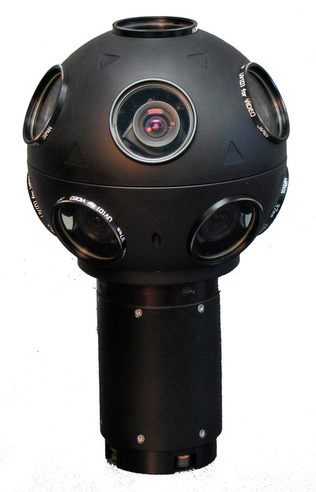
Two years ago, Google sent out an army of hybrid electric automobiles, each one bearing nine cameras on a single pole. Armed with a GPS and three laser range scanners, this fleet of cars began an endless quest to photograph every highway and byway in the free world.
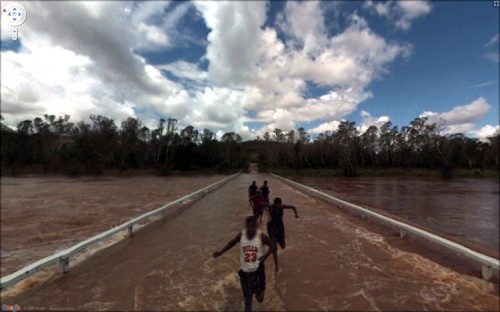
Victoria Highway, Gregory, Australia
Consistent with the company’s mission “to organize the world’s information and make it universally accessible and useful,” this enormous project, titled Google Street View, was created for the sole purpose of adding a new feature to Google Maps.
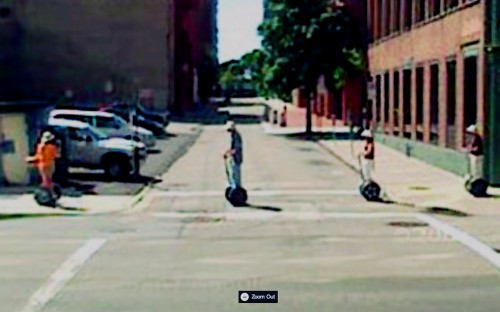
308 1st Ave. Pittsburgh, Pennsylvania
Never hiding its presence, but never announcing its arrival, the Street View vehicle is a systematic pursuer of fleeting moments.
Every ten to twenty meters, the nine cameras automatically capture whatever moves through their frame. Computer software stitches the photos together to create panoramic images. To prevent identification of individuals and vehicles, faces and license plates are blurred.
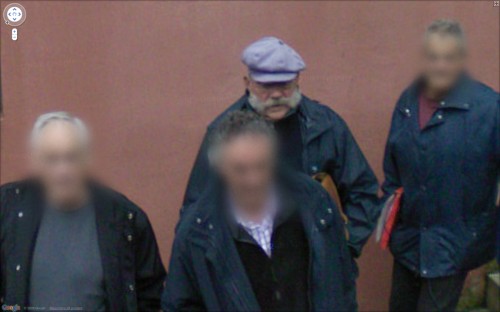
20 Rue de la Vicarie, Saint Brieuc, France
Street View’s facial recognition software sometimes fails, unintentionally revealing an individual’s identity.
Today, Google Maps provides access to 360° horizontal and 290° vertical panoramic views (from a height of about eight feet) of any street on which a Street View car has traveled. For the most part, those captured in Street View not only tolerate photographic monitoring, but even desire it. Rather than a distrusted invasion of privacy, online surveillance in general has gradually been made ‘friendly’ and transformed into an accepted spectacle.
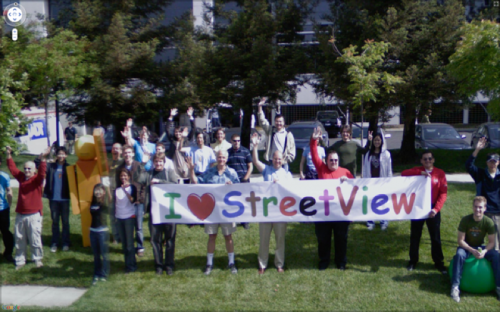
Subjects of their own gaze: the Street View car departs central HQ in Mountain View, CA to the enthusiastic cheers of Google employees.
One year ago, I started collecting screen captures of Google Street Views from a range of Street View blogs and through my own hunting. This essay illustrates how my Street View collections reflect the excitement of exploring this new, virtual world. The world captured by Google appears to be more truthful and more transparent because of the weight accorded to external reality, the perception of a neutral, unbiased recording, and even the vastness of the project. At the same time, I acknowledge that this way of photographing creates a cultural text like any other, a structured and structuring space whose codes and meaning the artist and the curator of the images can assist in constructing or deciphering.
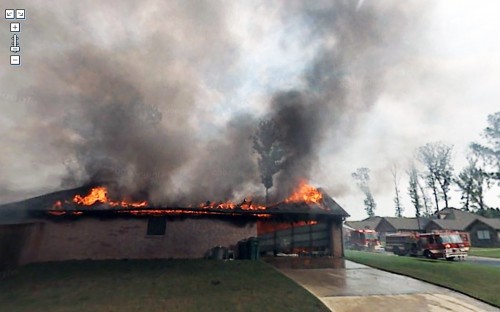
Eagle Point Dr, Sherwood, Pulaski, Arkansas
Street View collections represent our experience of the modern world, and in particular, the tension they express between our uncaring, indifferent universe and our search for connectedness and significance. A critical analysis of Google’s depiction of experience, however, requires a critical look at Google itself.
Initially, I was attracted to the noisy amateur aesthetic of the raw images. Street Views evoked an urgency I felt was present in earlier street photography. With its supposedly neutral gaze, the Street View photography had a spontaneous quality unspoiled by the sensitivities or agendas of a human photographer. It was tempting to see the images as a neutral and privileged representation of reality—as though the Street Views, wrenched from any social context other than geospatial contiguity, were able to perform true docu-photography, capturing fragments of reality stripped of all cultural intentions.
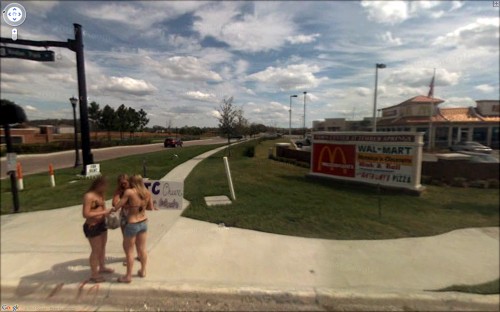
S. Avalon Park Blvd. Union Park, Florida
The way Google Street View records physical space restored the appropriate balance between photographer and subject. It allowed photography to accomplish what culture critic and film theorist Siegfried Kracauer viewed as its mission: “to represent significant aspects of physical reality without trying to overwhelm that reality so that the raw material focused upon is both left intact and made transparent.”1
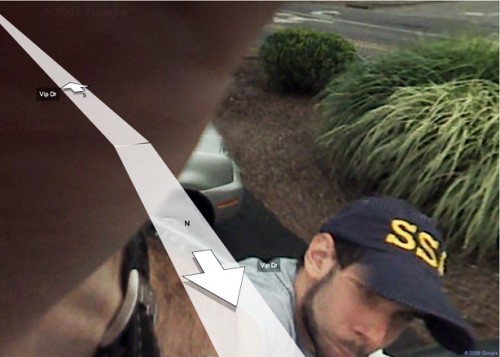
112 Vip Dr, Marshall, Pennsylvania
A momentary glimpse of a Street View driver.
This infinitely rich mine of material afforded my practice the extraordinary opportunity to explore, interpret, and curate a new world in a new way. To a certain extent, the aesthetic considerations that form the basis of my choices in different collections vary. For example, some selections are influenced by my knowledge of photographic history and allude to older photographic styles, whereas other selections, such as those representing Google’s depiction of modern experience, incorporate critical aesthetic theory. But throughout, I pay careful attention to the formal aspects of color and composition.
Within the panoramas, I can locate images of gritty urban life reminiscent of hard-boiled American street photography. Or, if I prefer, I can find images of rural Americana that recall photography commissioned by the Farm Securities Administration during the depression.
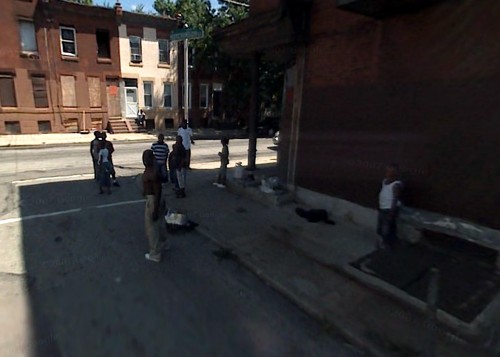
2588 N Hutchinson St. Philadelphia, Pennsylvania
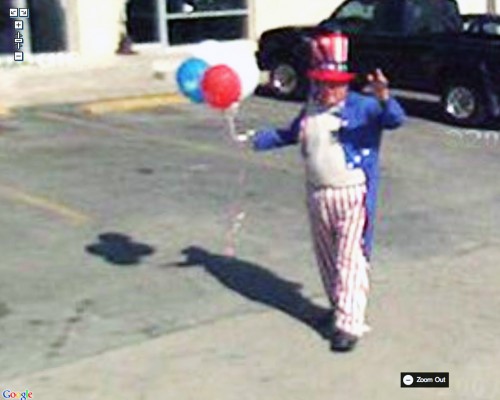
2104 S Lamar Blvd, Austin, Travis, Texas
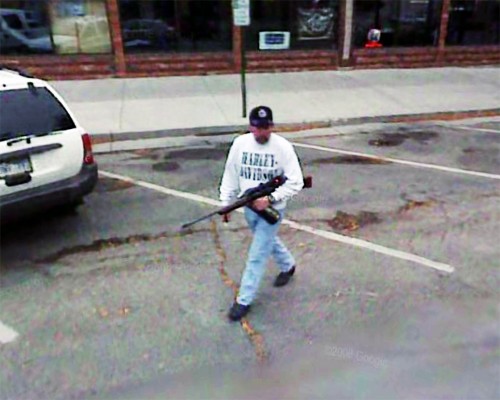
Main Street, Rapid City, South Dakota
I can seek out postcard-perfect shots that capture what Cartier-Bresson titled “the decisive moment,” as if I were a photojournalist responding instantaneously to an emerging event.
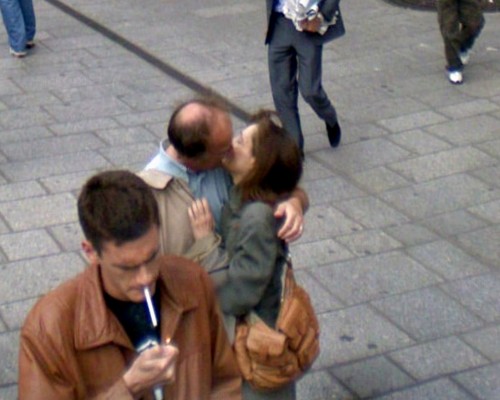
Rue de la Huchette, Paris, France
The ‘indifferent’ gaze countered even the sentimentality of the ubiquitous embracing Parisian couple of French street-photography.
At other times, I have been mesmerized by the sense of nostalgia, yearning, and loss in these images—qualities that evoke old family snapshots.
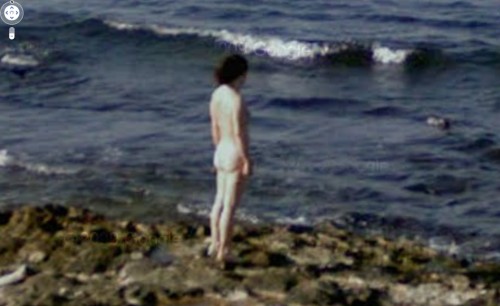
58 Lungomare 9 Maggio, Bari, Puglia, Italy
I can also choose to be a landscape photographer and meditate on the multitude of visual possibilities.
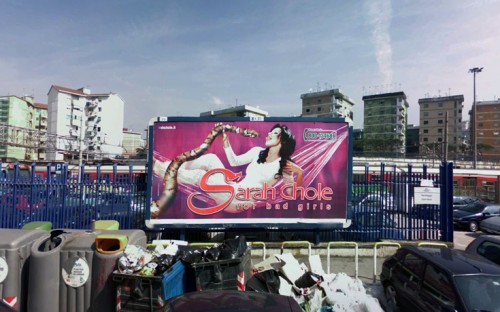
76 Piazetta Cumana, Naples, Italy
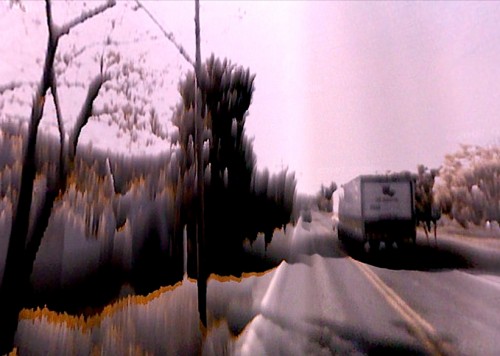
412 US-9W, Bethlehem, New York
Camera errors can form weird voids and dark psychedelic landscapes.
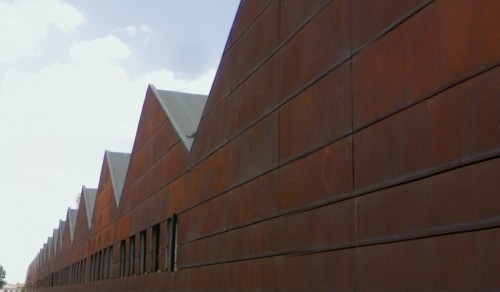
A future historian may wish to study the architecture of this soon-to-be-demolished Northern Parisian banlieu. If Google chooses, their systematic storing of panoramic views serves photography’s historic role of cultural preservation.
Or I can search for passing scenes that remind me of one of Jeff Wall’s staged tableaux.
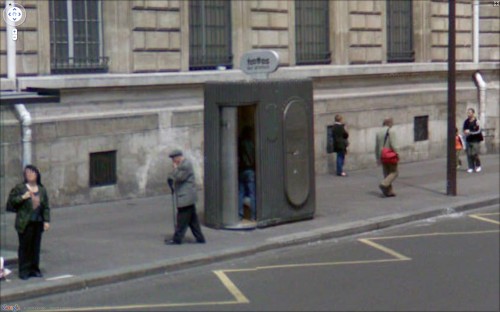
Rue du Faubourg du Temple, Paris, France
Although Street View stills may exhibit a variety of styles, their mode of production—an automated camera shot from a height of eight feet from the middle of the street and always bearing the imprimatur of Google—nonetheless limits and defines their visual aesthetic. The blurring of faces, the unique digital texture, and the warped sense of depth resulting from the panoramic view are all particular to Street View’s visual grammar.
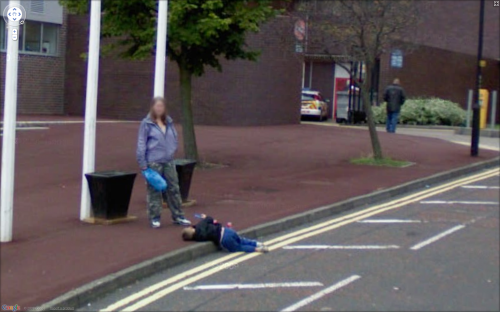
Warwick Street, Gateshead, England
Isn’t it appropriate that Google hides our identities? Do I not often see my neighbor’s face as an indistinct blur?
Many features within the captures, such as the visible Google copyright and the directional compass arrows, continually point us to how the images are produced. For me, this frankness about how the scenes are captured enhances, rather than destroys the thrill of the present instant projected on the image.
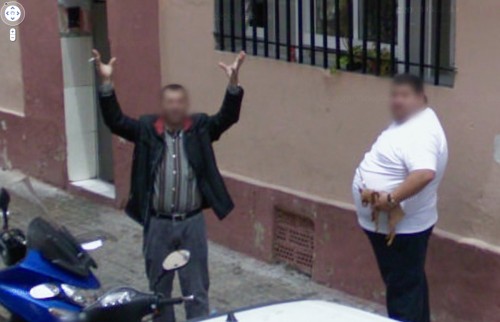
Calle del Padre Pedro Vallasco, Valencia, Spain
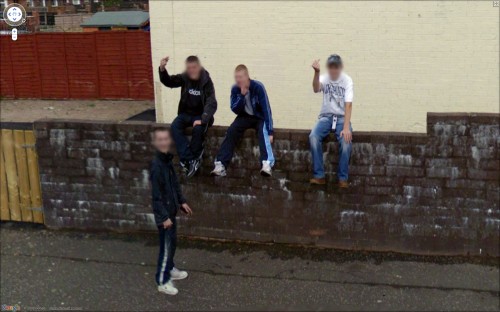
Berwick Rd. Belfast, Northern Ireland, United Kingdom
Although Google’s photography is obtained through an automated and programmed camera, the viewer interprets the images. This method of photographing, artless and indifferent, does not remove our tendency to see intention and purpose in images.
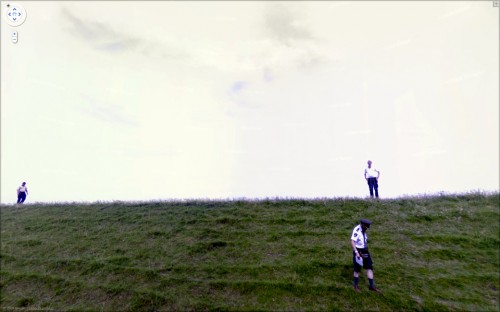
10 IJsselmeerdijk, Zeevang, Netherlands
The new form of photography may have removed the photographer from the mechanical process, but Street View photographs nonetheless remain cultural texts demanding interpretation.
This very way of recording our world, this tension between an automated camera and a human who seeks meaning, reflects our modern experience. As social beings we want to matter and we want to matter to someone, we want to count and be counted, but loneliness and anonymity are more often our plight.
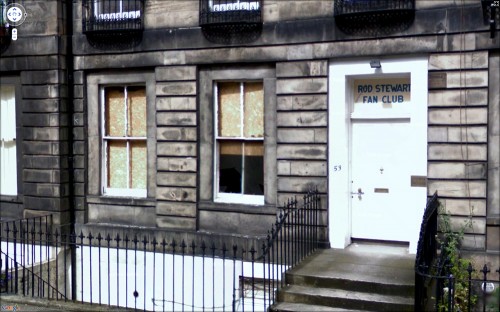
51 E. Claremont St. Edinburgh, Scotland
This tension between meaning and non-meaning is especially evident in those images that seek out the significance of the human, even if it is by illustrating its absence.
But Google does not necessarily impose their organization of experience on us; rather, their means of recording may manifest how we already structure our experience.
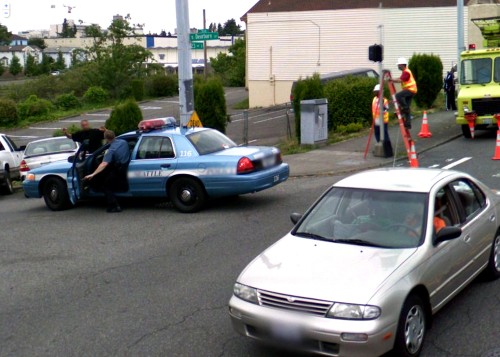
802 23rd Ave S, Seattle, Washington
Some, while searching Google Street View, adopt an investigative attitude and regale us with possible or actual crimes, such as muggings, break-ins, and police arrests.
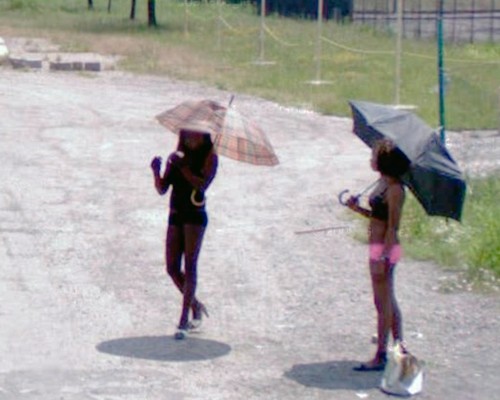
Via Valassa, Rho, Lombardy, Italy
Others with a more libidinal nature may single out images of prostitutes captured by the roving Google vehicle.
Street Views can suggest what it feels like when scenes are connected primarily by geographic contiguity as opposed to human bonds.
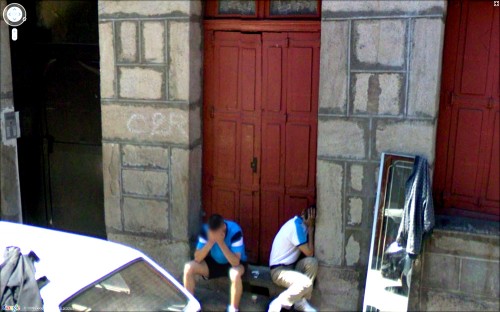
24 Rue Neyron, Saint Bienne, France
A street view image can give us a sense of what it feels like to have everything recorded, but no particular significance accorded to anything.
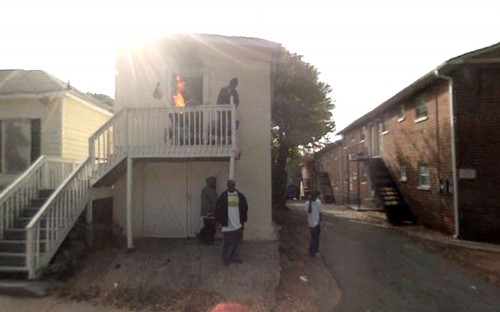
26 Little St SE. Atlanta, Georgia
The detached gaze of the automated camera can lead to a sense that we are observed simultaneously by everyone and by no one.
These collections seek to convey contemporary experience as represented by Google Street View. We are bombarded by fragmentary impressions and overwhelmed with data, but we often see too much and register nothing. In the past, religion and ideologies often provided a framework to order our experience; now, Google has laid an imperial claim to organize information for us. Sergey Brin and Larry Page have compared their search engines to the mind of God and proclaimed as their corporate motto, “do no evil.”
Although the Google search engine may be seen as benevolent, Google Street Views present a universe observed by the detached gaze of an indifferent Being. Its cameras witness but do not act in history. For all Google cares, the world could be absent of moral dimension.
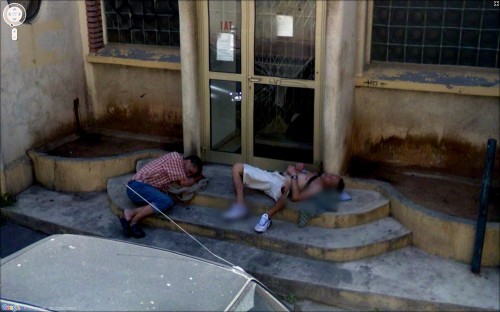
Rue Saunier, Toulon, France
In theory, we are all equally subject to being photographed, but the Street View collections often reveal it is the poor and the marginalized who fall within the purview of the Google camera gaze.
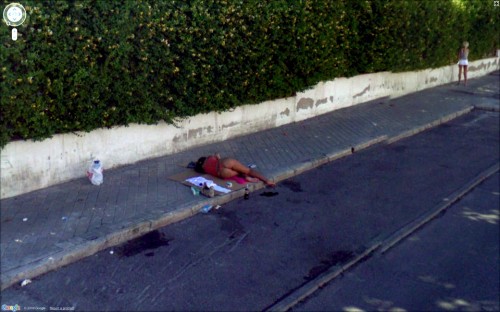
31 Calle de San Dalmacio, Madrid, Spain
Even though Google places a comment, ‘report a concern’ on the bottom of every single image, how can I demonstrate my concern for humanity within Google’s street photography?
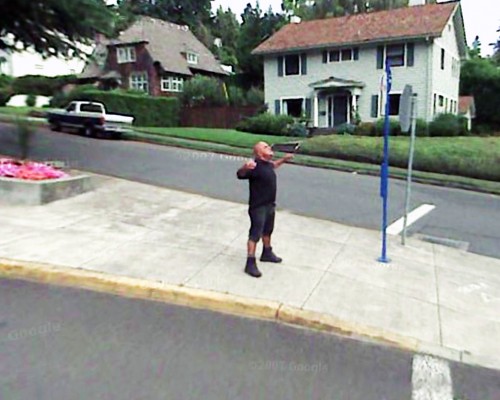
308 SW Rose Garden Way, Portland, Oregon
It is we who must make sense of Google’s record of our experience, for good or for ill.
The collections of Street Views both celebrate and critique the current world. To deny Google’s power over framing our perceptions would be delusional, but the curator, in seeking out frames within these frames, reminds us of our humanity. The artist/curator, in reasserting the significance of the human gaze within Street View, recognizes the pain and disempowerment in being declared insignificant. The artist/curator challenges Google’s imperial claims and questions the company’s right to be the only one framing our cognitions and perceptions.
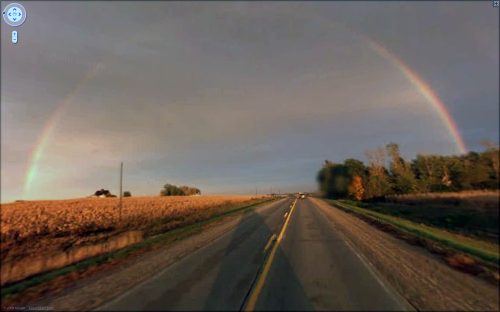
2368 IA-141, Dodge, Iowa
- Kracauer, S. Film Theory: The Redemption of Physical Reality. Princeton University Press: 1997. Pg. 23. [↩]


{ 193 comments }
A friend recently found a photograph on Google Street View of my wife leaving our old apartment. The effect was unexpected and odd, as if she were famous in an infinitesimal scale.
All those prostitutes captured by Google Street View have sadly reached a whole different kind of fame…
http://www.doxyspotting.com/
A friend recently found a photograph on Google Street View of my wife leaving our old apartment. The effect was unexpected and odd, as if she were famous in an infinitesimal scale.
What an amazing selection of Street Views, some are extraordinarily beautiful, all are wonderfully composed but the ones that capture modern life, our alone-ness, our separateness are very moving. And I love the three women in front of Wal-Mart, the three searchers and the Rod Stewart fan club. Very thoughtful comments about how Google’s way of photographing replicates contemporary life. Great job.
What an amazing selection of Street Views, some are extraordinarily beautiful, all are wonderfully composed but the ones that capture modern life, our alone-ness, our separateness are very moving. And I love the three women in front of Wal-Mart, the three searchers and the Rod Stewart fan club. Very thoughtful comments about how Google’s way of photographing replicates contemporary life. Great job.
Beautiful.
Beautiful.
I’m kind of fascinated myself with the “report a concern” feature, which, IIRC, was a PR response to people discovering and publicizing StreetView images of crimes being committed.
Google’s reaction at the time was to remove controversial–or potentially brand-tarnishing–images soon after they were publicized. So while it might at first seem like the “concern” is for the people/places in the photo, it’s really the viewer’s concern for his own discomfort in seeing something. Or it’s the company’s concern for the public perception of its own vast venture.
I’m kind of fascinated myself with the “report a concern” feature, which, IIRC, was a PR response to people discovering and publicizing StreetView images of crimes being committed.
Google’s reaction at the time was to remove controversial–or potentially brand-tarnishing–images soon after they were publicized. So while it might at first seem like the “concern” is for the people/places in the photo, it’s really the viewer’s concern for his own discomfort in seeing something. Or it’s the company’s concern for the public perception of its own vast venture.
An amazing collection of images with some very thoughtful and acute commentary about photography, technology, and humanity. Jon Rafman needs to get known! Even more!
An amazing collection of images with some very thoughtful and acute commentary about photography, technology, and humanity. Jon Rafman needs to get known! Even more!
This is a great essay, but I’m wondering why you haven’t provided the streetview links to these so we can see them in the web context?
He gave the streetnames and locations, a little effort on your side wouldn’t do much harm.
This is a great essay, but I’m wondering why you haven’t provided the streetview links to these so we can see them in the web context?
The possibilities are certainly present for this to become an accepted form of a Legal Document at some point. I have used Street view images on my Blog and also for reporting news such as pinpointing the location of a street fire in New York when no other images were available.
The project that I’m really interested at the moment is documenting the various places that I’ve worked at over the past 30-odd years since I’ve never held down a job for more than 4 years (until now).
Thanks for a most interesting collection and best wishes for the future !
The possibilities are certainly present for this to become an accepted form of a Legal Document at some point. I have used Street view images on my Blog and also for reporting news such as pinpointing the location of a street fire in New York when no other images were available.
The project that I’m really interested at the moment is documenting the various places that I’ve worked at over the past 30-odd years since I’ve never held down a job for more than 4 years (until now).
Thanks for a most interesting collection and best wishes for the future !
This is a great post…very thought provoking.
This is a great post…very thought provoking.
This is a great post…very thought provoking.
Dude,
Amazing. I’ll remember this for a long time. Very, very interesting and thought-provoking.
Dude,
Amazing. I’ll remember this for a long time. Very, very interesting and thought-provoking.
Dude,
Amazing. I’ll remember this for a long time. Very, very interesting and thought-provoking.
‘Report a concern’ is a very intriguing but also very problematic feature of Street View and makes visible the increasing tension between democracy and imperialism at the heart of modern corporate structures. When and to whom is a concern reported? And who is then responsible?
The information that Google owns is made available to everyone or until they start charging or requiring ads but it is ultimately at their discretion that is made available or removed.
‘Report a concern’ is a very intriguing but also very problematic feature of Street View and makes visible the increasing tension between democracy and imperialism at the heart of modern corporate structures. When and to whom is a concern reported? And who is then responsible?
The information that Google owns is made available to everyone or until they start charging or requiring ads but it is ultimately at their discretion that is made available or removed.
‘Report a concern’ is a very intriguing but also very problematic feature of Street View and makes visible the increasing tension between democracy and imperialism at the heart of modern corporate structures. When and to whom is a concern reported? And who is then responsible?
The information that Google owns is made available to everyone or until they start charging or requiring ads but it is ultimately at their discretion that is made available or removed.
While you try to establish a kind of neutrality to the process of capturing the photos, a neutrality that in turn promotes the role of the ‘curator’ or pix fisher to the absent role of sensibility, I don’t think you succeed. In any photographic ontology, there is a sensibility, a subject, and the intermediate stuff. In Google’s case, it is the sensibility of Sergei Brin and his cohort/s, the subject is the power to claim the world, and the role of the “curator” is really only a role of creating eddies and viscosities in the dizzying speed of accumulation.
While you try to establish a kind of neutrality to the process of capturing the photos, a neutrality that in turn promotes the role of the ‘curator’ or pix fisher to the absent role of sensibility, I don’t think you succeed. In any photographic ontology, there is a sensibility, a subject, and the intermediate stuff. In Google’s case, it is the sensibility of Sergei Brin and his cohort/s, the subject is the power to claim the world, and the role of the “curator” is really only a role of creating eddies and viscosities in the dizzying speed of accumulation.
While you try to establish a kind of neutrality to the process of capturing the photos, a neutrality that in turn promotes the role of the ‘curator’ or pix fisher to the absent role of sensibility, I don’t think you succeed. In any photographic ontology, there is a sensibility, a subject, and the intermediate stuff. In Google’s case, it is the sensibility of Sergei Brin and his cohort/s, the subject is the power to claim the world, and the role of the “curator” is really only a role of creating eddies and viscosities in the dizzying speed of accumulation.
Jon Rafman’s words and images are enlightening, perceptive, and alarming. well done!
Jon Rafman’s words and images are enlightening, perceptive, and alarming. well done!
Simply brilliant!
Simply brilliant!
I would totally tap that ass…
I would totally tap that ass…
I would totally tap that ass…
“every highway and byway in the free world”?
My hometown in Germany (Osnabrueck) is not shown in street view!?
“every highway and byway in the free world”?
My hometown in Germany (Osnabrueck) is not shown in street view!?
Your Google Street View selection is reminiscent of a Life magazine photo essay. Poignant and artful. Hope you do more.
Your Google Street View selection is reminiscent of a Life magazine photo essay. Poignant and artful. Hope you do more.
Wow… breath taking photo essay. This is the IMG MGMT series at it’s best!
Wow… breath taking photo essay. This is the IMG MGMT series at it’s best!
This is the first IMG MGMT post I’ve actually found interesting. Google Street View photos have been making the rounds on the internet since they first started, and it usually is about awkward or strange or funny moments captured by the car. This is quite beautiful and I think a far more thoughtful take on something people take for granted now.
This is the first IMG MGMT post I’ve actually found interesting. Google Street View photos have been making the rounds on the internet since they first started, and it usually is about awkward or strange or funny moments captured by the car. This is quite beautiful and I think a far more thoughtful take on something people take for granted now.
wow, that’s a nice collection of street views…very impressed
wow, that’s a nice collection of street views…very impressed
re: linking to the images, I just tried Google searches for a couple of the image titles–that rainbow is right there. and so’s that Sopranos dude in Valencia with the chihuahua. And those bummed out dudes in the Loire.
Just Google it.
re: linking to the images, I just tried Google searches for a couple of the image titles–that rainbow is right there. and so’s that Sopranos dude in Valencia with the chihuahua. And those bummed out dudes in the Loire.
Just Google it.
re: linking to the images, I just tried Google searches for a couple of the image titles–that rainbow is right there. and so’s that Sopranos dude in Valencia with the chihuahua. And those bummed out dudes in the Loire.
Just Google it.
amazing essay. thanks. times 1000.
amazing essay. thanks. times 1000.
amazing essay. thanks. times 1000.
I love this photo essay, though I can’t help but cringe at your use of the word “prostitute” to describe two dark-skinned women. How do we know they are prostitutes? Are there assumptions being made about their skin color and the clothing they are wearing?
Get over yourself Mike. Â How could anyone with an ounce of street savvy not conclude that these ladies were prostitutes? Â Their race had nothing to do with it. what exactly is your problem? Â Why do you, and people like you, constantly seek to reinforce racist agendas by creating these “phantom” issues?
Congratulations to the Artist BTW, what an amazing collection – a professional photographer once told me that every photo I take should tell a story, this collection is the best example of this mantra but somehow the “automated” nature of the photography gives this an interesting twist.
I love this photo essay, though I can’t help but cringe at your use of the word “prostitute” to describe two dark-skinned women. How do we know they are prostitutes? Are there assumptions being made about their skin color and the clothing they are wearing?
Many have already rightly pointed out how beautiful, inspiring, and elegant Jon Rafman’s photographic essay about Google Street View is, so I won’t say more about that. In defense of Google I would only say this: as far as empires go, Google is pretty benign. Massive media conglomerates like CNN do damage to our moral consciousness by glamorizing evil and catastrophe; Street View, by comparison, leaves the moral interpretation of its landscapes more or less up to us. I’m glad there are humane artist/interpreters like Jon around to make us sensitive to what we’re seeing on Street View. But the very fact that we need good artists to do this means that Google makes no “imperial claims.”
Many have already rightly pointed out how beautiful, inspiring, and elegant Jon Rafman’s photographic essay about Google Street View is, so I won’t say more about that. In defense of Google I would only say this: as far as empires go, Google is pretty benign. Massive media conglomerates like CNN do damage to our moral consciousness by glamorizing evil and catastrophe; Street View, by comparison, leaves the moral interpretation of its landscapes more or less up to us. I’m glad there are humane artist/interpreters like Jon around to make us sensitive to what we’re seeing on Street View. But the very fact that we need good artists to do this means that Google makes no “imperial claims.”
@mike:
in italy? sadly, yes.
(also, the umbrellas)
@mike:
in italy? sadly, yes.
(also, the umbrellas)
Very funny!
Very funny!
Very funny!
caguenlaputa! Si salen los gitaaaanos de Valencia…
caguenlaputa! Si salen los gitaaaanos de Valencia…
These Google Street Views invoke in me an eerie feeling of loneliness. But on a brighter note Google’s company motto is “Don’t be evil.” Find my don’t be evil sign on Street View!
These Google Street Views invoke in me an eerie feeling of loneliness. But on a brighter note Google’s company motto is “Don’t be evil.” Find my don’t be evil sign on Street View!
Q culo de la q duerme en la calle!!no?
Q culo de la q duerme en la calle!!no?
Q culo de la q duerme en la calle!!no?
loved it… art at it’s rawest
loved it… art at it’s rawest
Todas las fotografÃas deberÃan estar reguladas por una comisión ética, realizar estas fotos y que circulen libremente no me parece coherente. además esta comisión podrÃa de paso detectar problemas en las zonas puntuales de las ciudades y presentarlo a las administraciones que corresponden. ¿Mucha utopÃa verdad?
Todas las fotografÃas deberÃan estar reguladas por una comisión ética, realizar estas fotos y que circulen libremente no me parece coherente. además esta comisión podrÃa de paso detectar problemas en las zonas puntuales de las ciudades y presentarlo a las administraciones que corresponden. ¿Mucha utopÃa verdad?
Mi piace molto l’ideanJ like this ideanme plait l’idee
Mi piace molto l’idea\nJ like this idea\nme plait l’idee
when I read arguments against googleview, or whatever it’s called,nI get the impression of someone who fears humanity and the world. as if google corp. has become that threadbare cypher “Big Brother” and we will soon live at it’s mercy and discretion. please. these photos are proof of life and the commonality of human experience. nnlife is beautiful, messy and finite. here’s your evidence. lap up every drop will you can, because it ends, people
when I read arguments against googleview, or whatever it’s called,\nI get the impression of someone who fears humanity and the world. as if google corp. has become that threadbare cypher “Big Brother” and we will soon live at it’s mercy and discretion. please. these photos are proof of life and the commonality of human experience. \n\nlife is beautiful, messy and finite. here’s your evidence. lap up every drop will you can, because it ends, people
That was amazing… i love those pictures! i wonder how many more interesting stories are out there in the depths of google maps waiting to be discovered?
That was amazing… i love those pictures! i wonder how many more interesting stories are out there in the depths of google maps waiting to be discovered?
That was amazing… i love those pictures! i wonder how many more interesting stories are out there in the depths of google maps waiting to be discovered?
hahahaha, good recopilation
hahahaha, good recopilation
Some great images there. The Rod Stewart fan club picture, is close to where I work and it used to be used as a brothel!
Some great images there. The Rod Stewart fan club picture, is close to where I work and it used to be used as a brothel!
Some great images there. The Rod Stewart fan club picture, is close to where I work and it used to be used as a brothel!
Wish I’d run into a street view car and had a hammer with me. registering and cataloguing are the basic principles of control, how can you all be so into it?!
Wish I’d run into a street view car and had a hammer with me. registering and cataloguing are the basic principles of control, how can you all be so into it?!
Wish I’d run into a street view car and had a hammer with me. registering and cataloguing are the basic principles of control, how can you all be so into it?!
Reminds me of the (defunct?) Last Breath in Alaska:
http://www.rhizome.org/editorial/480
Reminds me of the (defunct?) Last Breath in Alaska:
http://www.rhizome.org/editorial/480
Reminds me of the (defunct?) Last Breath in Alaska:
http://www.rhizome.org/editorial/480
These photos paint a sad reality of the human state here on earth. Even so, it’s reality that is captured when no one is given a chance to fix their hair and put on a masking smile. It’s truth through photography, and truly beautiful.
These photos paint a sad reality of the human state here on earth. Even so, it’s reality that is captured when no one is given a chance to fix their hair and put on a masking smile. It’s truth through photography, and truly beautiful.
Not sad, just realistic. It’s just seems to be easier to focus on bad stuff than it is to good stuff. There’s a lot of normal and nice things going on in those pictures but since they are so normal they are easier to ignore. In the end it’s nothing more than a state of mind…
These photos paint a sad reality of the human state here on earth. Even so, it’s reality that is captured when no one is given a chance to fix their hair and put on a masking smile. It’s truth through photography, and truly beautiful.
Great project!
Using Google Street View, I visited every home address I’ve ever had and made a video entitled Homing. You can see it on Vimeo or my website. http://www.vimeo.com/2758520
I recently met the inventor of this technology after he saw my video in an exhibition. He gave me a tour of his studio and showed me the original version of the camera from 1995.
Great project!
Using Google Street View, I visited every home address I’ve ever had and made a video entitled Homing. You can see it on Vimeo or my website. http://www.vimeo.com/2758520
I recently met the inventor of this technology after he saw my video in an exhibition. He gave me a tour of his studio and showed me the original version of the camera from 1995.
I was able to find my car both at home and at work, seemingly simultaneously. I felt briefly like I was the subject of the project.
was that the day it got stolen?
I was able to find my car both at home and at work, seemingly simultaneously. I felt briefly like I was the subject of the project.
I feel a strong sense of nostalgia when viewing the images. It is an incredible archive and will shape our visual culture for years to come.
I feel a strong sense of nostalgia when viewing the images. It is an incredible archive and will shape our visual culture for years to come.
We really don’t need another government eye watching us, criminal or not. Eventually, the government will subpoena Google for a picture it “needs,” and there you go…
It’s the world, and it won’t change because Google’s watching it. I personally don’t want the U.S. to be like the U.K., with cameras everywhere. We lack enough personal freedoms. Just because we have the technology doesn’t always mean we should use it. Like little children with toys.
I’m sure Google will defend it, say it’s useful, or call it art, or whatever – of course they will. It’s their toy. Nobody likes giving up their toys.
Get a clue, Google. It’s your world you’re messing up, too.
We really don’t need another government eye watching us, criminal or not. Eventually, the government will subpoena Google for a picture it “needs,” and there you go…
It’s the world, and it won’t change because Google’s watching it. I personally don’t want the U.S. to be like the U.K., with cameras everywhere. We lack enough personal freedoms. Just because we have the technology doesn’t always mean we should use it. Like little children with toys.
I’m sure Google will defend it, say it’s useful, or call it art, or whatever – of course they will. It’s their toy. Nobody likes giving up their toys.
Get a clue, Google. It’s your world you’re messing up, too.
For those concerned about privacy, that was surrendered long ago when the camera was invented. The digital age has added the ability to distribute these images easily/everywhere. Like any documentary photographic project, Google’s seems to provide an objective reality. But you soon realize it’s only a brief second in time.
Incidentally, the Seattle photo in your essay is two blocks from where I used to live. The image is across the street from Parnells Grocery, a notorious drug selling corner.
For those concerned about privacy, that was surrendered long ago when the camera was invented. The digital age has added the ability to distribute these images easily/everywhere. Like any documentary photographic project, Google’s seems to provide an objective reality. But you soon realize it’s only a brief second in time.
Incidentally, the Seattle photo in your essay is two blocks from where I used to live. The image is across the street from Parnells Grocery, a notorious drug selling corner.
I wonder if anyone has tried to use StreetView as evidence in court?
Don’t know about StreetView, but Google Earth has been the subject of an international boundary dispute!
http://www.guardian.co.uk/technology/2010/nov/15/google-map-dispute-nicaragua
I used Google Maps as evidence in court to dispute a parking ticket. I made my case; the judge said, “It’s NOT an intersection? It’s just a corner where the street name changes?” I said, “That’s right. The street doesn’t cross another. It simply turns a corner.” He asked, “Can you prove this?” I said, “I have with me a map downloaded from the Internet.” He asked the clerk to take it from me to him. On it was a rectangle representing my car. He examined it and announced, “Case dismissed.”
I wonder if anyone has tried to use StreetView as evidence in court?
Hey Mike from 11:00 am. LAY OFF THE RACE topic. Stop trying to turn this into something racist. Enjoy your life and get your head out of your PC ass.
Hey Mike from 11:00 am. LAY OFF THE RACE topic. Stop trying to turn this into something racist. Enjoy your life and get your head out of your PC ass.
Hey Mike from 11:00 am. LAY OFF THE RACE topic. Stop trying to turn this into something racist. Enjoy your life and get your head out of your PC ass.
My (virtual) Porsche was away being serviced when the Street Car named Google passed by my house. Does that make me a loser or virtually a loser?
My (virtual) Porsche was away being serviced when the Street Car named Google passed by my house. Does that make me a loser or virtually a loser?
My (virtual) Porsche was away being serviced when the Street Car named Google passed by my house. Does that make me a loser or virtually a loser?
han ido a poner una de las calles mas particulares de valencia, en esa calle se pasa droga.
han ido a poner una de las calles mas particulares de valencia, en esa calle se pasa droga.
Cool essay. That round camera with all the lenses comes from Immersive Media which originally created Street View. Immersive now does video street views which they’re licensing instead of just stills that Google does.
Cool essay. That round camera with all the lenses comes from Immersive Media which originally created Street View. Immersive now does video street views which they’re licensing instead of just stills that Google does.
It is very nice to see art, seriousness and sincerity coexisting in one project, without the “out” of irony. This combination is not “in vogue” as far as I can tell.
It is very nice to see art, seriousness and sincerity coexisting in one project, without the “out” of irony. This combination is not “in vogue” as far as I can tell.
It is very nice to see art, seriousness and sincerity coexisting in one project, without the “out” of irony. This combination is not “in vogue” as far as I can tell.
It is very nice to see art, seriousness and sincerity coexisting in one project, without the “out” of irony. This combination is not “in vogue” as far as I can tell.
que fuerte. Buscando por “31 Calle de San Dalmacio, Madrid, Spain” (la foto de la negra en madird tirada en el suelo) Se ve una iamgen actualizada de la esquina, en este caso la mujer es otra aunque en una situación bastante precaria tambien…
http://maps.google.com/maps?client=safari&rls=en&q=31+Calle+de+San+Dalmacio,+Madrid,+Spain&oe=UTF-8&um=1&ie=UTF-8&split=0&ei=xN2aSuKGD9zKjAfY84S1BQ&sa=X&oi=geocode_result&ct=title&resnum=1
que fuerte. Buscando por “31 Calle de San Dalmacio, Madrid, Spain” (la foto de la negra en madird tirada en el suelo) Se ve una iamgen actualizada de la esquina, en este caso la mujer es otra aunque en una situación bastante precaria tambien…
http://maps.google.com/maps?client=safari&rls=en&q=31+Calle+de+San+Dalmacio,+Madrid,+Spain&oe=UTF-8&um=1&ie=UTF-8&split=0&ei=xN2aSuKGD9zKjAfY84S1BQ&sa=X&oi=geocode_result&ct=title&resnum=1
que fuerte. Buscando por “31 Calle de San Dalmacio, Madrid, Spain” (la foto de la negra en madird tirada en el suelo) Se ve una iamgen actualizada de la esquina, en este caso la mujer es otra aunque en una situación bastante precaria tambien…
http://maps.google.com/maps?client=safari&rls=en&q=31+Calle+de+San+Dalmacio,+Madrid,+Spain&oe=UTF-8&um=1&ie=UTF-8&split=0&ei=xN2aSuKGD9zKjAfY84S1BQ&sa=X&oi=geocode_result&ct=title&resnum=1
que fuerte. Buscando por “31 Calle de San Dalmacio, Madrid, Spain” (la foto de la negra en madird tirada en el suelo) Se ve una iamgen actualizada de la esquina, en este caso la mujer es otra aunque en una situación bastante precaria tambien…
http://maps.google.com/maps?client=safari&rls=en&q=31+Calle+de+San+Dalmacio,+Madrid,+Spain&oe=UTF-8&um=1&ie=UTF-8&split=0&ei=xN2aSuKGD9zKjAfY84S1BQ&sa=X&oi=geocode_result&ct=title&resnum=1
This is really fascinating–I’d never really considered Google Street View as art before, but you’re right. I really hope that when/if Google re-roams the streets that it doesn’t delete the original imagery, but instead finds a way to archive and present the old and new images together, thus letting us see how our physical surroundings change.
This is really fascinating–I’d never really considered Google Street View as art before, but you’re right. I really hope that when/if Google re-roams the streets that it doesn’t delete the original imagery, but instead finds a way to archive and present the old and new images together, thus letting us see how our physical surroundings change.
Wow___ you wrote that comment 5 years ago and google have this available for sometime nice… nice!
This is really fascinating–I’d never really considered Google Street View as art before, but you’re right. I really hope that when/if Google re-roams the streets that it doesn’t delete the original imagery, but instead finds a way to archive and present the old and new images together, thus letting us see how our physical surroundings change.
I sometimes search Google Street views for the fun of it, looking at still images of living streets, especially in New York where I once lived. I see the transformation of city blocks I once knew well. Jon Rafman’s selections are fantastic—adding the human element I often overlooked. They remind me of Bruce Davidson. I love this!
I sometimes search Google Street views for the fun of it, looking at still images of living streets, especially in New York where I once lived. I see the transformation of city blocks I once knew well. Jon Rafman’s selections are fantastic—adding the human element I often overlooked. They remind me of Bruce Davidson. I love this!
Fantastic blog post! Some incredible stuff there. thank you!
Fantastic blog post! Some incredible stuff there. thank you!
Fantastic blog post! Some incredible stuff there. thank you!
These photos are amazing!! Touching and horrifying at the same time. Good work following this.
These photos are amazing!! Touching and horrifying at the same time. Good work following this.
These photos are amazing!! Touching and horrifying at the same time. Good work following this.
You got it:
World:
World Street View
USA:
USA Street View
You got it:
World:
World Street View
USA:
USA Street View
You got it:
World:
World Street View
USA:
USA Street View
I think the whole thing is areal worry. The act of being filmed in an unknown way is the next stage in the march towards totalitarianism. This set of images may have been put together to form some sort of prosaic window on the world, but actually it represents the stripping bare of personal space. Google as a corporate entity is to be shunned and igored at all costs.
I think the whole thing is areal worry. The act of being filmed in an unknown way is the next stage in the march towards totalitarianism. This set of images may have been put together to form some sort of prosaic window on the world, but actually it represents the stripping bare of personal space. Google as a corporate entity is to be shunned and igored at all costs.
I think the whole thing is areal worry. The act of being filmed in an unknown way is the next stage in the march towards totalitarianism. This set of images may have been put together to form some sort of prosaic window on the world, but actually it represents the stripping bare of personal space. Google as a corporate entity is to be shunned and igored at all costs.
Google as a corporate entity is to be shunned and igored at all costs.
Oh do shut up. How does possibly being photographed once, in public, several months before the image is shown to anyone, possibly consitute “the stripping bare of personal space”?
Google as a corporate entity is to be shunned and igored at all costs.
Oh do shut up. How does possibly being photographed once, in public, several months before the image is shown to anyone, possibly consitute “the stripping bare of personal space”?
Rob, I have a sense of what you are saying, but B. Franklin might have some perspective on the topic.Â
Google as a corporate entity is to be shunned and igored at all costs.
Oh do shut up. How does possibly being photographed once, in public, several months before the image is shown to anyone, possibly consitute “the stripping bare of personal space”?
Good essay, wonder if (even only temporarily) more designers architects and artists will privilege the reading of particular works to the one seen in Google earth, maps, etc.
Good essay, wonder if (even only temporarily) more designers architects and artists will privilege the reading of particular works to the one seen in Google earth, maps, etc.
Good street view pictures.
Live street view and virtual driving is available at
http://propermap.com/street-directions.aspx
Good street view pictures.
Live street view and virtual driving is available at
http://propermap.com/street-directions.aspx
Like a student looking concepts and definitions from the new alejandria Library called GOOGLE, this artist found a several of photoes, make an essay, so the art is created. It´s a new kind of ready-made art, like Duchamp perhaps? It´s ready-seen by google but registered by us or the artist.
Excellent essay.
Like a student looking concepts and definitions from the new alejandria Library called GOOGLE, this artist found a several of photoes, make an essay, so the art is created. It´s a new kind of ready-made art, like Duchamp perhaps? It´s ready-seen by google but registered by us or the artist.
Excellent essay.
Like a student looking concepts and definitions from the new alejandria Library called GOOGLE, this artist found a several of photoes, make an essay, so the art is created. It´s a new kind of ready-made art, like Duchamp perhaps? It´s ready-seen by google but registered by us or the artist.
Excellent essay.
“Street Views can suggest what it feels like when scenes are connected primarily by geographic contiguity as opposed to human bonds”
d’accord, mais la photo a été prise à saint-étienne, FRANCE et non saint-bienne, qui n’existe pas. sinon c’est intéressant.
“Street Views can suggest what it feels like when scenes are connected primarily by geographic contiguity as opposed to human bonds”
d’accord, mais la photo a été prise à saint-étienne, FRANCE et non saint-bienne, qui n’existe pas. sinon c’est intéressant.
“Street Views can suggest what it feels like when scenes are connected primarily by geographic contiguity as opposed to human bonds”
d’accord, mais la photo a été prise à saint-étienne, FRANCE et non saint-bienne, qui n’existe pas. sinon c’est intéressant.
I also made an entire website about Strange Street View : http://www.dailystreetview.com
Stéphane.
I also made an entire website about Strange Street View : http://www.dailystreetview.com
Stéphane.
Nice pictures. But it gives me food for thought if we still have any privacy.
Nice pictures. But it gives me food for thought if we still have any privacy.
seeing the street view of my street in the summer was like glimpsing at something that you shouldnt have seen but secretly enjoyed. winters in new england are long and cold but seeing all the leaves on the trees just made me so happy.
seeing the street view of my street in the summer was like glimpsing at something that you shouldnt have seen but secretly enjoyed. winters in new england are long and cold but seeing all the leaves on the trees just made me so happy.
You may be interested in my blog, “Sheep View.” Sheep sightings on Street View. And more.
Here it is: sheepview.blogspot.com
You may be interested in my blog, “Sheep View.” Sheep sightings on Street View. And more.
Here it is: sheepview.blogspot.com
You may be interested in my blog, “Sheep View.” Sheep sightings on Street View. And more.
Here it is: sheepview.blogspot.com
Let’s make that a link:
http://sheepview.blogspot.com
Let’s make that a link:
http://sheepview.blogspot.com
Let’s make that a link:
http://sheepview.blogspot.com
Amazing selection! I have a dabble at making pictures when traveling – trying to capture street views at their most natural, but you cannot compete with Google. Thanks for the blog.
Amazing selection! I have a dabble at making pictures when traveling – trying to capture street views at their most natural, but you cannot compete with Google. Thanks for the blog.
Amazing selection! I have a dabble at making pictures when traveling – trying to capture street views at their most natural, but you cannot compete with Google. Thanks for the blog.
What an amazing project – and some very artful finds. It just reinforces that there is beauty everywhere – whether your idea of beauty is a rainbow over a rural highway or candidly capturing life in it’s most raw form. Sure there are privacy issues with any documenting of personal space and property but I can’t help but admire the emotional impact random occurrences in life can have on the viewer.
What an amazing project – and some very artful finds. It just reinforces that there is beauty everywhere – whether your idea of beauty is a rainbow over a rural highway or candidly capturing life in it’s most raw form. Sure there are privacy issues with any documenting of personal space and property but I can’t help but admire the emotional impact random occurrences in life can have on the viewer.
What an amazing project – and some very artful finds. It just reinforces that there is beauty everywhere – whether your idea of beauty is a rainbow over a rural highway or candidly capturing life in it’s most raw form. Sure there are privacy issues with any documenting of personal space and property but I can’t help but admire the emotional impact random occurrences in life can have on the viewer.
I’m kind of fascinated myself with the “report a concern” feature, which, IIRC, was a PR response to people discovering and publicizing StreetView images of crimes being committed.
Google’s reaction at the time was to remove controversial–or potentially brand-tarnishing–images soon after they were publicized. So while it might at first seem like the “concern” is for the people/places in the photo, it’s really the viewer’s concern for his own discomfort in seeing something. Or it’s the company’s concern for the public perception of its own vast venture.
Google’s reaction at the time was to remove controversial–or potentially brand-tarnishing–images soon after they were publicized. So while it might at first seem like the “concern” is for the people/places in the photo, it’s really the viewer’s concern for his own discomfort in seeing something. Or it’s the company’s concern for the public perception of its own vast venture.
Waow this is the art of the information
il love rafman work, but here is on the same topic something cool too: http://lafrecciaferma.wordpress.com
Photography? Okay. Get your butt off of that computer, guy! haha.
Why wouldn’t this be photography? He’s basically just framing out things and showing them as a still. Something most of us would have never seen if not for this person, perhaps he’s not using a camera but that doesn’t make it any less photography.
absolutely bewildering and amazing look on the world.
This is sweet.
hey,on 9-eyes there’s this really awesome building http://s3.amazonaws.com/data.tumblr.com/tumblr_l6nolrEXTA1qzun8oo1_1280.jpg?AWSAccessKeyId=AKIAJ6IHWSU3BX3X7X3Q&Expires=1305729292&Signature=IqkXFRZBzXNfZjOaxNMM81bhwRA%3D can anyone please tell me what it is ?!?
F N KILLERÂ
Interesting article. Minor point, the camera you show has 11 lenses, not 9. Sort of changes the title, sounds more spider-like.
All google street view images can be hyperlinked to. That you provided no links to any of these images is strong evidence that these are not legitimate. You’re not the first person to fake google street view images.
“Strong evidence”? The addresses are, for the most part, right there, if you’d like to check the images. A few have been changed – it’s been two years, after all, so in major urban areas Google has already updated the images – but most of them are still around.
E.g.:Â http://maps.google.com/maps?q=802+23rd+Ave+S,+Seattle,+Washington&hl=en&ll=47.595527,-122.302219&spn=0.001547,0.004128&sll=47.595490,-122.302196&layer=c&cbp=13,317.22,,0,10.47&cbll=47.595526,-122.302219&hnear=802+23rd+Ave+S,+Seattle,+Washington+98144&t=m&z=19&vpsrc=0&panoid=ZKGlatGOO0XFfH2Seb9_gw
Yes, strong evidence. His Tumblr never links to the images themselves. He’s a fake. I’m sure he’s using some real ones, or modifying them only slightly, (And yes, I understand for this blog post he provided street addresses (but again no links)) — but his refusal to link to the google source (which would be very easy) strongly suggests he’s a fake.
Smile if all you did was look at the pictures, and read what was under them looking for a description.
This posting is marvelous and what a fantastic research that you have done. It has helped me a lot. thank you very much.
Comments on this entry are closed.
{ 79 trackbacks }