
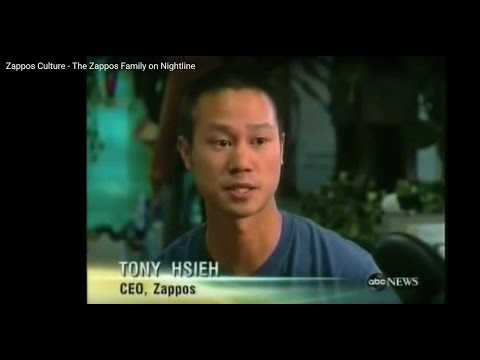
[Editor’s note: IMG MGMT is an annual image-based artist essay series. Today’s invited artist, Joel Holmberg, is still waiting to hear back from Yahoo with regards to a proposed Yahoo online artists residency. This program would simply involve Yahoo acknowledging certain users as artists by indicating this status on their Delicious, Flickr, or Answers accounts. Holmberg also recently pitched Yahoo a service called Yahoo! Mysteries, a knowledge base of user-submitted inexplicable theories, but hasn’t heard back about that either. He was featured in AFC’s Best Link Ever series on May 29, 2009, for his Yahoo Answers profile.]
I have always told people that if “it” doesn’t work out, then I am going to move to Las Vegas and work for Zappos. “It,” meaning my life, would restart itself there as I make new friends and grow as an individual while working for this online shoe retailer. Or maybe I’d just enroll in the four-week training, take the $2000 they offer new employees to quit after the first week, and get as far away as I could.

Although I’m sure that they would really love me there, I’m skeptical and terrified of what would happen to my moral consciousness if my creativity became corrupted by labor disguised as self-expression.

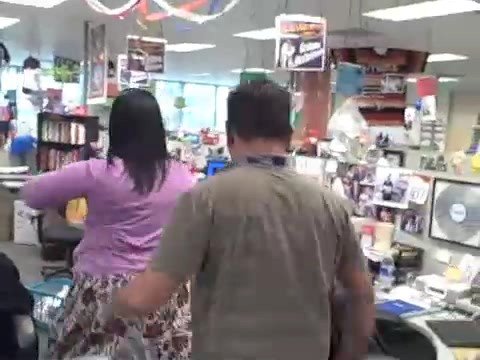
The Zappos office culture is seductive—it’s brimming with personality, enthusiasm and workplace morale. The management encourages all of the employees, called Zapponians, to twitter and publish fun YouTube videos. There are impromptu parades around the cubicles, designated costume days, and free food and snacks available at any time.

Most of the Zapponians are call center employees who are trained to place orders and assist customers in buying shoes. Ninety-five percent of Zappos’ business is conducted online, but they spend a lot of money training employees to talk with customers on the phone. There are no call center stats or time limits when dealing with customers.

Downtime for the Zapponians is filled with activities performed to generate online content. The employees are empowered through self-expression, but the flip side is that this strategy establishes control through participation. If the management can convince workers that it is their idea to continually prove company loyalty, then they also distract employees from realizing that they have forfeited the ability to complain about the corporate power structure.
Zappos Web 2.0 corporate culture brings to mind another hotbed of communal expression—Otto Muehl’s Actions Analysis commune, where members performed spontaneous acts of self-representation (Selbstdarstellung) before the whole community. At the AAO Commune, it was a daily routine to gather in groups and reveal one’s freest self.
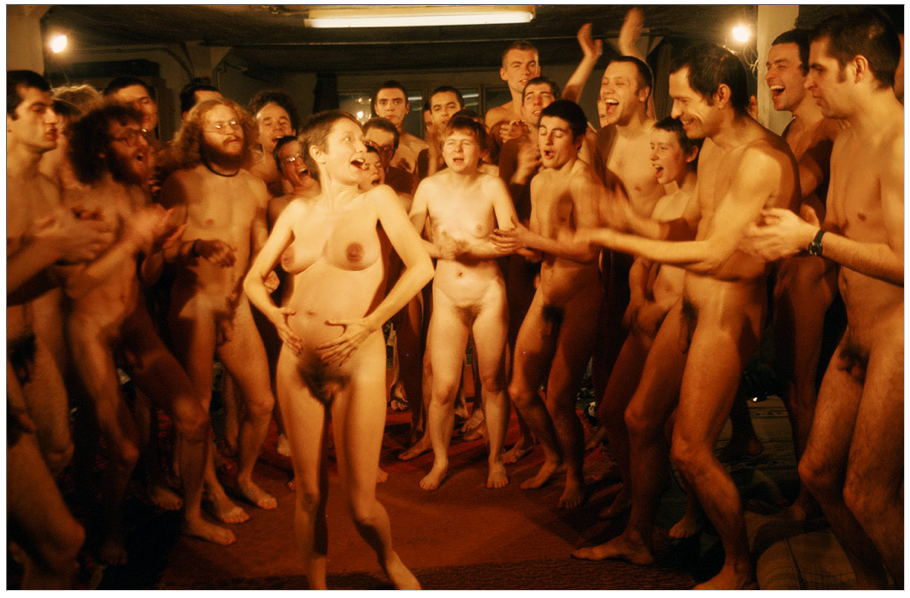
Selbstdarstellung, Friedrichshof, 1977, photographed by Theo Altenberg. Photo via: theoaltenberg.com
In a review of Theo Altenberg’s documentation of Selbstdarstellung performances at the AAO, Jörg Heiser draws attention to “whether it was heartfelt joy or a desperate attempt to top the hit-parade” that drew individuals to take part in Mühl’s lifestyle experiment. This joy-bordering-on-desperation resonates in Zappos corporate culture as well. Both Zappos and the AAO want members to experience pure happiness and seek unique outlets for them to freely express themselves (the former, through twitter and YouTube, the latter, through clichéd tropes of performance art). Both champion candor (Zappos, by allowing employees to speak for themselves rather than only through the mouthpiece of a PR department, and the AAO, through Mühl’s dogma of Reichian psychotherapy).
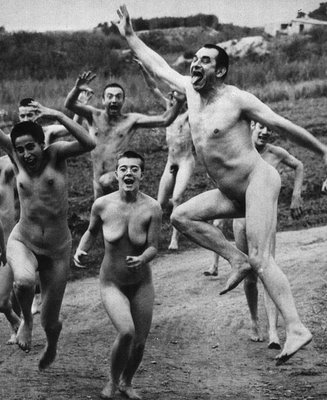
Selbstdarstellung at AAO. Photo via: toile-gothique.com
Over the last few years, the press has given a good deal of attention to what Zappos claims is a unique moment in office culture—and as the culture becomes better-known, Zappos employees have gained exposure. Nikki W. is an example of a Zappos employee whose online presence seems to have been cultivated by the company, and who was involved in shaping company’s identity through content she wrote, produced, and performed for Zappos’ Youtube Channel. She was the face of Zappos TV when I first became aware of their online presence, but she no longer works for Zappos. Mysteriously, only one video featuring Nikki still exists on the Zappos YouTube channel. All other content has been removed and the Zappos Channel to which she published has been deleted.

Her personal YouTube and twitter accounts are still active and not only document her daily activities, but also use the medium as a platform to defend her atheistic beliefs.
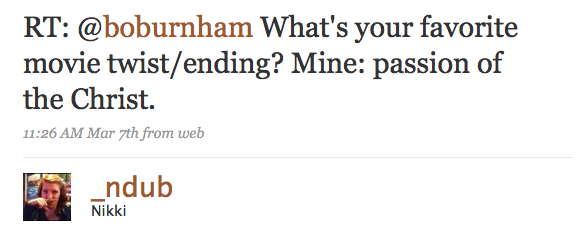
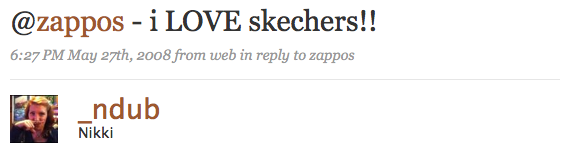
Early twitter updates by Nikki, 24, show enthusiasm for the company culture. But it seems as though the confidence she gained from learning how to be a participant on the web created a monster that Zappos could no longer contain. In a twitter update posted on December 3, 2008, Nikki reminisces that a year ago she “started working for zappos. crazy how much life stuff has happened in that time.” While her twitter history begins on April 19, 2008, her earliest YouTube video was published on December 10, 2007, approximately the same time as she began working for Zappos. As Nikki became more integrated into the YouTube atheist community, she began to make friends over the Internet and upload more content onto her personal channel. In July 2008, Nikki’s channel had 1000 subscribers, and today she has 2124, far surpassing the nearly 800 YouTube users currently subscribed to the official Zappos channels.

Nikki’s online activity caused a few confrontations with coworkers who held different religious beliefs and was likely a factor in Zappos management’s decision to delete the company YouTube account to which she was posting videos.
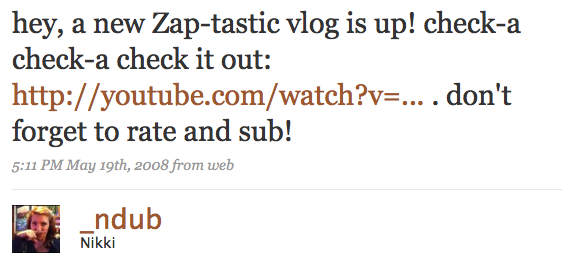
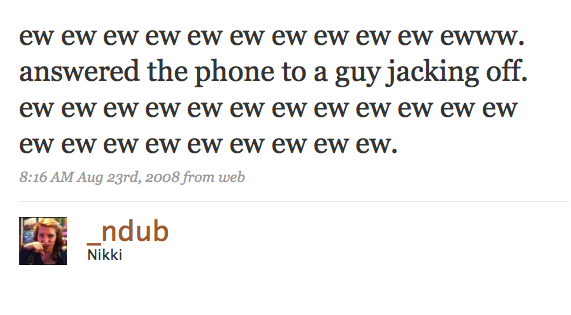
Nikki would often post twitter updates with regards to new creative projects that she was working on for Zappos, but her work morale dipped to a low point on 10:02 AM, June 20, 2008, when she posted, “the more i think about it, the more angry i get. i’m effing livid at this point.” Since the June 20th update, Nikki has not mentioned producing any Zappos-related videos. This leads me to speculate that management canceled her YouTube channel around the same time. For the next few months, Nikki’s twitter updates continually expressed frustrations with work until her mysterious relocation to Seattle in early September.
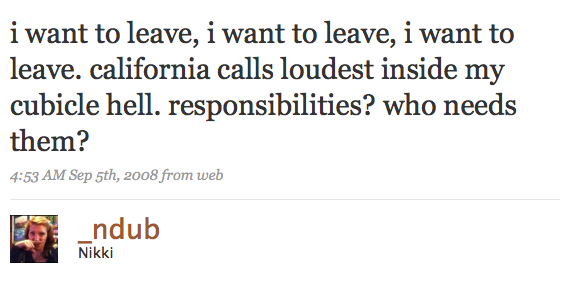
The YouTube channel for which Nikki was responsible (the same one to which “why do people work for Zappos” was originally posted) was called ZapposLV, LV standing for Las Vegas. Zappos currently has 4 YouTube channels featuring the lives of their employees: Inside Zappos Channel, Zappos.com, Zappos Experience, and Zappos Pipeline. In total, 720 Zappos videos are currently hosted on YouTube. There are 1300 employees, 436 of whom use twitter, so its clear that the majority of these people are comfortable being portrayed in online promotional videos for their company.

It’s unclear how much Nikki’s personal web content influenced Zappos to delete the ZapposLV account she maintained. It should be noted, however, that Zappos likely encouraged Nikki to develop an online persona for the sake of marketing themselves as a company that integrates social media into their workforce. If an employer can expand its audience simply by encouraging workers to express themselves online, then it is obviously contradictory for work-performers to be denied autonomy as pure, free thinking individuals.
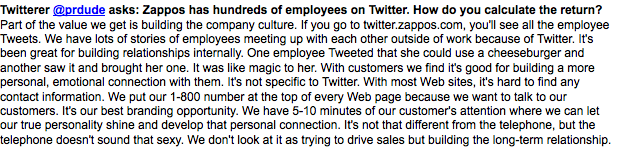
Zappos CEO: How to Build a Brand Without Spending Big on Ads, BrandWeek, December 22, 2008. Screenshot: Joel Holmberg
Twitter.Zappos.com reblogs all employee tweets and uses keywords in their posts as links to available merchandise. While the service attests to the friendships that are created in the workplace, it becomes morally problematic if participation becomes unwilling product placement.

If the boundary between content performed for one’s self-representation is blurred with content performed for a company’s identity, then what steps can management take if the personal content falls outside of what the company is willing to associate with? By integrating their lives into corporate online culture, the Zapponians become tied to the business well outside of office hours. While attending a work-sponsored event is not considered volunteering, Zapponians should be skeptical of what they are agreeing to as they participate in this never-ending office party.
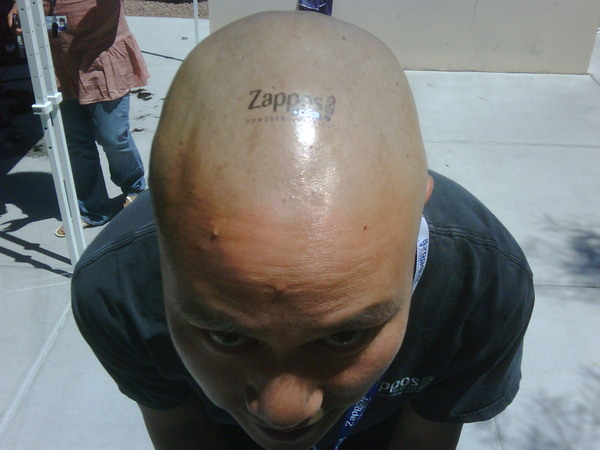
Photograph of Zappos CEO at annual head shaving competition. Image via: Tony Hsieh’s twitpic account


{ 20 comments }
This is really a great piece. The only company I ever felt this way about was Trader Joe’s and working there cured me of it for a while. It seems to me like any kind of super intense loyalty to a cause will sometimes resemble fascism, even when the cause is as benevolent as selling shoes.
This is really a great piece. The only company I ever felt this way about was Trader Joe’s and working there cured me of it for a while. It seems to me like any kind of super intense loyalty to a cause will sometimes resemble fascism, even when the cause is as benevolent as selling shoes.
Oh god, I can’t get any work done now that I am obsessed with these zappo employee videos. How do they get any work done writing plays, dancing, acting all the time?! Really intense stuff. Strange that at the end of the ‘Why do people work at Zappos?’ Nikki is drugged and kidnapped—cult reference?
Oh god, I can’t get any work done now that I am obsessed with these zappo employee videos. How do they get any work done writing plays, dancing, acting all the time?! Really intense stuff. Strange that at the end of the ‘Why do people work at Zappos?’ Nikki is drugged and kidnapped—cult reference?
Superb and fascinating work. I had no idea about this!
Superb and fascinating work. I had no idea about this!
I was just recently made aware of this article/ website, and feel compelled to introduce myself. Hello, I am Nikki.
“Nikki’s online activity caused a few confrontations with coworkers who held different religious beliefs and was likely a factor in Zappos management’s decision to delete the company YouTube account to which she was posting videos.”
I understand that teh interwebs as a whole does not place too much value on “fact checking”, but I would presume that a site operating under the banner of “New York art news, reviews and gossip” would have slightly higher standards in that regard.
“It’s unclear how much Nikki’s personal web content influenced Zappos to delete the ZapposLV account she maintained.”
Honestly, a simple YouTube message to my frisbeesANDflipflops channel could have answered questions/ cleared-up misconceptions as to why and by whom the videos in question were removed.
In addition, I have my doubts the author of this article actually spoke with anyone involved with Zappos regarding their policies on employee-Twitter-Youtube-etc conduct. It would appear that many faulty conclusions regarding Zappos and their employee’s personal use of online social media have been drawn based on pure speculation with little to no regard to the facts of the matter at hand.
I was just recently made aware of this article/ website, and feel compelled to introduce myself. Hello, I am Nikki.
“Nikki’s online activity caused a few confrontations with coworkers who held different religious beliefs and was likely a factor in Zappos management’s decision to delete the company YouTube account to which she was posting videos.”
I understand that teh interwebs as a whole does not place too much value on “fact checking”, but I would presume that a site operating under the banner of “New York art news, reviews and gossip” would have slightly higher standards in that regard.
“It’s unclear how much Nikki’s personal web content influenced Zappos to delete the ZapposLV account she maintained.”
Honestly, a simple YouTube message to my frisbeesANDflipflops channel could have answered questions/ cleared-up misconceptions as to why and by whom the videos in question were removed.
In addition, I have my doubts the author of this article actually spoke with anyone involved with Zappos regarding their policies on employee-Twitter-Youtube-etc conduct. It would appear that many faulty conclusions regarding Zappos and their employee’s personal use of online social media have been drawn based on pure speculation with little to no regard to the facts of the matter at hand.
Nikki, thank you for introducing yourself. Hello, I am Joel. Our correspondence feels like if a character in a novel were to call the author’s credibility into question. However, the potential for this conversation to exist at all attests to the fact that this is not fiction. You are real and so is Zappos’ savvy branding strategy.
My apologies for taking so long to respond. You haven’t uploaded a new youtube video in the past 10 months so I didn’t think that messaging your account would yield a timely response. I did send you a message on stickam before the article was published letting you know that I wanted to speak with you. I actually chose not to interview you or anyone at Zappos because the piece required a critical distance and is constructed together from bits of information that have been made available to me as an outsider. I make my speculations clear, and I use language like “was likely a factor” and “it’s unclear how much” to reinforce my limitations.
My position is meant to draw into question whether participation in office culture not only asserts an employee’s approval of company policies but also forfeits their ability to express discontentment in the corporate power structure.
I first saw your face about a year ago as I explored the call center and met other Zapponians and heard workplace testimonials all via the company YouTube channel. While preparing this essay, I had remembered seeing a mural of the Emerald City from the Wizard of Oz in the background in one of your videos. I wanted to include a screenshot of the mural to illustrate Zappos’ paradoxical relationship towards the concept of individuality. I searched all of the Zappos videos for a glimpse of the mural and that is when I realized that your videos were removed and the ZapposLV account had been deleted. The search for these removed videos led me to your personal twitter account and your frisbessandflipflops channel.
Was there a mural of the emerald city at some point somewhere in the Zappos offices? Do you have a picture of it?
Your earliest “friesbeesandflipflops” YouTube video is dated shortly after you began working for the online retailer and your twitter account was created a few months later. This correlation backs-up my claim that Zappos encourages and cultivates their employees to maintain an online presence using social media.
Did you have a youtube or twitter account before you began working for Zappos?
Do Zappos employees have control over what keywords in their personal tweets get linked to merchandise pages?
Do Zappos employees receive bonuses if website visitors click on the links to merchandise in their twitters?
Who deleted the ZapposLV channel?
Nikki, thank you for introducing yourself. Hello, I am Joel. Our correspondence feels like if a character in a novel were to call the author’s credibility into question. However, the potential for this conversation to exist at all attests to the fact that this is not fiction. You are real and so is Zappos’ savvy branding strategy.
My apologies for taking so long to respond. You haven’t uploaded a new youtube video in the past 10 months so I didn’t think that messaging your account would yield a timely response. I did send you a message on stickam before the article was published letting you know that I wanted to speak with you. I actually chose not to interview you or anyone at Zappos because the piece required a critical distance and is constructed together from bits of information that have been made available to me as an outsider. I make my speculations clear, and I use language like “was likely a factor” and “it’s unclear how much” to reinforce my limitations.
My position is meant to draw into question whether participation in office culture not only asserts an employee’s approval of company policies but also forfeits their ability to express discontentment in the corporate power structure.
I first saw your face about a year ago as I explored the call center and met other Zapponians and heard workplace testimonials all via the company YouTube channel. While preparing this essay, I had remembered seeing a mural of the Emerald City from the Wizard of Oz in the background in one of your videos. I wanted to include a screenshot of the mural to illustrate Zappos’ paradoxical relationship towards the concept of individuality. I searched all of the Zappos videos for a glimpse of the mural and that is when I realized that your videos were removed and the ZapposLV account had been deleted. The search for these removed videos led me to your personal twitter account and your frisbessandflipflops channel.
Was there a mural of the emerald city at some point somewhere in the Zappos offices? Do you have a picture of it?
Your earliest “friesbeesandflipflops” YouTube video is dated shortly after you began working for the online retailer and your twitter account was created a few months later. This correlation backs-up my claim that Zappos encourages and cultivates their employees to maintain an online presence using social media.
Did you have a youtube or twitter account before you began working for Zappos?
Do Zappos employees have control over what keywords in their personal tweets get linked to merchandise pages?
Do Zappos employees receive bonuses if website visitors click on the links to merchandise in their twitters?
Who deleted the ZapposLV channel?
“You haven’t uploaded a new youtube video in the past 10 months so I didn’t think that messaging your account would yield a timely response. I did send you a message on stickam before the article was published letting you know that I wanted to speak with you.”
My last video was uploaded March 23, 2009 (that’s 5 months ago, not 10). I haven’t been uploading lately as my video editing system isn’t very good hasn’t been working- the source of many of the frustrating tweets mentioned in your article. In addition, if one were to check the ‘last signed in’ section of my YouTube channel, one would see that I am logged in daily. Although I haven’t been uploading videos, I am still active in the community via comments, messages, etc.
Speaking of log in dates, I haven’t logged into my Stickam account in at least 3 weeks. Having logged on today I see that the only thing I’ve missed was a friend request on July 24 with an attached message of “hi, would be nice to talk with you sometime soon. I like all of your stories a lot. Maybe we can talk this weekend?” Was that your attempt at trying to contact me?
“Was there a mural of the emerald city at some point somewhere in the Zappos offices? Do you have a picture of it?”
Yes and yes. You’ll forgive me if I don’t jump at the chance to share said images with you as your article has the look and smell of a smear campaign against both myself and Zappos.com. (“… it seems as though the confidence she gained from learning how to be a participant on the web created a monster that Zappos could no longer contain.” That was sweet.)
“Your earliest ‘friesbeesandflipflops’ (sic) YouTube video is dated shortly after you began working for the online retailer and your twitter account was created a few months later. This correlation backs-up my claim that Zappos encourages and cultivates their employees to maintain an online presence using social media.”
Again, your aforementioned “claims” and “correlations” are based on faulty data. The first video on my personal channel was posted April 17, 2007- about 7 months before I started working at Zappos. I have since changed the setting on that and other early videos to “private” as I felt they were direction-less and not relevant to the topic I have since decided I want my channel to focus. (They were basically just me talking about myself/ daily life- none too compelling, I can assure you.)
“Did you have a youtube or twitter account before you began working for Zappos?”
As previously mentioned, I did have a YouTube account/ channel long before I began working at Zappos. Checking the “Joined” section of my YouTube channel (located at the top of the channel page) reveals that the account was created on December 8, 2006- a full year before I started working for Zappos.com.
I hadn’t heard about Twitter until after I had started working at Zappos.
“Do Zappos employees have control over what keywords in their personal tweets get linked to merchandise pages?”
As far as I understand, employee tweets are only linked to merchandise on twitter.zappos.com, not on their individual Twitter pages. Having one’s Twitter account linked to twitter.zappos.com was, and I would assume still is, voluntary. I have no idea whether employees have control over what merchandise gets linked. That system was not in place when I worked there.
“Do Zappos employees receive bonuses if website visitors click on the links to merchandise in their twitters?”
I have no idea, but SERIOUSLY doubt it. Again, this system wasn’t in place when I was a participant in twitter.zappos.com. Maybe you could talk to someone who actually works for or represents Zappos.com in some capacity? I haven’t worked there in almost a year.
I have never received any “kickbacks” for mentioning Zappos.com or the merchandise therein via Twitter or any other social media outlets. In case any further false assumptions are made, I’m not getting paid for this response, either.
“Who deleted the ZapposLV channel?”
I did. There were several Zappos affiliated channels floating around- ZapposLV being only one. In an attempt to “trim the fat”, so to speak, many of those channels were deleted in order to organize the official Zappos vlog projects and keep the focus on the main Zappos channel.
I hope this clarifies a few things for you.
*Kisses*
Nikki
“You haven’t uploaded a new youtube video in the past 10 months so I didn’t think that messaging your account would yield a timely response. I did send you a message on stickam before the article was published letting you know that I wanted to speak with you.”
My last video was uploaded March 23, 2009 (that’s 5 months ago, not 10). I haven’t been uploading lately as my video editing system isn’t very good hasn’t been working- the source of many of the frustrating tweets mentioned in your article. In addition, if one were to check the ‘last signed in’ section of my YouTube channel, one would see that I am logged in daily. Although I haven’t been uploading videos, I am still active in the community via comments, messages, etc.
Speaking of log in dates, I haven’t logged into my Stickam account in at least 3 weeks. Having logged on today I see that the only thing I’ve missed was a friend request on July 24 with an attached message of “hi, would be nice to talk with you sometime soon. I like all of your stories a lot. Maybe we can talk this weekend?” Was that your attempt at trying to contact me?
“Was there a mural of the emerald city at some point somewhere in the Zappos offices? Do you have a picture of it?”
Yes and yes. You’ll forgive me if I don’t jump at the chance to share said images with you as your article has the look and smell of a smear campaign against both myself and Zappos.com. (“… it seems as though the confidence she gained from learning how to be a participant on the web created a monster that Zappos could no longer contain.” That was sweet.)
“Your earliest ‘friesbeesandflipflops’ (sic) YouTube video is dated shortly after you began working for the online retailer and your twitter account was created a few months later. This correlation backs-up my claim that Zappos encourages and cultivates their employees to maintain an online presence using social media.”
Again, your aforementioned “claims” and “correlations” are based on faulty data. The first video on my personal channel was posted April 17, 2007- about 7 months before I started working at Zappos. I have since changed the setting on that and other early videos to “private” as I felt they were direction-less and not relevant to the topic I have since decided I want my channel to focus. (They were basically just me talking about myself/ daily life- none too compelling, I can assure you.)
“Did you have a youtube or twitter account before you began working for Zappos?”
As previously mentioned, I did have a YouTube account/ channel long before I began working at Zappos. Checking the “Joined” section of my YouTube channel (located at the top of the channel page) reveals that the account was created on December 8, 2006- a full year before I started working for Zappos.com.
I hadn’t heard about Twitter until after I had started working at Zappos.
“Do Zappos employees have control over what keywords in their personal tweets get linked to merchandise pages?”
As far as I understand, employee tweets are only linked to merchandise on twitter.zappos.com, not on their individual Twitter pages. Having one’s Twitter account linked to twitter.zappos.com was, and I would assume still is, voluntary. I have no idea whether employees have control over what merchandise gets linked. That system was not in place when I worked there.
“Do Zappos employees receive bonuses if website visitors click on the links to merchandise in their twitters?”
I have no idea, but SERIOUSLY doubt it. Again, this system wasn’t in place when I was a participant in twitter.zappos.com. Maybe you could talk to someone who actually works for or represents Zappos.com in some capacity? I haven’t worked there in almost a year.
I have never received any “kickbacks” for mentioning Zappos.com or the merchandise therein via Twitter or any other social media outlets. In case any further false assumptions are made, I’m not getting paid for this response, either.
“Who deleted the ZapposLV channel?”
I did. There were several Zappos affiliated channels floating around- ZapposLV being only one. In an attempt to “trim the fat”, so to speak, many of those channels were deleted in order to organize the official Zappos vlog projects and keep the focus on the main Zappos channel.
I hope this clarifies a few things for you.
*Kisses*
Nikki
Sir, I do believe you should actually know a person before you start belittling them and making them a large target in your articles.
“It should be noted, however, that Zappos likely encouraged Nikki to develop an online persona for the sake of marketing themselves as a company that integrates social media into their workforce.”
Sir, I do believe you should actually know a person before you start belittling them and making them a large target in your articles.
“It should be noted, however, that Zappos likely encouraged Nikki to develop an online persona for the sake of marketing themselves as a company that integrates social media into their workforce.”
Nikki is more true to herself than most her age.
Nikki is more true to herself than most her age.
2REAL2HANDLE
2REAL2HANDLE
It is absolutely surrealistic to see Selbsdarstellung, AAAO, and Zappos, (an online peddler of character armor!), all be mentioned together on the same hemisphere, let alone one blog! What’s next, quantum electrodyamics and the Devil? Machine shop consumables and haute cuisine?
It is absolutely surrealistic to see Selbsdarstellung, AAAO, and Zappos, (an online peddler of character armor!), all be mentioned together on the same hemisphere, let alone one blog! What’s next, quantum electrodyamics and the Devil? Machine shop consumables and haute cuisine?
Comments on this entry are closed.