
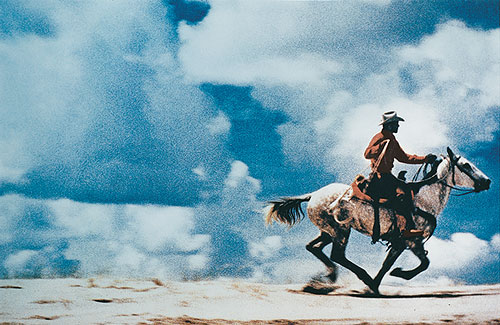
Richard Prince, Untitled (Cowboy), 1989
Is Cheap The New Black? So reads the title of Jörg Colberg’s latest post on how lower photography price points don’t facilitate increased experiential knowledge of the medium. There’s probably an argument to be made for this even if I don’t agree with it—certainly, we tend to treat the cheaper objects we own with greater disregard—but I’m not sure I follow Colberg’s logic.
A while ago, I read an interview with British art duo Gilbert and George, and the issue of pricing came up. I don’t remember the exact conversation, but the interviewer asked them about the fact that the high prices of their art works made them unaffordable for many people. George’s reply: You could always buy a book. I’ve read and/or listened to many of their interviews, and I know he wasn’t trying to be facetious or cynical. I think he has a very valid point (of course, given that a) I love photo books, b) my wall space doesn’t allow the hanging of one of their pieces, and c) I don’t have the spare change for any of their pieces you could argue I have no other choice).
But when one replaces a (n affordable) book for a (n unaffordable) photograph there is no kind of cheating involved. You’re not being cheated out of the experience of having a photo on the wall. Instead, you are being offered a different way to experience the photography – and art is about experiencing, isn’t it? Or at least it should be?
Putting aside my dislike of Gilbert and George (their work is not as accessible as they claim), to my mind, describing a book as an entirely different art experience places an awfully positive spin on the value of reproductions. Sure, as Colberg notes, books save space, but then so do cheap prints. (I’d really like to see a bookshelf-like storage solution for prints. Flatfiles are expensive, and it’s hard to flip through them casually.) Frankly, I’m not sure why in this scenario a book offers a valuable alternative aesthetic experience when you’re shelling out money for both of them. Aren’t “free” aesthetic experiences, such as museum or gallery openings, just as, if not more informative?
Not to flog this dead horse, but we don’t call catalogues “supplemental exhibition material” for nothing. The original experience of the art work is generally more valuable, not merely different. Notably, though Colberg himself subscribes to the belief that one of art’s essential values—its ability to challenge the marketplace—holds such a powerful place in the art world his post only identifies the ways in which we experience photography as commodifiable objects.
Topically, curator Hans Ulrich Obrist outlined a similar position yesterday as summarized by our Associate Editor Karen Archey: “Although the history of art is largely one of objects, we can look to oral or experiential histories to challenge the history of art-as-commodity.” I’d like to believe there’s some truth to this but I can’t help but note a few practical concerns, namely the fact that virtually every form of documentation has been monetized, including oral and experiential histories. After all, Mr. Obrist surely received an honorarium for the oral history he delivered at the Guggenheim yesterday.
Personally, I see this as a reflection of the mechanisms of contemporary life, which are not without their issues. Art, like everything else, operates within the world of capital. Colberg outlines outlines a few ways in which we increasingly experience art and omits others—but none of these occur outside the market.


{ 18 comments }
I believe what Joerg means, although the work of Gilbert and George is not a convincing example, is that photography (more than other visual arts) can translate to a printed page with little degradation. That isn’t to say that a photograph isn’t also an object that has properties specific to itself, but it is a PRINTED object, and although Gursky and others might insist on the legitimacy of such large prints, I doubt they have ever turned down a request for reproduction in a book. I personally enjoy seeing Robert Frank’s prints, but think that if you own The Americans, you own a work of art.
I believe what Joerg means, although the work of Gilbert and George is not a convincing example, is that photography (more than other visual arts) can translate to a printed page with little degradation. That isn’t to say that a photograph isn’t also an object that has properties specific to itself, but it is a PRINTED object, and although Gursky and others might insist on the legitimacy of such large prints, I doubt they have ever turned down a request for reproduction in a book. I personally enjoy seeing Robert Frank’s prints, but think that if you own The Americans, you own a work of art.
Personally, no one seems to think that a 50 dollar photo book is exceedingly cheap, but there’s an average of 40-60 images in any of mine. So, they’re non-darkroom prints, and are a bit more than half the size of my exhibition prints, and come out to less than a dollar each.
People would think that I’m insane if I was selling prints that size for less than a dollar, and I would be, I think, but the book is still my original “work” – that’s the art to me. So it does have a special status, not just viewing the work in a different manner. It’s the actual art object and the sequence is extremely important.
A book, at least any good book, is always a lot more than a collection of cheap prints. So like the comment above, while I’d never even think of buying a Frank print, I love having an old battered copy of his book.
I don’t know. I hardly even care about prints. But I grew up with computers, so maybe I’m used to the art coming to me.
I still like looking at a nice painting though, for some reason.
Personally, no one seems to think that a 50 dollar photo book is exceedingly cheap, but there’s an average of 40-60 images in any of mine. So, they’re non-darkroom prints, and are a bit more than half the size of my exhibition prints, and come out to less than a dollar each.
People would think that I’m insane if I was selling prints that size for less than a dollar, and I would be, I think, but the book is still my original “work” – that’s the art to me. So it does have a special status, not just viewing the work in a different manner. It’s the actual art object and the sequence is extremely important.
A book, at least any good book, is always a lot more than a collection of cheap prints. So like the comment above, while I’d never even think of buying a Frank print, I love having an old battered copy of his book.
I don’t know. I hardly even care about prints. But I grew up with computers, so maybe I’m used to the art coming to me.
I still like looking at a nice painting though, for some reason.
Also about treating cheaper objects with greater disregard – do people really do this?
I have always thought that if I mistreat something it is because it is easily replaceable. That has nothing to do with how much money you paid for it.
We tend to associate it with that, since we routinely pay very little money for say, a toothbrush or a paper cup, but I’m sure a huge amount of people are bargain finders and tag sale treasure hunters. Some of my most prized materiel possessions I only got for a couple bucks. Almost all of my artistic treasures I got for free or trade. My favorite copy of a book is often one I found at the town dump.
I’m sure I’m not the only one who has never equated original purchase value with emotional or aesthetic value.
Also about treating cheaper objects with greater disregard – do people really do this?
I have always thought that if I mistreat something it is because it is easily replaceable. That has nothing to do with how much money you paid for it.
We tend to associate it with that, since we routinely pay very little money for say, a toothbrush or a paper cup, but I’m sure a huge amount of people are bargain finders and tag sale treasure hunters. Some of my most prized materiel possessions I only got for a couple bucks. Almost all of my artistic treasures I got for free or trade. My favorite copy of a book is often one I found at the town dump.
I’m sure I’m not the only one who has never equated original purchase value with emotional or aesthetic value.
It used to be that one of the ways photography was going to be revolutionary was in this ability to endlessly reproduce them, and the object/fetish/commodity aspect of art was going to be unable to deal with that. There were essays written by critics who held to this view disparaging the artificial means to retain the preciousness of photographs (like limiting editions) and of the way certain industries popped up anyway (like the specialist who can determine if artist x really processed this negative…). They were obviously of a Marxist bent, but they had influence for a while.
It used to be that one of the ways photography was going to be revolutionary was in this ability to endlessly reproduce them, and the object/fetish/commodity aspect of art was going to be unable to deal with that. There were essays written by critics who held to this view disparaging the artificial means to retain the preciousness of photographs (like limiting editions) and of the way certain industries popped up anyway (like the specialist who can determine if artist x really processed this negative…). They were obviously of a Marxist bent, but they had influence for a while.
Love this: ““Although the history of art is largely one of objects, we can look to oral or experiential histories to challenge the history of art-as-commodity.†I’d like to believe there’s some truth to this but I can’t help but note a few practical concerns, namely the fact that virtually every form of documentation has been monetized, including oral and experiential histories. After all, Mr. Obrist surely received an honorarium for the oral history he delivered at the Guggenheim yesterday.”
After all, part of the delight of print (or web, or any other secondary source) is the way it democratizes information access for those of us who (a) cannot afford travel to globe to hear oral and experiential histories (or hey, even just plain ol’ see shows) firsthand and (b) can only afford to go to the library rather than the museum.
I’m all for firsthand experience, but only a very few of us have the cash money to make it happen for all art/art histories.
Love this: ““Although the history of art is largely one of objects, we can look to oral or experiential histories to challenge the history of art-as-commodity.†I’d like to believe there’s some truth to this but I can’t help but note a few practical concerns, namely the fact that virtually every form of documentation has been monetized, including oral and experiential histories. After all, Mr. Obrist surely received an honorarium for the oral history he delivered at the Guggenheim yesterday.”
After all, part of the delight of print (or web, or any other secondary source) is the way it democratizes information access for those of us who (a) cannot afford travel to globe to hear oral and experiential histories (or hey, even just plain ol’ see shows) firsthand and (b) can only afford to go to the library rather than the museum.
I’m all for firsthand experience, but only a very few of us have the cash money to make it happen for all art/art histories.
OTOH, there are artists whose photos work better as a book, like Ed Ruscha, who only much later has begun “cashing in” by making exhibitable portfolio editions of some of his classic photo books. [More power to him, I say, but it’s hard not to feel that it’s somehow derivative or 2nd gen. work.]
Then there are the Bechers, whose beautiful, typological books seem far tighter conceptually than any single subset framed prints.
And someone like Kelley Walker, too, who leaves his digital original [sic] photo open and available, even after it enters MoMA’s collection.
OTOH, there are artists whose photos work better as a book, like Ed Ruscha, who only much later has begun “cashing in” by making exhibitable portfolio editions of some of his classic photo books. [More power to him, I say, but it’s hard not to feel that it’s somehow derivative or 2nd gen. work.]
Then there are the Bechers, whose beautiful, typological books seem far tighter conceptually than any single subset framed prints.
And someone like Kelley Walker, too, who leaves his digital original [sic] photo open and available, even after it enters MoMA’s collection.
There are some very smart commentors on this thread.
@Ian Aleksander Adams: “I have always thought that if I mistreat something it is because it is easily replaceable. That has nothing to do with how much money you paid for it.” I think this is a wise correction.
@Reply to Art Fag: I hadn’t read the post as a specific commentary on the photograph as a PRINT, and many photography books, therefore a work of art. The Gilbert and George example threw me on that. As @Greg.org begins, it’s perhaps a more interesting exercise to name examples in which the artist’s photos look better as a book (or the reproduction is more compelling than the original). This is going to require a bit of research, but I think I feel another post coming on…
There are some very smart commentors on this thread.
@Ian Aleksander Adams: “I have always thought that if I mistreat something it is because it is easily replaceable. That has nothing to do with how much money you paid for it.” I think this is a wise correction.
@Reply to Art Fag: I hadn’t read the post as a specific commentary on the photograph as a PRINT, and many photography books, therefore a work of art. The Gilbert and George example threw me on that. As @Greg.org begins, it’s perhaps a more interesting exercise to name examples in which the artist’s photos look better as a book (or the reproduction is more compelling than the original). This is going to require a bit of research, but I think I feel another post coming on…
Its important to be specific in what we are discussing when it comes to books and prints. Historically, most of the great photography projects of the past 150+ years have come to us through books. Reproductions of paintings and sculptures in book form (photographed and reproduced) is a different matter. They are, after all, photographs of object, and therefore interpreted by a photographer before they are set into a book. A photograph that begins as a photograph and is then laid onto a page is a slightly different condition.
Its important to be specific in what we are discussing when it comes to books and prints. Historically, most of the great photography projects of the past 150+ years have come to us through books. Reproductions of paintings and sculptures in book form (photographed and reproduced) is a different matter. They are, after all, photographs of object, and therefore interpreted by a photographer before they are set into a book. A photograph that begins as a photograph and is then laid onto a page is a slightly different condition.
The history of photography and the history of the photobook are completely intertwined. Have the practices of editioning prints and issuing limited print runs for books been a desperate attempt to preserve the ‘aura’ of the art object, which mechanical reproduction may have had a part in degrading (as B would have it)?
The history of photography and the history of the photobook are completely intertwined. Have the practices of editioning prints and issuing limited print runs for books been a desperate attempt to preserve the ‘aura’ of the art object, which mechanical reproduction may have had a part in degrading (as B would have it)?
Comments on this entry are closed.
{ 1 trackback }