
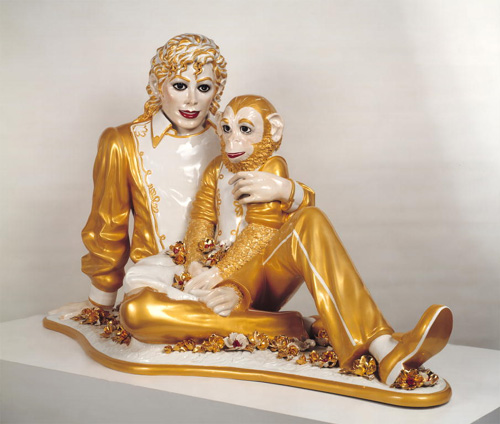
Jeff Koons, Bubbles, 1988. Ceramic. 42 x 70 1/2 x 32 1/2 inches
Joining those whose art ruminations have been prompted by the death of Michael Jackson, this week at The L Magazine I attempt to locate the role of fan production in art. The teaser below.
This March at the SXSW Interactive Media festival, MIT's Comparative Media Studies Co-Director Henry Jenkins restated his much-tweeted maximum, “Web 2.0 is fan culture without the stigma.” According to Jenkins, the Internet is now the primary outlet for culturally-accepted obsessions about one thing or another. The statement proves to be true for most of us — who doesn't identify as a “fan” of something — but it made me wonder: where does fan production show up in the fine art world? I drew a blank.
Prompted in part by Michael Jackson's death and the subsequently renewed interest in artworks using him as subject matter (Jeff Koons' Bubbles [above] and Dana Schutz' The Autopsy of Michael Jackson amongst them), I decided I would try to get to the bottom of it. But in order to locate fan production in the art world, I knew a few working definitions needed to be established. After all, who are fans and why are they important?
According to Ivan Askwith, a senior strategist at the digital marketing company Big Spaceship, the term has evolved from those exhibiting a freakish obsession to simply describing an “engaged audience.” Online marketing companies understand the expanding definition represents a mobilizing force likely to result in cash, so at least from a production and economic stand point, it isn't difficult to establish that fans are a powerful force in contemporary culture.
To read the full piece click here.


{ 12 comments }
Am I a fan of Michael Jackson?
Well, as a 62 year old who followed the artistic career of a cute, young, talented, black American boy, I can say that I am a light-colored fan, but not a ‘groupay.’
To see the amount of junk, tacky sculptures and figurines of M.J. yet to come, do no justice to the man; it just makes money. And, since, Michael had no respect for money, it should not worry anyone that T-shirts were made five minutes after the strange conditions of his death, which may or may not ever be brought to light.
Out of respect, I will keep my memories and listen to Thriller again. As an artist myself, it is nice to know someone will remember the good things of a life of creativity.
Am I a fan of Michael Jackson?
Well, as a 62 year old who followed the artistic career of a cute, young, talented, black American boy, I can say that I am a light-colored fan, but not a ‘groupay.’
To see the amount of junk, tacky sculptures and figurines of M.J. yet to come, do no justice to the man; it just makes money. And, since, Michael had no respect for money, it should not worry anyone that T-shirts were made five minutes after the strange conditions of his death, which may or may not ever be brought to light.
Out of respect, I will keep my memories and listen to Thriller again. As an artist myself, it is nice to know someone will remember the good things of a life of creativity.
i wonder how someone like william powhida fits into this dialogue? his work certainly requires a fan-level engagement/understanding of his subject matter.
i feel that the art context represents an interesting potential for a sort of hyper-fan behavior, as the shift from passive to active participation occurs. in my own work i am drawn to sports as a basic metaphor for this behavior, especially spaces of heightened interaction-collecting/fantasy football/etc.
very pleased to see someone discussing this!
i wonder how someone like william powhida fits into this dialogue? his work certainly requires a fan-level engagement/understanding of his subject matter.
i feel that the art context represents an interesting potential for a sort of hyper-fan behavior, as the shift from passive to active participation occurs. in my own work i am drawn to sports as a basic metaphor for this behavior, especially spaces of heightened interaction-collecting/fantasy football/etc.
very pleased to see someone discussing this!
Good point. Powhida really should have been mentioned. As you point out his fictional character certainly do require a fan-level engagement/understanding of subject matter. Notably, that work has received a mixed reception.
There’s a whole genre of fictional work circulating, but my sense is that someone like Walid Raad or Andrea Fraser doesn’t quite fit into the category of fan production (Andrea Fraser being the closer fit). Powhida it seems, is the closest thing to fan production we have.
Good point. Powhida really should have been mentioned. As you point out his fictional character certainly do require a fan-level engagement/understanding of subject matter. Notably, that work has received a mixed reception.
There’s a whole genre of fictional work circulating, but my sense is that someone like Walid Raad or Andrea Fraser doesn’t quite fit into the category of fan production (Andrea Fraser being the closer fit). Powhida it seems, is the closest thing to fan production we have.
I wonder too if certain types of appropriation art might be understood as ‘fan’ based? Right this second I am thinking of Cory Arcangel or Michael Bell-Smith, where the use and manipulation of pre-existing material is in such a way that the relationship seems to be founded less upon irony, and more upon a desire for a participatory interaction with the subject[which might be one definition of fan-fiction(at least my basic understanding of it)]
I wonder too if certain types of appropriation art might be understood as ‘fan’ based? Right this second I am thinking of Cory Arcangel or Michael Bell-Smith, where the use and manipulation of pre-existing material is in such a way that the relationship seems to be founded less upon irony, and more upon a desire for a participatory interaction with the subject[which might be one definition of fan-fiction(at least my basic understanding of it)]
Who could further comment on this wordy, balooney, pretentious thread? My fan base ends here.
Who could further comment on this wordy, balooney, pretentious thread? My fan base ends here.
@Patrick I thought about that when I was writing the piece. Somehow it seemed inappropriate to label Archangel’s Kurt Cobain suicide letter with google ads a “fan” work though. Perhaps the Simon and Garfunkel performance piece he did closer resembles this. I think there’s too much irony in MBS’s In the Closet piece to consider that fan production, and I think Lonergan’s work appropriates the work of fans, but isn’t the result of the artist’s fandom.
@Patrick I thought about that when I was writing the piece. Somehow it seemed inappropriate to label Archangel’s Kurt Cobain suicide letter with google ads a “fan” work though. Perhaps the Simon and Garfunkel performance piece he did closer resembles this. I think there’s too much irony in MBS’s In the Closet piece to consider that fan production, and I think Lonergan’s work appropriates the work of fans, but isn’t the result of the artist’s fandom.
Comments on this entry are closed.