
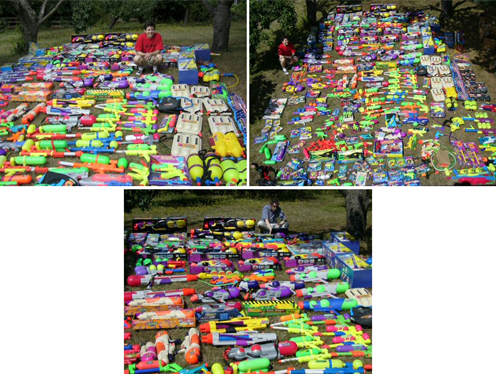
Chris Reid‘s Super Soaker Collection. Via: Guthrie Lonergan
When it rains, it rains. Coinciding with The New York Times‘ tiresome obsession with the perils of professionalism in the art world, Rhizome’s Ed Halter produced a text this April describing the professional, the amateur, and a new category he calls the sub-amateur. The paper is amongst the clearest and most well-researched works I’ve read to date on the subject. A few highlights:
- One can fail to be a professional, but one cannot fail to be an amateur. A simple observation, but one not commonly thought to be described. Part of section 1, which outlines the basic distinctions between professional and amateur.
- The culture of MFA programs: a simultaneous embrace and disavowal of professional status, even as the degree functions specifically to enforce and validate a categorical distinction from the amateur.
(amateur = “too sloppy”, professional = “too perfect” ?)
(amateur = “not careful enough”, professional = “too careful” ?)
(amateur = “not finished enough”, professional = “too finished” ?)While amateurishness and slickness can be recouped as conceptual maneuvers, a distancing and thus partial disavowal of one's own production, this gesture itself might be denounced as “too studied.” From section 2b
And most importantly, Halter’s notes on the sub-amateur category assigned to artists engaged with the Internet.
The price of a snapshot's ease is a loss of control. The world seeps back into the frame like the messy monsters of the unconscious.
Thus, “Robert Frank's terrible Polaroid pictures of his friends are like anyone else's terrible Polaroid pictures”—save, Malcolm argues, for the Duchampian valence that emerges in the gallery context.
As Sontag or Deren defined them, amateurs are lovers of beauty. They invest a certain level of devotion to the technologies they employ—so much that a talented amateur may achieve the same level of technical sophistication as the professional, even if they miss the subtlety of art.
But as the very word reveals, the snapshot is the epitome of photography at its most automatic (its “most purely photographic”—but only in one sense). Snapshots are the result of corporate interest in broadening the market for photography as widely as possible by lowering the learning curve for the successful use of cameras.
But as the very word reveals, the snapshot is the epitome of photography at its most automatic (its “most purely photographic”—but only in one sense). Snapshots are the result of corporate interest in broadening the market for photography as widely as possible by lowering the learning curve for the successful use of cameras.
Similar motivations can be found in film: the devolution from 35mm to 16mm to 8mm to Super-8 to the video camcorder to the webcam is driven by a desire to increase user-friendliness and decrease the need for learning the technology.
The ideal camera would be one that involved no training whatsoever. Lack of formal control is traded for the assurance of image-capturing. This is the greater socio-economic mechanism that produces the default.
This historical process allows for—and encourages—the removal of the amateur's “love” that had always been implicated in the devotion necessary to learn the technology.
The amateur enjoyed spending time with the camera, and thus could become caught up in its formal possibilities; the sub-amateur sees the camera in terms of pure and immediate functionality. Section 3.
We’ll have more comments on this in the future, but in the meantime, read the full piece here.


{ 11 comments }
Halter begins by talking about the “professional vs the amateur” distinction in film, video, and photography and then expands his field of inquiry halfway through, applying that distinction to current web art, which is a rather broader category, encompassing those media but also drawing, web design, “social sculpture” (for want of a better term) and performance. The art part is important–it explains how someone could seem to be an amateur as a form of acting out. The sentence you quote “One can fail to be a professional, but one cannot fail to be an amateur” simply isn’t true anymore. (If you want an example, compare Cory Arcangel’s old website to his current “Flash” one, or for that matter my old blog to my current “Word Press” one, ha ha.) Halter used that sentence in Part 1, where he was talking about the old camera club vs magazine photographer distinction from 40 years ago–I’m pretty sure he offered it as a statement meant to be long outmoded. And I’m not sure how readily his discussion of the breakdown of that distinction applies to particular current web artists, who are not film or video makers or photographers per se. The discussion around Pop art and Pictures Generation art has been fairly nuanced on the various stances and vantage points people take regarding images. “Professional vs amateur” is just one part of that dialog, there are also class issues, gender issues, perceptual psychology issues. The web artists Ed mentions aren’t just heirs to the traditions of Robert Frank and the MOMA photo department but also the problems posed by artists such as Robert Rauschenberg, Elaine Sturtevant, Sherrie Levine, Jeff Koons, Martin Kippenberger, etc. The love of “defaults” is a professional (as in art-schooled trained) stance and doesn’t really need a new definition. When Guthrie presents the supersoaker collection he is the pro and the collector is the amateur. The default is the web page as much as the photos. When Guthrie says “I really like how he [the amateur] presents this collection†that means that its formal qualities and the presentation *do* matter–e.g., the photos of the plastic guns spread out in a grassy field, but also the links to different angles and stages of the array, absurdly mimicking corporate display techniques. Guthrie is “liking” more than just the Excel-like catalog of data that Ed suggests. There are precedents in the art world for arranging collections of found plastic (such as Tony Cragg’s work – http://images.google.com/images?hl=en&q=%22tony+cragg%22&btnG=Search+Images&gbv=2&aq=f&oq= ) and the professional ironist web artist riffs on that history to some extent.
Halter begins by talking about the “professional vs the amateur” distinction in film, video, and photography and then expands his field of inquiry halfway through, applying that distinction to current web art, which is a rather broader category, encompassing those media but also drawing, web design, “social sculpture” (for want of a better term) and performance. The art part is important–it explains how someone could seem to be an amateur as a form of acting out. The sentence you quote “One can fail to be a professional, but one cannot fail to be an amateur” simply isn’t true anymore. (If you want an example, compare Cory Arcangel’s old website to his current “Flash” one, or for that matter my old blog to my current “Word Press” one, ha ha.) Halter used that sentence in Part 1, where he was talking about the old camera club vs magazine photographer distinction from 40 years ago–I’m pretty sure he offered it as a statement meant to be long outmoded. And I’m not sure how readily his discussion of the breakdown of that distinction applies to particular current web artists, who are not film or video makers or photographers per se. The discussion around Pop art and Pictures Generation art has been fairly nuanced on the various stances and vantage points people take regarding images. “Professional vs amateur” is just one part of that dialog, there are also class issues, gender issues, perceptual psychology issues. The web artists Ed mentions aren’t just heirs to the traditions of Robert Frank and the MOMA photo department but also the problems posed by artists such as Robert Rauschenberg, Elaine Sturtevant, Sherrie Levine, Jeff Koons, Martin Kippenberger, etc. The love of “defaults” is a professional (as in art-schooled trained) stance and doesn’t really need a new definition. When Guthrie presents the supersoaker collection he is the pro and the collector is the amateur. The default is the web page as much as the photos. When Guthrie says “I really like how he [the amateur] presents this collection†that means that its formal qualities and the presentation *do* matter–e.g., the photos of the plastic guns spread out in a grassy field, but also the links to different angles and stages of the array, absurdly mimicking corporate display techniques. Guthrie is “liking” more than just the Excel-like catalog of data that Ed suggests. There are precedents in the art world for arranging collections of found plastic (such as Tony Cragg’s work – http://images.google.com/images?hl=en&q=%22tony+cragg%22&btnG=Search+Images&gbv=2&aq=f&oq= ) and the professional ironist web artist riffs on that history to some extent.
Halter begins by talking about the “professional vs the amateur” distinction in film, video, and photography and then expands his field of inquiry halfway through, applying that distinction to current web art, which is a rather broader category, encompassing those media but also drawing, web design, “social sculpture” (for want of a better term) and performance. The art part is important–it explains how someone could seem to be an amateur as a form of acting out. The sentence you quote “One can fail to be a professional, but one cannot fail to be an amateur” simply isn’t true anymore. (If you want an example, compare Cory Arcangel’s old website to his current “Flash” one, or for that matter my old blog to my current “Word Press” one, ha ha.) Halter used that sentence in Part 1, where he was talking about the old camera club vs magazine photographer distinction from 40 years ago–I’m pretty sure he offered it as a statement meant to be long outmoded. And I’m not sure how readily his discussion of the breakdown of that distinction applies to particular current web artists, who are not film or video makers or photographers per se. The discussion around Pop art and Pictures Generation art has been fairly nuanced on the various stances and vantage points people take regarding images. “Professional vs amateur” is just one part of that dialog, there are also class issues, gender issues, perceptual psychology issues. The web artists Ed mentions aren’t just heirs to the traditions of Robert Frank and the MOMA photo department but also the problems posed by artists such as Robert Rauschenberg, Elaine Sturtevant, Sherrie Levine, Jeff Koons, Martin Kippenberger, etc. The love of “defaults” is a professional (as in art-schooled trained) stance and doesn’t really need a new definition. When Guthrie presents the supersoaker collection he is the pro and the collector is the amateur. The default is the web page as much as the photos. When Guthrie says “I really like how he [the amateur] presents this collection†that means that its formal qualities and the presentation *do* matter–e.g., the photos of the plastic guns spread out in a grassy field, but also the links to different angles and stages of the array, absurdly mimicking corporate display techniques. Guthrie is “liking” more than just the Excel-like catalog of data that Ed suggests. There are precedents in the art world for arranging collections of found plastic (such as Tony Cragg’s work – http://images.google.com/images?hl=en&q=%22tony+cragg%22&btnG=Search+Images&gbv=2&aq=f&oq= ) and the professional ironist web artist riffs on that history to some extent.
I’d actually meant to include more of the section you talk about in the quote above. It looks like I made a copy and pasting error.
I have a piece coming out in the L Magazine this coming week that touches on the professional artist vrs the amateur or the fan so I won’t discuss everything to do with that subject. I do think you’re right though about what Lonergan is responding to when he says he likes the presentation.
I’d actually meant to include more of the section you talk about in the quote above. It looks like I made a copy and pasting error.
I have a piece coming out in the L Magazine this coming week that touches on the professional artist vrs the amateur or the fan so I won’t discuss everything to do with that subject. I do think you’re right though about what Lonergan is responding to when he says he likes the presentation.
I look forward to that piece and hope we can discuss this more after it comes out.
I look forward to that piece and hope we can discuss this more after it comes out.
I was thinking similar thoughts to Tom Moody’s while reading the piece, especially as I linked on the works that Halter offers as examples. There is a troublesome distinction for Halter, it seems, between the performers and the artist in Laric’s piece 50/50 (a great piece), for instance, or the photographers in Double Happiness’s series and the ‘aggregator/artist’ compiling the shots.
Thanks for covering this article. For Halter’s aversion to establishing a taxonomy, though, it seems that’s what he’s done. But it remains unclear how the reader is meant to filter his terms. The professional gets paid and the amateur doesn’t; or the professional has proficiencies that the amateur lacks? Those are not exclusive determinations (as many commercial galleries illustrate). And where Halter places value in this system is also a question- if this is a text working to further critique a power structure based on the terms professional and amateur, then the sub-amateur status performs what critical function? If that’s the wrong way to think about it, and sub-amateur is no more than a term meant to describe a contemporary tendency to appropriate the work of amateurs, then much of the professional vs. amateur discourse cited early on might not be necessary to the essay. I think the professional/amateur dichotomy is an historical one in any case, and would have preferred an essay that didn’t accept their meanings as natural.
One last thought- the contention that ease-of-use of equipment is a corporate strategy for boosting sales is a stretch, at least insofar as we’re supposed to understand that as some kind of exploitation. Where one would indict cynical corporations for putting substandard equipment into the hands of the masses, another could laud technological advancement that enables more and more people to document their world. The second position was the one taken by the Soviet Union when the LOMO camera was developed and introduced there.
Looking forward to the L piece.
I was thinking similar thoughts to Tom Moody’s while reading the piece, especially as I linked on the works that Halter offers as examples. There is a troublesome distinction for Halter, it seems, between the performers and the artist in Laric’s piece 50/50 (a great piece), for instance, or the photographers in Double Happiness’s series and the ‘aggregator/artist’ compiling the shots.
Thanks for covering this article. For Halter’s aversion to establishing a taxonomy, though, it seems that’s what he’s done. But it remains unclear how the reader is meant to filter his terms. The professional gets paid and the amateur doesn’t; or the professional has proficiencies that the amateur lacks? Those are not exclusive determinations (as many commercial galleries illustrate). And where Halter places value in this system is also a question- if this is a text working to further critique a power structure based on the terms professional and amateur, then the sub-amateur status performs what critical function? If that’s the wrong way to think about it, and sub-amateur is no more than a term meant to describe a contemporary tendency to appropriate the work of amateurs, then much of the professional vs. amateur discourse cited early on might not be necessary to the essay. I think the professional/amateur dichotomy is an historical one in any case, and would have preferred an essay that didn’t accept their meanings as natural.
One last thought- the contention that ease-of-use of equipment is a corporate strategy for boosting sales is a stretch, at least insofar as we’re supposed to understand that as some kind of exploitation. Where one would indict cynical corporations for putting substandard equipment into the hands of the masses, another could laud technological advancement that enables more and more people to document their world. The second position was the one taken by the Soviet Union when the LOMO camera was developed and introduced there.
Looking forward to the L piece.
There is a tendency in art to write the complete history of this or that intellectual trend followed by abrupt, one- or two-sentence readings of what some of the writer’s current favorite artists are doing, with no final section relating the former to the latter. It’s weight by association for the artists, too much weight if they are themselves self-publishers with a couple of years’ worth of blog posts to their credit. Lonergan isn’t giving the supersoaker guy cachet but the same can’t be said of what Halter is attempting to do with Lonergan.
Halter does go into some depth on Lonergan’s lecture but about Lonergan’s artwork (Internet Group Shot) all he says is it “reveals that the snapshot imposes its own social defaults. The convention of the group shot becomes a non-technological default setting for the snapshot.” I’m sorry to report the group shot existed before the Internet and Guthrie did not reveal it to us. which is that the Internet is as conformist as it is vastInstead he showed us something we already know, which is that the Internet is as conformist as it is vast. He did it in a way that makes us laugh with the sheer repetition of the motif and his “good enough” technical skill. This has nothing to do with Robert Frank’s snapshots of his friends.
There is a tendency in art to write the complete history of this or that intellectual trend followed by abrupt, one- or two-sentence readings of what some of the writer’s current favorite artists are doing, with no final section relating the former to the latter. It’s weight by association for the artists, too much weight if they are themselves self-publishers with a couple of years’ worth of blog posts to their credit. Lonergan isn’t giving the supersoaker guy cachet but the same can’t be said of what Halter is attempting to do with Lonergan.
Halter does go into some depth on Lonergan’s lecture but about Lonergan’s artwork (Internet Group Shot) all he says is it “reveals that the snapshot imposes its own social defaults. The convention of the group shot becomes a non-technological default setting for the snapshot.” I’m sorry to report the group shot existed before the Internet and Guthrie did not reveal it to us. which is that the Internet is as conformist as it is vastInstead he showed us something we already know, which is that the Internet is as conformist as it is vast. He did it in a way that makes us laugh with the sheer repetition of the motif and his “good enough” technical skill. This has nothing to do with Robert Frank’s snapshots of his friends.
Comments on this entry are closed.