

Painter David Hockney displays his iphone art. Image via: The Daily Mail.
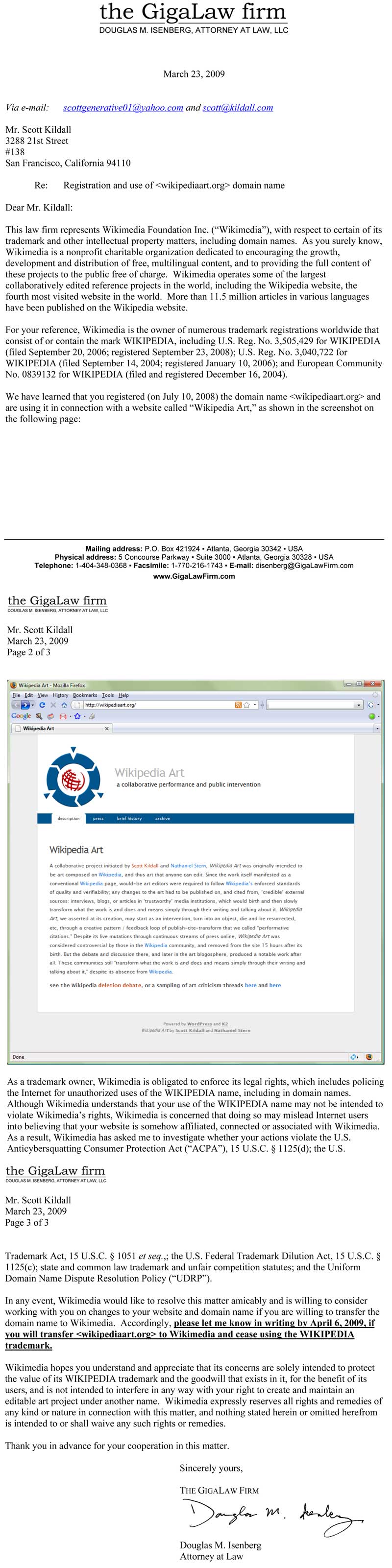
- Wikipedia founder Jimmy Wales describes Wikipediaart, a project by artists Nathaniel Stern and Scott Kidall, as “alleged performance art” run by “trolls” seeking publicity. Two months ago, the artists created an entry under the heading “Wikipediaart” with the hopes that the “art” conversation about the entry would be enough to earn its place on the site. Not surprisingly, Wikipedians didn’t buy the concept and the site was removed after a small amount of debate. The artists migrated all correspondence to their domain Wikipediaart.org, at which point we assumed the story had died. Not so much. Wales hired lawyers who sent the Stern and Kidall a letter requesting the two change their domain name so as not to be confused with Wikipedia. Some debate has occurred as to whether the correspondence was a request or a demand — Wales says no, legal advisers for the artists say it was. Not that it makes any difference, though. Wikipedia’s worries over such a small outfit make no sense, and reads as a possible publicity stunt. We just hope the artists characterize this debate as legal squabbling and not art. Resting the art laurels on a legal dispute gives the initial work a weight it doesn’t deserve.
- In other grating news, The Daily Mail reports famed artist David Hockney creates digital paintings on his iPhone and He also sells prints created on his computer in limited editions. If there were any interest in this project past the fact people are actually willing to pay for it, lifestyle, the display of Hockney’s iPhone on an easel certainly destroys it. Surely the artist doesn’t use the easel to make the work and the iPhone is not equivalent to a stretcher– its frame is invisible– so why display it as such? The iPhone as medium is a gimmick that needs to die a quick death.
- On a related note, conversation in the AFC HQ about this story prompted the observation that limited edition work seems to have greater importance in the art world than it has previously. Despite the ease of digital production, the exclusivity of the object remains desirable to collectors. To cite a parallel example in the music world– nobody’s buying CD’s but we seem to like records still. The sound is different, yes, but certainly their rarity makes them appealing. Notably, earlier this year I wondered whether digital reproduction would force change upon the art world model of scarcity. Today that conclusion seems absurd.
- Stacey Williams-Ng uses her friends’ Facebook updates in her paintings — mashable.com reports the story. Bad art is not bettered by a topical status update.
- As it happens, I will speak on a panel organized by Sharon Butler in New Haven next Thursday about social networking in art with Matt Held (I'll Have my Facebook Portrait Painted by Matt Held), Sharon Kleinman (author of Displacing Place) and An Xiao ( http://thatwaszen.blogspot.com ). I intend to discuss the pivotal role Eyebeam played in the development of the net art community circa 2001 – 2006 and the consequences of losing some of those artists to the commercial Fine Art and Internet world. I realize this is a contentious statement to make, but with only a few exceptions, I don’t see a lot of good social networking art being made. What’s more, there is an unwillingness amongst many net artists — the leaders of all things Internet — to engage newer technologies. Innovation exists within surf clubs, but I’m not seeing the same engagement in Twitter or Facebook. I suspect part of this comes from a resistance to certain branding; privileging Twitter over del.icio.us for example is a little like choosing to wear Nike over Converse for the average net artist. Personally, I find these concerns a great distraction from art making.
- And on that note, I leave you with the Opportunist guide to art, a small blurb courtesy of New York Magazine telling readers art isn’t a “cool t-bond”. Apparently, art is always a luxury and only affordable if you happen to be sitting on a little money. I can think of a few people likely to disagree with that sentiment.


{ 54 comments }
Your comment,”The iPhone as medium is a gimmick that needs to die a quick death.”, discounts the work being done by serious artists around the world using the iPhone as their toolkit of choice. Check out the work of Xoan Baltar or José Andrés Guijarro Ponce, and then show me what YOU got!
Your comment,”The iPhone as medium is a gimmick that needs to die a quick death.”, discounts the work being done by serious artists around the world using the iPhone as their toolkit of choice. Check out the work of Xoan Baltar or José Andrés Guijarro Ponce, and then show me what YOU got!
“The iPhone as medium is a gimmick that needs to die a quick death.”
And all that cutting edge .gif art you’ve linked to in the past?
“The iPhone as medium is a gimmick that needs to die a quick death.”
And all that cutting edge .gif art you’ve linked to in the past?
@jeff Are you saying .gifs are simply trendy? I think there’s some merit to that comment though I wouldn’t apply it quite so evenhandedly.
@jeff Are you saying .gifs are simply trendy? I think there’s some merit to that comment though I wouldn’t apply it quite so evenhandedly.
@jeff Are you saying .gifs are simply trendy? I think there’s some merit to that comment though I wouldn’t apply it quite so evenhandedly.
Any chance Jimmy Wales is trying to help Wikipediaart gain enough notability to gain entry into the encyclopedia? Surely a lawsuit would help Stern & Kidall’s cause.
Any chance Jimmy Wales is trying to help Wikipediaart gain enough notability to gain entry into the encyclopedia? Surely a lawsuit would help Stern & Kidall’s cause.
Dont forget [dNASAb’s] Ipod sculpture
http://www.tc43.com/2006/MAINandtoolbarFRAMESET.htm
Dont forget [dNASAb’s] Ipod sculpture
http://www.tc43.com/2006/MAINandtoolbarFRAMESET.htm
Dont forget [dNASAb’s] Ipod sculpture
http://www.tc43.com/2006/MAINandtoolbarFRAMESET.htm
GIFs aren’t trendy, they are the volkswagens of online production.
The picture of the iPhone on the easel is dumb–it’s like something a public relations person would dream up. Is anyone disputing that?
Art made on a phone is fine as long as we don’t have to own the phone or mention the brand.
The makers of the Wikipedia-as-art page were doubtless delighted with the revived attention after everyone had stopped talking about their project.
GIFs aren’t trendy, they are the volkswagens of online production.
The picture of the iPhone on the easel is dumb–it’s like something a public relations person would dream up. Is anyone disputing that?
Art made on a phone is fine as long as we don’t have to own the phone or mention the brand.
The makers of the Wikipedia-as-art page were doubtless delighted with the revived attention after everyone had stopped talking about their project.
And volkswagens undeniably have a charm to them. GIFs are popular within a specific group of art makers, and certain Internet nerds. That doesn’t necessarily make them trendy, but I also wouldn’t characterize them as “uncool”.
And volkswagens undeniably have a charm to them. GIFs are popular within a specific group of art makers, and certain Internet nerds. That doesn’t necessarily make them trendy, but I also wouldn’t characterize them as “uncool”.
And volkswagens undeniably have a charm to them. GIFs are popular within a specific group of art makers, and certain Internet nerds. That doesn’t necessarily make them trendy, but I also wouldn’t characterize them as “uncool”.
Ah, Jeff was just baiting you–he obviously doesn’t like the GIF art you post and thought he could tie it to your dismissal of the iPhone-as-medium.
No one said anything about either being “cool”–though that is precisely how Apple is marketing its products.
Ah, Jeff was just baiting you–he obviously doesn’t like the GIF art you post and thought he could tie it to your dismissal of the iPhone-as-medium.
No one said anything about either being “cool”–though that is precisely how Apple is marketing its products.
Ah, Jeff was just baiting you–he obviously doesn’t like the GIF art you post and thought he could tie it to your dismissal of the iPhone-as-medium.
No one said anything about either being “cool”–though that is precisely how Apple is marketing its products.
An iPhone on an easel is simply stupid, but an elderly, and seemingly pleased, David Hockney pointing at his iPhone, on an easel, is transcendently stupid, so I am required to love it.
An iPhone on an easel is simply stupid, but an elderly, and seemingly pleased, David Hockney pointing at his iPhone, on an easel, is transcendently stupid, so I am required to love it.
An iPhone on an easel is simply stupid, but an elderly, and seemingly pleased, David Hockney pointing at his iPhone, on an easel, is transcendently stupid, so I am required to love it.
LOL at Jimmy Wales labeled as “founder” of Wikipedia. C’mon, guys, don’t you know that’s a big lie?
http://blog.citizendium.org/2009/04/08/an-open-letter-to-jimmy-wales-copy/
LOL at Jimmy Wales labeled as “founder” of Wikipedia. C’mon, guys, don’t you know that’s a big lie?
http://blog.citizendium.org/2009/04/08/an-open-letter-to-jimmy-wales-copy/
social media takin over my braaaaaaaaaain
social media takin over my braaaaaaaaaain
social media takin over my braaaaaaaaaain
I really like the design of the citizendium blog!!
As for the easeled iPhone, I wish Hockney luck bringing his collectors into the 21st Century. “These prints are nice but we’d like to see some of David’s older, handmade work.”
I really like the design of the citizendium blog!!
As for the easeled iPhone, I wish Hockney luck bringing his collectors into the 21st Century. “These prints are nice but we’d like to see some of David’s older, handmade work.”
I really like the design of the citizendium blog!!
As for the easeled iPhone, I wish Hockney luck bringing his collectors into the 21st Century. “These prints are nice but we’d like to see some of David’s older, handmade work.”
I had thought one of the major accomplishments of the Rhizome crew was to argue that it’s not the media, and there’s certainly no hierarchy of media, but what an artist does with any media they choose to pick up, no?
I had thought one of the major accomplishments of the Rhizome crew was to argue that it’s not the media, and there’s certainly no hierarchy of media, but what an artist does with any media they choose to pick up, no?
Hi, Ed,
We’re not talking about a medium here (as in “low res imaging software”), we’re talking about a phone. A very specific phone, heavily marketed as a must-own lifestyle accessory. And Hockney’s role in making that hardware seem more “creative.”
Hi, Ed,
We’re not talking about a medium here (as in “low res imaging software”), we’re talking about a phone. A very specific phone, heavily marketed as a must-own lifestyle accessory. And Hockney’s role in making that hardware seem more “creative.”
I wasn’t baiting and I have no problem with .gif art I just think that it (like everything else) can be as schlocky as “iPhone” art and felt the post was being dismissive of a technology/medium that was obviously more personal than historic. nnMy .gif example was just to illustrate that it too is tied to a whole host of pretty ubiquitous consumer products e.g. the personal computer, the world wide web, etc. Isn’t this just a rehash of outdated ideas regarding the merits of “high/low” art?
I wasn’t baiting and I have no problem with .gif art I just think that it (like everything else) can be as schlocky as “iPhone” art and felt the post was being dismissive of a technology/medium that was obviously more personal than historic. \n\nMy .gif example was just to illustrate that it too is tied to a whole host of pretty ubiquitous consumer products e.g. the personal computer, the world wide web, etc. Isn’t this just a rehash of outdated ideas regarding the merits of “high/low” art?
You’re saying Johnson has a personal beef against the iPhone?
You’re saying Johnson has a personal beef against the iPhone?
i love and agree with your statement L.M.! really well put!
i love and agree with your statement L.M.! really well put!
i love and agree with your statement L.M.! really well put!
I think it’s worth considering the larger context of Hockney’s practice when evaluating his use of the iPhone. I found his recent show at L.A. Louver (a gallery I normally avoid), which included digitally made prints, interesting for a related reason.
Hockney’s interests, at their simplest, tend to involve traditional things, seeing, portraiture, landscape. In his statement for the Louver show, he says “These prints are made by drawing and collage, they exist either in the computer or on a piece of paper, they were made for printing, and so will be printed. They are not photographic reproductions.” He talks about draftsmen, tools and picture making. It’s true that the framing of the Daily Mail article is cheesy, but that isn’t really Hockney’s fault. Even when prompted along art-meets-technology lines, he’s mostly interested in sending his friends paintings spontaneously. For him, it really is just a tool.
He’s generally a pretty straightforward guy, and I think his acceptance of these media points to the problem with technology-themed art in general: the use of a particular technology in an artwork is unlikely to ever as “cutting-edge” or even as exciting as the technology itself was whenever it was launched (or, in the case of retro-technology-nostalgia, like the .gifs, to ever appeal to more than a narrow set of internet types). If Hockney was hoping that iPhone art would make him more relevant, he’s stuck, inherently less fresh than the phone itself. But I don’t get that impression from him. I think, even more than Claire Fontaine’s self-conscious iPhone hack video, he has managed to incorporate the iPhone into his practice without making it about the technology and how contemporary it is. Again, the article does all the things we want Hockney not to do. But that’s not really his fault.
And really, does anyone actually paint using a stretcher that small?
Thanks for putting your finger on this story. This is an ongoing subject of interest for me and I am glad to hear your thoughts.
I think it’s worth considering the larger context of Hockney’s practice when evaluating his use of the iPhone. I found his recent show at L.A. Louver (a gallery I normally avoid), which included digitally made prints, interesting for a related reason.
Hockney’s interests, at their simplest, tend to involve traditional things, seeing, portraiture, landscape. In his statement for the Louver show, he says “These prints are made by drawing and collage, they exist either in the computer or on a piece of paper, they were made for printing, and so will be printed. They are not photographic reproductions.” He talks about draftsmen, tools and picture making. It’s true that the framing of the Daily Mail article is cheesy, but that isn’t really Hockney’s fault. Even when prompted along art-meets-technology lines, he’s mostly interested in sending his friends paintings spontaneously. For him, it really is just a tool.
He’s generally a pretty straightforward guy, and I think his acceptance of these media points to the problem with technology-themed art in general: the use of a particular technology in an artwork is unlikely to ever as “cutting-edge” or even as exciting as the technology itself was whenever it was launched (or, in the case of retro-technology-nostalgia, like the .gifs, to ever appeal to more than a narrow set of internet types). If Hockney was hoping that iPhone art would make him more relevant, he’s stuck, inherently less fresh than the phone itself. But I don’t get that impression from him. I think, even more than Claire Fontaine’s self-conscious iPhone hack video, he has managed to incorporate the iPhone into his practice without making it about the technology and how contemporary it is. Again, the article does all the things we want Hockney not to do. But that’s not really his fault.
And really, does anyone actually paint using a stretcher that small?
Thanks for putting your finger on this story. This is an ongoing subject of interest for me and I am glad to hear your thoughts.
I think it’s worth considering the larger context of Hockney’s practice when evaluating his use of the iPhone. I found his recent show at L.A. Louver (a gallery I normally avoid), which included digitally made prints, interesting for a related reason.
Hockney’s interests, at their simplest, tend to involve traditional things, seeing, portraiture, landscape. In his statement for the Louver show, he says “These prints are made by drawing and collage, they exist either in the computer or on a piece of paper, they were made for printing, and so will be printed. They are not photographic reproductions.” He talks about draftsmen, tools and picture making. It’s true that the framing of the Daily Mail article is cheesy, but that isn’t really Hockney’s fault. Even when prompted along art-meets-technology lines, he’s mostly interested in sending his friends paintings spontaneously. For him, it really is just a tool.
He’s generally a pretty straightforward guy, and I think his acceptance of these media points to the problem with technology-themed art in general: the use of a particular technology in an artwork is unlikely to ever as “cutting-edge” or even as exciting as the technology itself was whenever it was launched (or, in the case of retro-technology-nostalgia, like the .gifs, to ever appeal to more than a narrow set of internet types). If Hockney was hoping that iPhone art would make him more relevant, he’s stuck, inherently less fresh than the phone itself. But I don’t get that impression from him. I think, even more than Claire Fontaine’s self-conscious iPhone hack video, he has managed to incorporate the iPhone into his practice without making it about the technology and how contemporary it is. Again, the article does all the things we want Hockney not to do. But that’s not really his fault.
And really, does anyone actually paint using a stretcher that small?
Thanks for putting your finger on this story. This is an ongoing subject of interest for me and I am glad to hear your thoughts.
As a note to Forrest’s comment the original post described the sale of the iphone prints. I originally misread the line in the article that explains that he doesn’t see the iphone prints, but makes prints on the computer that he does sell.
As a note to Forrest’s comment the original post described the sale of the iphone prints. I originally misread the line in the article that explains that he doesn’t see the iphone prints, but makes prints on the computer that he does sell.
“…he has managed to incorporate the iPhone into his practice without making it about the technology and how contemporary it is.”nnPlease, he is holding an iPhone and pointing to it. Bully for him for “managing” to use digital tools in his art, he’s only about 20 years behind everyone else.
“…he has managed to incorporate the iPhone into his practice without making it about the technology and how contemporary it is.”nnPlease, he is holding an iPhone and pointing to it. Bully for him for “managing” to use digital tools in his art, he’s only about 20 years behind everyone else.
“…he has managed to incorporate the iPhone into his practice without making it about the technology and how contemporary it is.”\n\nPlease, he is holding an iPhone and pointing to it. Bully for him for “managing” to use digital tools in his art, he’s only about 20 years behind everyone else.
I don’t know about you guys, but I think the iPhone with its little easel is fucking hilarious and I think the world is a better place for it having existed.
I don’t know about you guys, but I think the iPhone with its little easel is fucking hilarious and I think the world is a better place for it having existed.
I don’t know about you guys, but I think the iPhone with its little easel is fucking hilarious and I think the world is a better place for it having existed.
I don’t know about you guys, but I think the iPhone with its little easel is fucking hilarious and I think the world is a better place for it having existed.
Comments on this entry are closed.