

[Editors note: IMG MGMT is an artist essay series highlighting the diversity of curatorial processes within the art making practice. Today’s invited artist, Penelope Umbrico, works with LMAK Projects and maintains the website penelopeumbrico.net.]
Wandering through images of rooms on consumer home-improvement websites it’s impossible to not to notice fresh signs of someone’s presence. Since there are rarely any people in any of the rooms, the viewer (consumer) becomes the subject, invited to move through the space and vicariously try on the idealized life-styles of the virtual home’s absent occupants.
My interest in these spaces began after 9/11 in response to news that, along with art-and-crafts, the retail market for home-improvement had sharply risen (while all other markets had fallen). I wanted to understand what the impulse was to “cocoon” (as it was called) and see how this was played out in visual consumer media. My initial thought was that it had to do with an implied control of the mess of personal space though organization and self-reliance, but I found details in these images that pointed elsewhere.
The most common visual tropes I found there depicted books, which on first glance seemed to act as a symbol for knowledge, history, meaning, all things deep and thoughtful. But on closer study the use of books on these sites seems perversely inverted; they are used solely as props, retaining only a vestige of their former life as objects containing content.
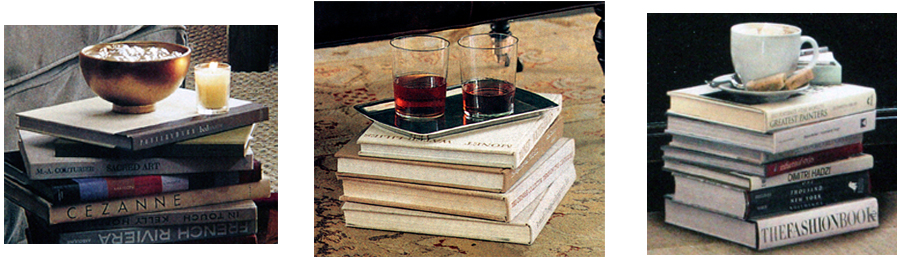
Stacks of art and photography books were everywhere, almost all used as pedestals for evening cocktails and white wine…

27 of approximately 600 collected images of instances of books as pedestals from home-décor and home-improvement websites and mail-order catalogs.
…and there were many books were left open, face up, as though the reader was urgently called away, soon to return; was it a phone call, a neighbor, a whistling kettle?
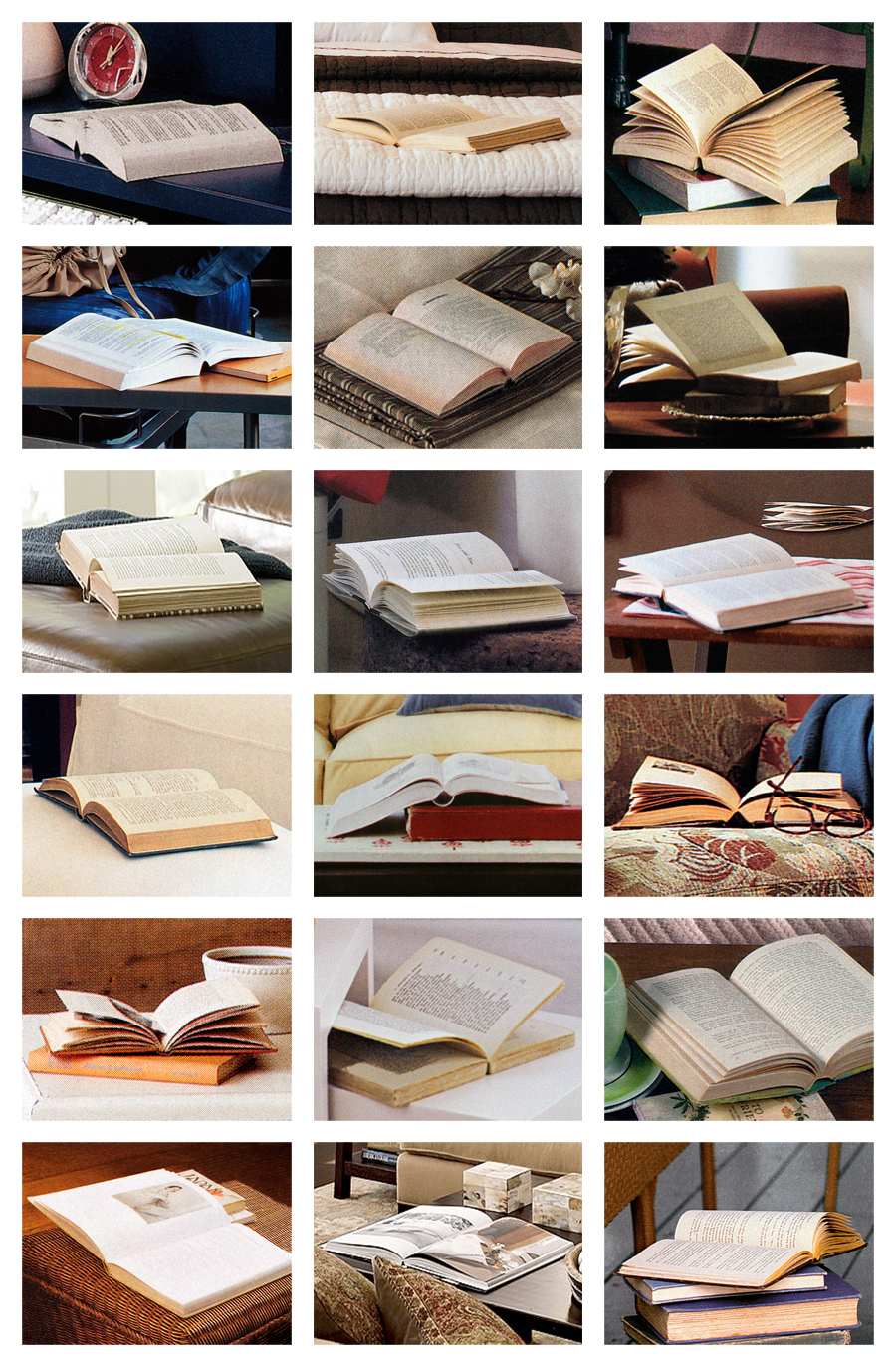
18 of approximately 500 collected images of instances of books being read from home-décor and home-improvement websites and mail-order catalogs.
At every turn, there was a new story. The pages fluttering there so invitingly, almost readable, incite a voyeuristic curiosity about what is being read. This, mixed with the open and exposed book waiting for scrutinizing eyes, verges on the erotic.1 Oddly, there were a number of books with various objects in their gutter”¦
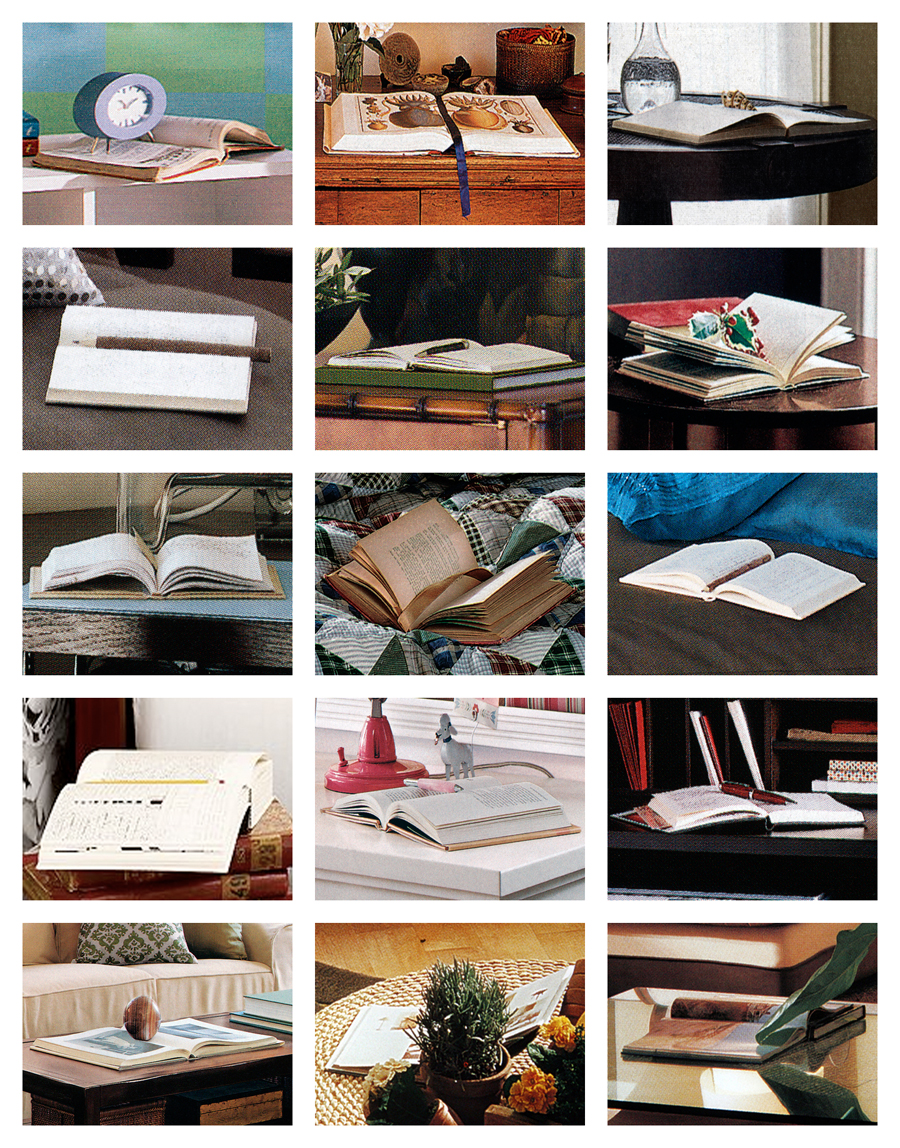
15 of approximately 500 collected images instances of books being read from home-décor and home-improvement websites and mail-order catalogs.
These books are meant to seduce the viewer, though clearly not by way of their content (that information is unreadable). Is it the promise of knowledge just beyond one’s grasp that makes these books compelling, or the suggestion of intimacy with a subject/reader nowhere to be seen?
As if to point to this promise of access and intimacy just beyond one’s grasp, bookshelves on these sites abound with backward-facing books.
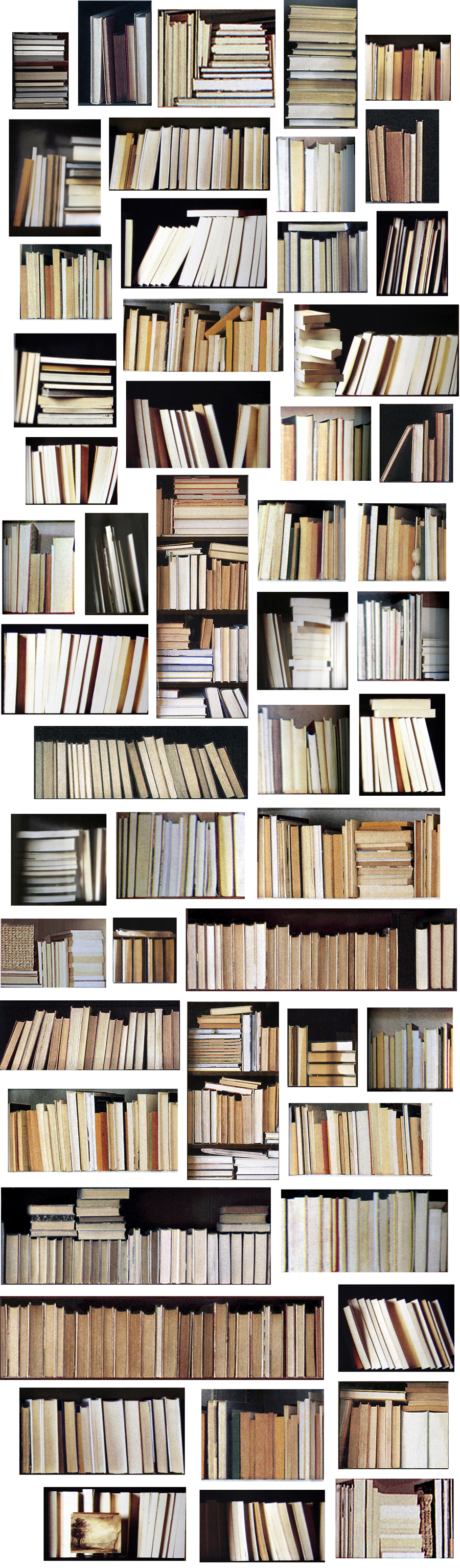
“All the Embarrassing Books” – details of bookcases collected from home-décor and home-improvement websites and mail-order catalogs.
Only someone who is deeply embarrassed by the content of books would turn them around this way — or, perhaps, these books have turned themselves around because they are embarrassing by their owners.
In this never-ending variety of perfectly appointed, vapidly flawless rooms, this refusal of content actually makes sense. In the ultimate subservience to the decorative, these books have become nutrition-less, emptied of purpose and content, and erased of meaning. It’s a sedated empty exchange, that produces a valueless object from the apparition of an object of value.These books are comparable to the identity exchange of the viewing subject in these spaces. The shift in the viewer from consumer to vicarious subject, produces the peculiar condition of empathetic identification with the absent occupant – an “other” who does not exist – and who, like the books, has no content, no mess, no history, no emotional fluctuation.
- In his novel about phone sex, Vox, Nicholson Baker makes reference to a book held open by a “book mate”: “There’s nothing the book can do, it’s powerless — it’s strapped wide open — for all hungry eyes of the world to admire.” p 67- 68 (New York: Vintage Contemporary, 1993 [↩]


{ 30 comments }
Umbrico skewers the icons of our very empty consumer ism. We are encouraged to want what is attractive, not what is useful, necessary or meaningful.And we buy the message. No wonder our country’s in such a mess.
Umbrico skewers the icons of our very empty consumer ism. We are encouraged to want what is attractive, not what is useful, necessary or meaningful.And we buy the message. No wonder our country’s in such a mess.
Umbrico skewers the icons of our very empty consumer ism. We are encouraged to want what is attractive, not what is useful, necessary or meaningful.And we buy the message. No wonder our country’s in such a mess.
This is a very interesting piece! I have always noticed the book open with the pen on it, as to show someone who is “important” and and the middle of a job, in their study or den, etc. This collection is interesting and thought provoking, especially the books turned backwards.
I always look closely at the titles of books in shelves in advertising and home pics. Usually they have no title at all, but in this case, the cover is not even seen…I will look for this more often in the future…thanks for sending this!
Joe
This is a very interesting piece! I have always noticed the book open with the pen on it, as to show someone who is “important” and and the middle of a job, in their study or den, etc. This collection is interesting and thought provoking, especially the books turned backwards.
I always look closely at the titles of books in shelves in advertising and home pics. Usually they have no title at all, but in this case, the cover is not even seen…I will look for this more often in the future…thanks for sending this!
Joe
This is a very interesting piece! I have always noticed the book open with the pen on it, as to show someone who is “important” and and the middle of a job, in their study or den, etc. This collection is interesting and thought provoking, especially the books turned backwards.
I always look closely at the titles of books in shelves in advertising and home pics. Usually they have no title at all, but in this case, the cover is not even seen…I will look for this more often in the future…thanks for sending this!
Joe
I’m deeply unpersuaded. For one thing, this thesis takes as its starting point the background work of catalog art directors. Their job is to sell the stuff in the catalog, a perfectly honorable way to make a living–but not necessarily a livelihood given to a lot of self-reflection.
And hey guess what! I like books too, and my art books have a decorative place in my living room, when they’re not in the studio. And they’re in the living room roughly 98% percent of the time. Doing nothing, save symbolizing some story I want to believe about myself. Again, a perfectly honorable pursuit.
I’m deeply unpersuaded. For one thing, this thesis takes as its starting point the background work of catalog art directors. Their job is to sell the stuff in the catalog, a perfectly honorable way to make a living–but not necessarily a livelihood given to a lot of self-reflection.
And hey guess what! I like books too, and my art books have a decorative place in my living room, when they’re not in the studio. And they’re in the living room roughly 98% percent of the time. Doing nothing, save symbolizing some story I want to believe about myself. Again, a perfectly honorable pursuit.
BRILLIANT/AMAZING/PERFECT. REPOSTED.
BRILLIANT/AMAZING/PERFECT. REPOSTED.
BRILLIANT/AMAZING/PERFECT. REPOSTED.
great, i’ll bookmark this.
great, i’ll bookmark this.
great, i’ll bookmark this.
Terrific essay by Penelope Umbrico.It is making me second guess my own collecting habits and how they’re displayed in my own space. I will share this essay it has wit too.
Terrific essay by Penelope Umbrico.It is making me second guess my own collecting habits and how they’re displayed in my own space. I will share this essay it has wit too.
dry semi idiotics——- the turned around books are because of possible copyright issues. Studying dust too closely makes you sneeze out absurdities!
dry semi idiotics——- the turned around books are because of possible copyright issues. Studying dust too closely makes you sneeze out absurdities!
Penelope,
This looks great. Congratulations
Randy
Penelope,
This looks great. Congratulations
Randy
Rudy Riddlestein: Do you know for a fact turning books around on shelves is about possible copyright issues, because I’m fairly certain that’s not an issue. After all, why on earth is an author going to complain about free advertising for their book? There’s an explanation about the parallel practice of blurring out license plates in Mazda car commercials on Metafilter somewhere from one of their companies reps. He said the rationale had nothing to do with copyright issues, but rather the desire to keep extraneous information from distracting a viewer from the object. When Penelope talks of “knowledge just beyond one’s grasp”, she’s not merely putting forth an abstract concept, but referencing the very strategies you claim call the essay into question.
Rudy Riddlestein: Do you know for a fact turning books around on shelves is about possible copyright issues, because I’m fairly certain that’s not an issue. After all, why on earth is an author going to complain about free advertising for their book? There’s an explanation about the parallel practice of blurring out license plates in Mazda car commercials on Metafilter somewhere from one of their companies reps. He said the rationale had nothing to do with copyright issues, but rather the desire to keep extraneous information from distracting a viewer from the object. When Penelope talks of “knowledge just beyond one’s grasp”, she’s not merely putting forth an abstract concept, but referencing the very strategies you claim call the essay into question.
My focus here is PBTeen. PBTeen sells life style both to the purchasing parent and consuming teen. Their stillborn set designs I think go differently than Umbrico’s kinda Baudrillardian model, a model more like period room mentality. More than the implied passive props, the books are markers that each browser will recognize and identity w/ the content. Connectivity. In lieu of cat hair, hair brushes, dust, the book w/ pen in gutter go a little further than props for an absent presence and imply habitation, albeit in a rhetorical way. So, the viewer becomes more like a hunter/gatherer looking thru Someone’s room, not just a set. Again, connectivity, cool people live like this. Like Cezanne’s shifting perspectives, each catalog set (these are not real rooms in a real house) proposes a content enabler for an imagined perusal, for girls it’s Women Who Win to Blonde Ambition on to Surf Diva, surfing and going green being two fav girl things. Boys r oceanographers living in loft settings to Death metal loving X Gamers w/ NIN marked black boards for walls. So the books and mags r not contentless, they r there to connect, 2b read, like the iPod laying around, the person’s song list being unavailable. However, Umbrico is right, they do not want u to dwell on this, it blurs the products, and PBTeen has often used, in girl’s living spaces of course, generic ‘books’ covered in pastel covers, to just show usage of the furniture. I have one PBTeen that actually has the covers printed backwards, either due a mistake or the scene looked better reversed. Little problems remain like the ‘read’ books next to a bed that obviously has not been laid on, or the clock on the night stand turned to greet the viewer, but which couldn’t be seen by a person whose head was at the headboard.
Books gender. No doubt these r simulacra for exchange and fit the reality-is-a-construct kind of argument, but if u wanted fodder for the gender is a social construct thesis, PBTeen offers a lot. Books serve as topical markers for career path, well educated, female consumers, while tints of pink, blue and lemony green paint a loud ‘Girl Country’. Boys get deeper shades of gray and blue, serious, almost moody. Drug titles r forbidden like bongs. As a teen u will know what u should be reading depending on your gender. And, PBTeen polices the borders on sexuality, Household is between a man and a woman, Heterosexuality rules. What the books never suggest is LGBT or how to be in drag and still nail the interview. I’m guessing the books r vacuous , as mentioned above, to a certain degree, but they also serve to reinstate heterogemeny.
Race and Class: Again the books serve both functions as it is clear who would read these sign posts and, thus, who can afford the affluent abundance of ersatz culture. Privileging has its members. White well funded or credit stretched middle class who r heterosexual. However, my fav on class sex race is LLBean. The only blacks r Denzel and Mrs. Denzel clones, w/ no Asians and Hispanics to be seen, unless Cal. versions cater differently. And, no LLBian of any sort.
My focus here is PBTeen. PBTeen sells life style both to the purchasing parent and consuming teen. Their stillborn set designs I think go differently than Umbrico’s kinda Baudrillardian model, a model more like period room mentality. More than the implied passive props, the books are markers that each browser will recognize and identity w/ the content. Connectivity. In lieu of cat hair, hair brushes, dust, the book w/ pen in gutter go a little further than props for an absent presence and imply habitation, albeit in a rhetorical way. So, the viewer becomes more like a hunter/gatherer looking thru Someone’s room, not just a set. Again, connectivity, cool people live like this. Like Cezanne’s shifting perspectives, each catalog set (these are not real rooms in a real house) proposes a content enabler for an imagined perusal, for girls it’s Women Who Win to Blonde Ambition on to Surf Diva, surfing and going green being two fav girl things. Boys r oceanographers living in loft settings to Death metal loving X Gamers w/ NIN marked black boards for walls. So the books and mags r not contentless, they r there to connect, 2b read, like the iPod laying around, the person’s song list being unavailable. However, Umbrico is right, they do not want u to dwell on this, it blurs the products, and PBTeen has often used, in girl’s living spaces of course, generic ‘books’ covered in pastel covers, to just show usage of the furniture. I have one PBTeen that actually has the covers printed backwards, either due a mistake or the scene looked better reversed. Little problems remain like the ‘read’ books next to a bed that obviously has not been laid on, or the clock on the night stand turned to greet the viewer, but which couldn’t be seen by a person whose head was at the headboard.
Books gender. No doubt these r simulacra for exchange and fit the reality-is-a-construct kind of argument, but if u wanted fodder for the gender is a social construct thesis, PBTeen offers a lot. Books serve as topical markers for career path, well educated, female consumers, while tints of pink, blue and lemony green paint a loud ‘Girl Country’. Boys get deeper shades of gray and blue, serious, almost moody. Drug titles r forbidden like bongs. As a teen u will know what u should be reading depending on your gender. And, PBTeen polices the borders on sexuality, Household is between a man and a woman, Heterosexuality rules. What the books never suggest is LGBT or how to be in drag and still nail the interview. I’m guessing the books r vacuous , as mentioned above, to a certain degree, but they also serve to reinstate heterogemeny.
Race and Class: Again the books serve both functions as it is clear who would read these sign posts and, thus, who can afford the affluent abundance of ersatz culture. Privileging has its members. White well funded or credit stretched middle class who r heterosexual. However, my fav on class sex race is LLBean. The only blacks r Denzel and Mrs. Denzel clones, w/ no Asians and Hispanics to be seen, unless Cal. versions cater differently. And, no LLBian of any sort.
It’s very interesting to think about the kinds of meanings created from the ways in which these objects (books) are treated – and the shared visual language in the catalogs.. reminds me of family photo albums with the understood visual cues that signify some sense of well being.
And also the ways in which we think about books, as ideas, objects -even more so today in the age of information. Looking at these images, I experience the same kind of feeling when looking at images of ruins. Desire, nostalgia, passage of time, utopic idealism. Interesting that a book
can have a similar impact.
It’s very interesting to think about the kinds of meanings created from the ways in which these objects (books) are treated – and the shared visual language in the catalogs.. reminds me of family photo albums with the understood visual cues that signify some sense of well being.
And also the ways in which we think about books, as ideas, objects -even more so today in the age of information. Looking at these images, I experience the same kind of feeling when looking at images of ruins. Desire, nostalgia, passage of time, utopic idealism. Interesting that a book
can have a similar impact.
Penelope,
Works of art are occasions not for exegesis but for remebering. So: just a few weeks ago I was in pretty tough shape, and after only a moment of hasty consideration, I decided to sell a bunch of my books. No weeping and moaning here about how these were the vessels of my empty dreams, the repositories of my fondest memories, etc. I have a house that groans under the weight. Suddenly, the things I thought I would never sell, the test patterns of my consciousness, were liquid assets. That conversation with Gaddis, after which he signed my copy of JR “with increasing admiration”? Into the pile with first editions of Naked Lunch and The Crying of Lot 49., Forget about the so-called art books, which I had been dispensing to various dealers over the years like a squirrel distributing a too large hord of acorns. Nothing like a little poverty to overcome your commodity fetishism. (By the way, I got major street cred with the buyers at the Strand — like Matthew Marks returning your call right away.)
But a coupole of things were going on that weren’t so nice. The first was the recurring dreadful experience of categorical ambiguties that has plagued every collector for millennia. Where does this book belong? Is it one of the things desired by the Emperor or a history of an inconsequential happening or spomething designed as a perfect square? Is it a volume in the Blue Jade Library, that collection of racist and vaguely antiquarian texts reprinted by Alfred A Knopf in the 1920s, just at the time when they were publishing Spengler’s Decline of the West? Or is it just plain French — NRF, Pleiades, Plon, etc? Which are the books I intend to read but haven’t got to yet? Michel de Certeau — seriously? Isn’t it a little late for that? Which are the monuments to my past enthusiasms, now (nearly) dead? The library of Borges obviates this problem to some degree by making all the boks exactly the same size and format, so no distracting visual associations, no seductions or demands, like those Konemann books whose spines shout BAUHAUS and BAROQUE ART in huge letters and shame you with your enormous ignorance about fabric design in Dessau and isn’t Sophie Tauber Arp the greatest artist of the twentieth century?
But really, the problem is, where do you stop? If I was willing to sell all my Don Delillo books which were so important to me when I first discovered him in the basement of the Strand in 1971, then what should I not sell? There are only a handful of books (I was forced to admit) that I felt I “couldn’t do without” and I wasn’t sure what they were. Most of them I had already given away anyway to people who probably had no idea what the gesture meant Vergil the Necromancer, the Collected Poems of Thomas Lovell Beddoes, The Sleepwalkers all went to people who didn’t deserve them or wouldn’t remember me anymore and how I grabbed them by the arm, waved the book at them, and said “You HAVE to read this! It will change your life.” (I’m not so sure it changed mine.) Shouldn’t I have sold everything I had to buy that copy of Blake’s poems from the early 1800s, with engravings? And wouldn’t it have been so much easier to divest if I had that copy of the Shakespeare and Company Ulysses that my wife was going to steal from the library in Besancon. Or, to get even more into the fantasy, a copy of Fox Talbot’s Pencil of Nature? It was probably affordable back when I first started to buy books compulsively (that phrase is either an oxymoron or redundant).
To look at my rooms, you wouldn’t know what I’m going through. I don’t seem to have made a dent. There are books open all over the place, with stuff stuck between the pages (broken eyeglasses, crayons, CDs) and books piled up like pagodas with cups and shoes perched on them. Just like the catalogues. I can’t find anything. People (some) say the clutter looks quaint, just like a real writer. But I look at the catalogues and say, you mad, impetuous fools, don’t let these vampires into your home. They will take over. Your life will have no content and they will have it all. That’s when I begin to dream of day when the books all turn their spines to the wall ands become anonymous, as if to say, forget us. You’re on your own now.
Penelope,
Works of art are occasions not for exegesis but for remebering. So: just a few weeks ago I was in pretty tough shape, and after only a moment of hasty consideration, I decided to sell a bunch of my books. No weeping and moaning here about how these were the vessels of my empty dreams, the repositories of my fondest memories, etc. I have a house that groans under the weight. Suddenly, the things I thought I would never sell, the test patterns of my consciousness, were liquid assets. That conversation with Gaddis, after which he signed my copy of JR “with increasing admiration”? Into the pile with first editions of Naked Lunch and The Crying of Lot 49., Forget about the so-called art books, which I had been dispensing to various dealers over the years like a squirrel distributing a too large hord of acorns. Nothing like a little poverty to overcome your commodity fetishism. (By the way, I got major street cred with the buyers at the Strand — like Matthew Marks returning your call right away.)
But a coupole of things were going on that weren’t so nice. The first was the recurring dreadful experience of categorical ambiguties that has plagued every collector for millennia. Where does this book belong? Is it one of the things desired by the Emperor or a history of an inconsequential happening or spomething designed as a perfect square? Is it a volume in the Blue Jade Library, that collection of racist and vaguely antiquarian texts reprinted by Alfred A Knopf in the 1920s, just at the time when they were publishing Spengler’s Decline of the West? Or is it just plain French — NRF, Pleiades, Plon, etc? Which are the books I intend to read but haven’t got to yet? Michel de Certeau — seriously? Isn’t it a little late for that? Which are the monuments to my past enthusiasms, now (nearly) dead? The library of Borges obviates this problem to some degree by making all the boks exactly the same size and format, so no distracting visual associations, no seductions or demands, like those Konemann books whose spines shout BAUHAUS and BAROQUE ART in huge letters and shame you with your enormous ignorance about fabric design in Dessau and isn’t Sophie Tauber Arp the greatest artist of the twentieth century?
But really, the problem is, where do you stop? If I was willing to sell all my Don Delillo books which were so important to me when I first discovered him in the basement of the Strand in 1971, then what should I not sell? There are only a handful of books (I was forced to admit) that I felt I “couldn’t do without” and I wasn’t sure what they were. Most of them I had already given away anyway to people who probably had no idea what the gesture meant Vergil the Necromancer, the Collected Poems of Thomas Lovell Beddoes, The Sleepwalkers all went to people who didn’t deserve them or wouldn’t remember me anymore and how I grabbed them by the arm, waved the book at them, and said “You HAVE to read this! It will change your life.” (I’m not so sure it changed mine.) Shouldn’t I have sold everything I had to buy that copy of Blake’s poems from the early 1800s, with engravings? And wouldn’t it have been so much easier to divest if I had that copy of the Shakespeare and Company Ulysses that my wife was going to steal from the library in Besancon. Or, to get even more into the fantasy, a copy of Fox Talbot’s Pencil of Nature? It was probably affordable back when I first started to buy books compulsively (that phrase is either an oxymoron or redundant).
To look at my rooms, you wouldn’t know what I’m going through. I don’t seem to have made a dent. There are books open all over the place, with stuff stuck between the pages (broken eyeglasses, crayons, CDs) and books piled up like pagodas with cups and shoes perched on them. Just like the catalogues. I can’t find anything. People (some) say the clutter looks quaint, just like a real writer. But I look at the catalogues and say, you mad, impetuous fools, don’t let these vampires into your home. They will take over. Your life will have no content and they will have it all. That’s when I begin to dream of day when the books all turn their spines to the wall ands become anonymous, as if to say, forget us. You’re on your own now.
Wow, Lyle! thanks for that exhilarating collision of two disparate worlds. If only…
Wow, Lyle! thanks for that exhilarating collision of two disparate worlds. If only…
Comments on this entry are closed.