

IMG MGMT is an artist essay series highlighting the diversity of curatorial processes within the art making practice. Today’s invited artist Tom Moody shows at artMovingProjects in New York, maintains the blog tommoody.us, and recently exhibited videos in the Dallas Video Festival.
Animated GIFs have evolved over the last several years into a kind of ubiquitous “mini-cinema,” entirely native to the personal computer and the World Wide Web. Almost anyone can make one and almost every browser will read them. (From Wikipedia: “the Graphics Interchange Format is an 8-bit-per-pixel bitmap image format that was introduced by CompuServe in 1987 and has since come into widespread usage on the World Wide Web due to its wide support and portability.”)
In other words, no YouTube compression, no wait time, no subscriptions or proprietary formats to view, and they can be made in the most elementary and cheap imaging programs (free if you search for open source). GIFs are the purest expression of the democratic web and along with JPEGs and PNGs comprise its most authentic visual language.
As an artist I am attracted to this medium and have been making and posting GIFs for several years. This mini-cinema can be “scaled up” for galleries and film festivals but it’s equally fun to surrender it to the big pool of home-made creations that circulates on the Web. It’s gratifying to find GIFs you made yourself circulating on the pages of strangers months or years later. I don’t consider this “mail art”–it is too chaotic and lacks that practice’s genre rules. At the same time I do consider it a legit and underexamined form of post-studio art. My main point of comparison is Jim Shaw’s “Thrift Store Paintings” show at Metro Pictures gallery (also the book), for the questions that show raised regarding authorship and taste in the art world.
“Psychotronic” is a term coined by writer and low-budget film buff Michael Weldon to describe a certain type of movie:
Psychotronic films range from sincere social commentary to degrading trash. They concern teenagers, rock and roll, juvenile delinquents, monsters, aliens, killers, spies, detectives, bikers, communists, drugs, natural catastrophes, atomic bombs, the prehistoric past, and the projected future. They star ex-models, would be Marilyns, future Presidents (and First Ladies), dead rock stars, and has-beens of all types.
…according to the intro to the Psychotronic Encyclopedia of Film, 1983. The great thing about “psychotronic” is it is in the eye of the beholder–it could be a quality of weirdness in an otherwise “normal” film. (Although there is some dispute about this among Weldon and subsequent users of the term–it doesn’t appear to have been trademarked by Weldon and is also used by a film society of that name. The term originally came from a film called The Psychotronic Man.)
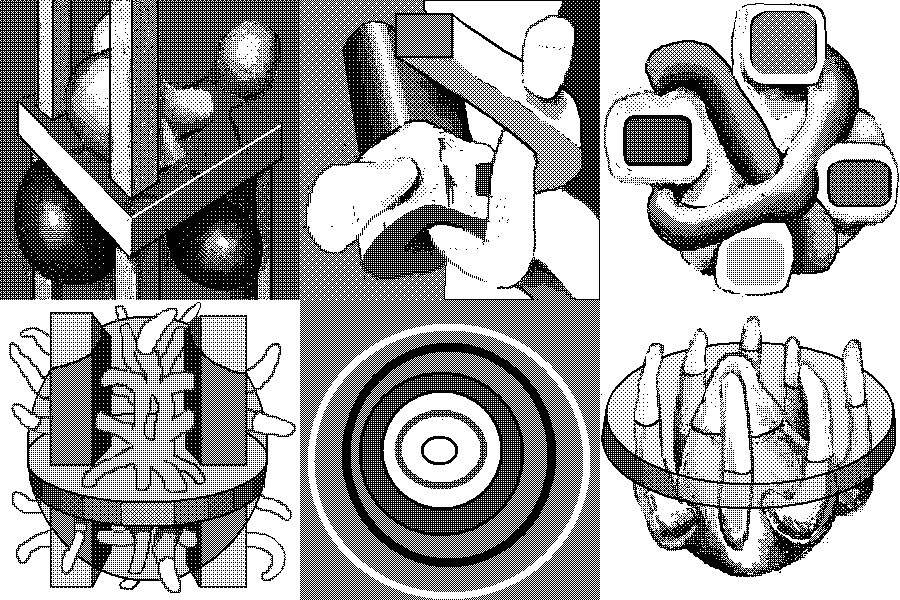
For this IMG MGMT essay I present a smaller pool of mostly psychotronic GIFs. About half are ones I made (or remixed) and half are ones I found on the Internet and saved. My site tells which is which but here I have numbered them a1, a2, etc as a gesture to the “authorless” quality of their web milieu. All of them are subject to whatever copyright claims adhere to their original publication source, so I will remove them or attribute them if you so request in the comments, and I ask that you not use any of them for commercial purposes (as if!).
GIF fans know that there is a lot sicker material out there. Gruesome actual deaths, bestiality, coprophagy (yum), etc. Psychotronic films, while not exactly family fare, generally avoid the hardcore and the abyss. Exploitation, fine, but there is nothing easier than a “money shot.”













{ 32 comments }
Good read. I think if someone viewed enough of these at once it would make them insane. 🙂
Good read. I think if someone viewed enough of these at once it would make them insane. 🙂
Good read. I think if someone viewed enough of these at once it would make them insane. 🙂
Good read. I think if someone viewed enough of these at once it would make them insane. 🙂
Good read. I think if someone viewed enough of these at once it would make them insane. 🙂
Reminds me of when I was reading the Rhizome discussion pages on web/net 2.0, someone commented that they couldn’t stand looking at looped GIFS. I can’t imagine not being transported by these things, I can watch short loops for hours. Nice essay Tom.
Reminds me of when I was reading the Rhizome discussion pages on web/net 2.0, someone commented that they couldn’t stand looking at looped GIFS. I can’t imagine not being transported by these things, I can watch short loops for hours. Nice essay Tom.
Reminds me of when I was reading the Rhizome discussion pages on web/net 2.0, someone commented that they couldn’t stand looking at looped GIFS. I can’t imagine not being transported by these things, I can watch short loops for hours. Nice essay Tom.
Reminds me of when I was reading the Rhizome discussion pages on web/net 2.0, someone commented that they couldn’t stand looking at looped GIFS. I can’t imagine not being transported by these things, I can watch short loops for hours. Nice essay Tom.
Reminds me of when I was reading the Rhizome discussion pages on web/net 2.0, someone commented that they couldn’t stand looking at looped GIFS. I can’t imagine not being transported by these things, I can watch short loops for hours. Nice essay Tom.
Reminds me of when I was reading the Rhizome discussion pages on web/net 2.0, someone commented that they couldn’t stand looking at looped GIFS. I can’t imagine not being transported by these things, I can watch short loops for hours. Nice essay Tom.
Thanks. I have been enjoying L.M.’s blown up GIFs on her and Sally’s blog. It is nice to have a small dedicated group who believes in this stuff.
I would wager that person at Rhizome who didn’t like looped GIFs somewhere else claimed to have invented them back in the ’90s.
Thanks. I have been enjoying L.M.’s blown up GIFs on her and Sally’s blog. It is nice to have a small dedicated group who believes in this stuff.
I would wager that person at Rhizome who didn’t like looped GIFs somewhere else claimed to have invented them back in the ’90s.
Thanks. I have been enjoying L.M.’s blown up GIFs on her and Sally’s blog. It is nice to have a small dedicated group who believes in this stuff.
I would wager that person at Rhizome who didn’t like looped GIFs somewhere else claimed to have invented them back in the ’90s.
Thanks. I have been enjoying L.M.’s blown up GIFs on her and Sally’s blog. It is nice to have a small dedicated group who believes in this stuff.
I would wager that person at Rhizome who didn’t like looped GIFs somewhere else claimed to have invented them back in the ’90s.
good one Tom. The vertical line gifs [verb] a memory of ‘Rear Window’… Stewart in wheelchair and Kelly in the blue looking out to the worlds each their own call and groove. In this scene the viewer starts to get in on the act that irregularity is what Stewart is sniffing for.
good one Tom. The vertical line gifs [verb] a memory of ‘Rear Window’… Stewart in wheelchair and Kelly in the blue looking out to the worlds each their own call and groove. In this scene the viewer starts to get in on the act that irregularity is what Stewart is sniffing for.
good one Tom. The vertical line gifs [verb] a memory of ‘Rear Window’… Stewart in wheelchair and Kelly in the blue looking out to the worlds each their own call and groove. In this scene the viewer starts to get in on the act that irregularity is what Stewart is sniffing for.
Thanks, c.p. When Journalpics.net first appeared it just scraped images off LiveJournal users’ pages which felt like looking in rear windows even though the pages were public.
The scraper went to hell (literally) when it started relying so heavily on 4Chan and other sites featuring “faces of death” and porn loops. To find good GIFs there now you have to have a kind of nictitating membrane that shields your psyche from acts of disgusting sadism before they “register.”
It’s true it’s all part of “life” but filtering unwanted data is also part of life.
Thanks, c.p. When Journalpics.net first appeared it just scraped images off LiveJournal users’ pages which felt like looking in rear windows even though the pages were public.
The scraper went to hell (literally) when it started relying so heavily on 4Chan and other sites featuring “faces of death” and porn loops. To find good GIFs there now you have to have a kind of nictitating membrane that shields your psyche from acts of disgusting sadism before they “register.”
It’s true it’s all part of “life” but filtering unwanted data is also part of life.
Thanks, c.p. When Journalpics.net first appeared it just scraped images off LiveJournal users’ pages which felt like looking in rear windows even though the pages were public.
The scraper went to hell (literally) when it started relying so heavily on 4Chan and other sites featuring “faces of death” and porn loops. To find good GIFs there now you have to have a kind of nictitating membrane that shields your psyche from acts of disgusting sadism before they “register.”
It’s true it’s all part of “life” but filtering unwanted data is also part of life.
A rambunctious (not work safe) collection of GIFs that includes one of my “optical disc” animations being hotlinked from, as coincidence would have it, Paddy’s blog:
http://forums.myspace.com/t/4102189.aspx?fuseaction=forums.viewthread
A rambunctious (not work safe) collection of GIFs that includes one of my “optical disc” animations being hotlinked from, as coincidence would have it, Paddy’s blog:
http://forums.myspace.com/t/4102189.aspx?fuseaction=forums.viewthread
Didn’t you link up that punching cat on the best of the web too?
The dog humping that kids leg, and her running off screening is pretty funny!
Didn’t you link up that punching cat on the best of the web too?
The dog humping that kids leg, and her running off screening is pretty funny!
Didn’t you link up that punching cat on the best of the web too?
The dog humping that kids leg, and her running off screening is pretty funny!
Yes, I got one of the punching cat without the author’s logo.
That Best of the Web 2006 went down when Michael Bell-Smith’s website, ahem, disappeared. I kept an online record of the cats:
http://www.digitalmediatree.com/tommoody/general/?38511
Yes, I got one of the punching cat without the author’s logo.
That Best of the Web 2006 went down when Michael Bell-Smith’s website, ahem, disappeared. I kept an online record of the cats:
http://www.digitalmediatree.com/tommoody/general/?38511
this is my mascott in the background of my myspace page. check it out.
go lo-fi!
this is my mascott in the background of my myspace page. check it out.
go lo-fi!
this is my mascott in the background of my myspace page. check it out.
go lo-fi!
this is my mascott in the background of my myspace page. check it out.
go lo-fi!
Comments on this entry are closed.
{ 1 trackback }