
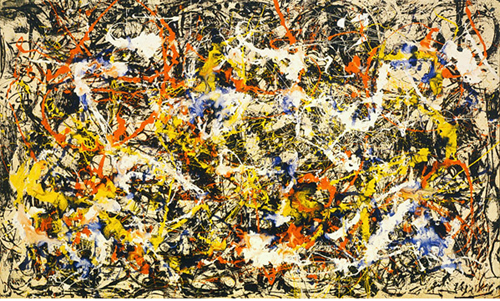
Jackson Pollock (1912-1956), Convergence, 1952, Oil on canvas, 93 1/2 x 155 inches, Image courtesy of the Jewish Museum
My latest review is up at The L Magazine. It is published in full below as it is no longer available at The L Magazine.
New York Times critic Roberta Smith describes the Jewish Museum’s Action/Abstraction…1940-1976, an exhibition arranged from the perspectives of critics Clement Greenberg and Harold Rosenberg (including a lot of their writing), as “a series of lavishly illustrated talking points,” while Peter Schjeldahl at the New Yorker calls the show “more a perambulatory essay than an art exhibition.” Though the reviews themselves are largely positive, both statements imply a certain wariness about presenting art through the eyes of its critics, a position I’m a little hesitant to take myself, if only because it seems a little absurd to pick on an exhibition just because the wall labels are better than usual.
Probably the most illuminating thing about the highlighted writing is that even in a period when movements were aptly named, the artists didn’t necessarily fit squarely into these critics’ theories. “At a certain moment in time, the canvas began to appear to one American painter after another as an arena in which to act — rather than a space in which to reproduce, re-design, or ‘express’ an object,” Rosenberg writes, aptly describing the work of Jackson Pollock and Willem de Kooning in the first room of the exhibition, while ignoring the properties of Hans Hoffman’s carefully painted square fields of color displayed in the next gallery. Greenberg’s message also aptly described Pollock and de Kooning’s work, though it was similarly exclusive, and ultimately his undoing. “The essence of Modernism,” he wrote, “lies, as I see it, in the use of the characteristic methods of a discipline to criticize the discipline itself, not in order to subvert it but in order to entrench it more firmly in its area of competence.” He wasn’t wrong of course, but he never did come to terms with the fact that not all painters would want to define their art purely through formalism.
Sadly, the critic went on to sink his reputation in the ceaseless promotion of color field painters, though an upstairs gallery exhibiting the work of major artists working in this vein including Helen Frankenthaler, Morris Lewis, Anthony Caro (a sculptor), Jules Olitski, and Kenneth Noland goes a far way in demonstrating why he might have become fixated on such work. And here in lies the crux of the exhibition; while the art itself certainly represents a powerful force as both object and communication, that dialogue does not end on the surface of a painting. Clement Greenberg and Harold Rosenberg were two such figures to push ideas back at artists, and while no firm consensus was drawn relative to those thoughts, that conversation is a necessary part of understanding any work.


{ 28 comments }
This is a good review, thanks. I haven’t seen the exhibit but wanted to mention that the feedback cycles went through many strokes. Greenberg got much of his lingo and ideas about abstraction (flatness, push and pull, etc.) from Hans Hoffman and other artists, in effect translating studio talk into critical language. Then the artists reacted to the codified arguments, dividing into camps based on whether they agreed. Then the critics defined the camps. And so on.
Also worth noting: Rosenberg doesn’t have much of a reputation outside the art world, and his writing and theory is not as cogent as Greenberg’s. “American Action Painters” is pretty much of a crock–the artist as existential hero, but who must also be “serious,” gimme a break. Whereas Harvard modernism scholar Daniel Albright (a cross-disciplinary thinker) recently said of Greenberg’s “Towards a Newer Laocoon,” which presents the argument for separating media into areas of competence (or honesty, as Greenberg phrased it at that time): “in this essay Greenberg presents the finest statement I know of Modernist aesthetic purism.”
This is a good review, thanks. I haven’t seen the exhibit but wanted to mention that the feedback cycles went through many strokes. Greenberg got much of his lingo and ideas about abstraction (flatness, push and pull, etc.) from Hans Hoffman and other artists, in effect translating studio talk into critical language. Then the artists reacted to the codified arguments, dividing into camps based on whether they agreed. Then the critics defined the camps. And so on.
Also worth noting: Rosenberg doesn’t have much of a reputation outside the art world, and his writing and theory is not as cogent as Greenberg’s. “American Action Painters” is pretty much of a crock–the artist as existential hero, but who must also be “serious,” gimme a break. Whereas Harvard modernism scholar Daniel Albright (a cross-disciplinary thinker) recently said of Greenberg’s “Towards a Newer Laocoon,” which presents the argument for separating media into areas of competence (or honesty, as Greenberg phrased it at that time): “in this essay Greenberg presents the finest statement I know of Modernist aesthetic purism.”
It makes sense that Greenberg got much of his ideas from the painters themselves – he describes are in the same way those artists would have to be thinking about it to make it.
If the show pits the two critics against one another — which it kind of does, there’s a whole section dedicated to their arguments — Rosenberg surely comes out on top. I didn’t read all the material in that room (who could), but there’s just so much more material from Rosenberg in the exhibition.
I don’t think American Action Painters is a crock though I’d agree it’s an overly romantic picture of the artist. I rather like the idea that objects disappeared because they were getting in the way of the act of painting though I don’t understand why it had to include the simultaneous dismissal of the artist’s aesthetic interests.
It makes sense that Greenberg got much of his ideas from the painters themselves – he describes are in the same way those artists would have to be thinking about it to make it.
If the show pits the two critics against one another — which it kind of does, there’s a whole section dedicated to their arguments — Rosenberg surely comes out on top. I didn’t read all the material in that room (who could), but there’s just so much more material from Rosenberg in the exhibition.
I don’t think American Action Painters is a crock though I’d agree it’s an overly romantic picture of the artist. I rather like the idea that objects disappeared because they were getting in the way of the act of painting though I don’t understand why it had to include the simultaneous dismissal of the artist’s aesthetic interests.
I can present dozens and dozens of excellent quotes by both Greenberg and Rosenberg that are still relevant. They are great stylists who did not use opaque jargon and wrote in a clear manner. Rosenberg published several excellent essay collections before he died, most of which are still worth reading. Look at what they did in its proper perspective and the very last thing that should come to mind is the word “failure”.
I can present dozens and dozens of excellent quotes by both Greenberg and Rosenberg that are still relevant. They are great stylists who did not use opaque jargon and wrote in a clear manner. Rosenberg published several excellent essay collections before he died, most of which are still worth reading. Look at what they did in its proper perspective and the very last thing that should come to mind is the word “failure”.
I can present dozens and dozens of excellent quotes by both Greenberg and Rosenberg that are still relevant. They are great stylists who did not use opaque jargon and wrote in a clear manner. Rosenberg published several excellent essay collections before he died, most of which are still worth reading. Look at what they did in its proper perspective and the very last thing that should come to mind is the word “failure”.
I can present dozens and dozens of excellent quotes by both Greenberg and Rosenberg that are still relevant. They are great stylists who did not use opaque jargon and wrote in a clear manner. Rosenberg published several excellent essay collections before he died, most of which are still worth reading. Look at what they did in its proper perspective and the very last thing that should come to mind is the word “failure”.
Eric: Has anyone used the word failure here?
Eric: Has anyone used the word failure here?
No. I was reacting to Tom’s “crock” statement. Also, Greenberg really never gets mentioned nowadays by critics and bloggers except in a negative way. They were both great writers and thinkers and I don’t see comparable talents working in the field today. Sorry if I implied that someone here used the specific word “failure” in reference to Rosenberg or Greenberg.
No. I was reacting to Tom’s “crock” statement. Also, Greenberg really never gets mentioned nowadays by critics and bloggers except in a negative way. They were both great writers and thinkers and I don’t see comparable talents working in the field today. Sorry if I implied that someone here used the specific word “failure” in reference to Rosenberg or Greenberg.
Greenberg isn’t very fashionable these days it’s true, but like you, I think he’s a great talent.
Greenberg isn’t very fashionable these days it’s true, but like you, I think he’s a great talent.
Greenberg isn’t very fashionable these days it’s true, but like you, I think he’s a great talent.
Greenberg isn’t very fashionable these days it’s true, but like you, I think he’s a great talent.
Naifeh and Smith’s Pollock bio has a good discussion of “American Action Painters” and all the contradictory things Rosenberg was trying to reconcile in that essay. He wanted an existential hero but the logic of his essay was pointing to Pollock, who was Clem’s guy, so he said the Action Painter had to be serious, that is, couldn’t have any mystical influences. Ultimately the essay lent support to Rosenberg’s championing of De Kooning, who was very organized and meticulous in his methods and European in his influences (i.e., not American or Action). Naifeh and Smith have a damning selection of quotes of what artists and other writers thought of Rosenberg’s work.
Greenberg is hated because he was high handed and dictatorial later in life. Trashing him was a rite of passage for the baby boomer generation of artists. Sounds like he’s still being punished.
Naifeh and Smith’s Pollock bio has a good discussion of “American Action Painters” and all the contradictory things Rosenberg was trying to reconcile in that essay. He wanted an existential hero but the logic of his essay was pointing to Pollock, who was Clem’s guy, so he said the Action Painter had to be serious, that is, couldn’t have any mystical influences. Ultimately the essay lent support to Rosenberg’s championing of De Kooning, who was very organized and meticulous in his methods and European in his influences (i.e., not American or Action). Naifeh and Smith have a damning selection of quotes of what artists and other writers thought of Rosenberg’s work.
Greenberg is hated because he was high handed and dictatorial later in life. Trashing him was a rite of passage for the baby boomer generation of artists. Sounds like he’s still being punished.
Now I have to read that Pollock bio…
Now I have to read that Pollock bio…
Now I have to read that Pollock bio…
Now I have to read that Pollock bio…
Now I have to read that Pollock bio…
They are mean but man is it thorough!
They are mean but man is it thorough!
Neither of them are above criticism. I would never argue that. I guess the thing I have to say to these people who dismiss Rosenberg and Greenberg en masse is this: “Let’s see you produce as much intelligent and constructive writing on the arts as the two of them did before they croaked.” No non-fiction writer is infallible or free from being just plain wrong when examined in retrospect because ideas get trampled by the passage of time. Find me one art writer who didn’t produce some laughable stinkers, some chaff along with the wheat.
Neither of them are above criticism. I would never argue that. I guess the thing I have to say to these people who dismiss Rosenberg and Greenberg en masse is this: “Let’s see you produce as much intelligent and constructive writing on the arts as the two of them did before they croaked.” No non-fiction writer is infallible or free from being just plain wrong when examined in retrospect because ideas get trampled by the passage of time. Find me one art writer who didn’t produce some laughable stinkers, some chaff along with the wheat.
Neither of them are above criticism. I would never argue that. I guess the thing I have to say to these people who dismiss Rosenberg and Greenberg en masse is this: “Let’s see you produce as much intelligent and constructive writing on the arts as the two of them did before they croaked.” No non-fiction writer is infallible or free from being just plain wrong when examined in retrospect because ideas get trampled by the passage of time. Find me one art writer who didn’t produce some laughable stinkers, some chaff along with the wheat.
Comments on this entry are closed.