
There was surprisingly little conversation about how quickly technology and the Internet changes at last Friday’s Net Aesthetics 2.0 panel discussion at the New Museum, a topic that permeated its first incarnation in 2006, and presumably created a need to revisit the subject only two years later. Held in conjunction with EAI, the original panel was moderated by Rhizome’s executive director Lauren Cornell, and included curators Michael Connor and Caitlin Jones, as well as artists Wolfgang Staehle, Michael Bell-Smith, Marisa Olson, and Cory Arcangel. Notably, with the exception of Lauren Cornell, none of these panelists were in attendance for the second round of this discussion, most of them in different parts of the globe for other professional engagements.
To be honest, I can’t say I was overly impressed with the new incarnation of this panel, and certainly, if one is to judge by the number of people who stayed through the whole event, I wasn’t the only one who felt that way. Moderated by curator, author, and Rhizome staff writer Ed Halter with artists Petra Cortright, Jennifer and Kevin McCoy, Tom Moody, Tim Whidden representing the collective MTAA, and Damon Zucconi, the presentations and subsequent conversation were often littered with the use of net-specific terms only those in the community were likely to understand, and therefore failed to engage many in the audience. I suspect part of the underlying issue here is that so much has changed over the last two years that the discussion would really benefit from being narrowed; a three part series discussing surf clubs, hacking versus defaults, and protocol, as separate issues certainly would have solved a few problems.
I’m not going to bother discussing the failures of the conversation at any length because it won’t be of use to anyone and will give me a headache. To briefly summarize the less successful aspects of the evening however, both Damon Zucconi and Petra Cortright spoke poorly about their work, Kevin and Jennifer McCoy’s only connection to net art with regards to their practice is that they pulled a document off the Smoking Gun to make their piece Vice Presidential Downtime Requirements — at one point Jennifer McCoy bizarrely suggested the net wasn’t the right medium to make political art, and Tim Whidden asked the younger artists why they didn’t get that the Internet was a dead end, only to later admit that he wasn’t familiar enough with their work to make that claim. That said, even if some of the panelists didn’t do enough homework, more than a few worthwhile points of departure from Net Aesthetic 2.0’s first incarnation came up. As a result, I’ve provided a summation of these points after the jump, with the disclaimer that this is not meant to be seen as a comprehensive document on the issues raised, but a distillation of issues artists felt were important in 2006, and 2008. Notably, there was a lot more agreement amongst the 2006 panel than there was last week.
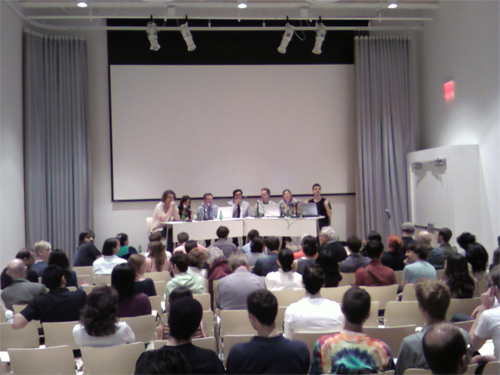
Photo by: Aron Namenwirth
Artistic Rationale for working on the web
2006
- Artists who began working on the web because they had no chance of exhibiting due to their field of interest (Cory Arcangel)
- Artists using the web as a tool (Wolfgang Staehle)
- Artists whose offline work is influenced by the internet but who also make online (MBS and Marisa Olson)
2008
- Everyone is interdisciplinary. (Damon Zucconi, Petra Cortright and Tom Moody)
- Artists using the web as a tool (MTAA — they’ve transitioned to this)
- Artists whose offline work is influenced by the internet but who also make online (Jennifer and Kevin McCoy)
Internet Outsider Art (found or appropriated material)
2006
- Described as interest in nostalgia. A strategy employed by artists as a means of dealing with the rate of technological change. (i.e. a movie looks pretty much the same 15 years later; the internet does not) Working with older material gives the artist a means of understanding it .
2008
- Originality and production. Oliver Laric is quoted by Petra Cortright, who represents the younger generation: “I’ve kind of come to the point right now where I don’t see any necessity in producing images myself — everything that I would need exists, it’s just about finding it.” Everyone is talking about surf clubs.
The web is about communication
2006
- Discussion about Friendster and MySpace (Marisa Olson)
- Individual blogs are discussed (Marisa Olson and Cory Arcangel)
- Internet as a glimpse of ourselves. Monikers as representation of individuality (MBS)
2008
- Social networking sites like Facebook don’t come up once, though two of the panelists tweeted throughout the talk
- In-between states of communication, and the way essentially meaningless sites are assigned meaning naturally on the web (Sometimesredsometimesblue.com) were of interest to Damon Zucconi.
- The simple net art diagram — a strict definition of net art that illustrates the position of Internet-mediated communication and interaction between two people as a lightning bolt between two computers. Tim Whidden says Net Art, as he defines it, is dead. People seemed more bothered by his definition of net art than trying to determine if he was right.
Is it art? How can we tell?
2006
- Marisa Olson doesn’t make a distinction between pop culture and the arts.
- Cory Arcangel sees the net as a real benefit because there are so many people doing interesting things, and his job is just to stay on top of it. Context is what determines whether it’s art.
2008
- Group surf clubs are discussed at length — communication about what’s art and what’s not on these sites isn’t deemed to be an issue for the artists, though Tom Moody admits the issue is confusing. Surf clubs demonstrate that artists use their “art head” when surfing. Moody asks, How do you stand out? Do I care? Do I stop people from putting it into contexts I didn’t intend?
- Hacking vrs Defaults is vaguely referenced.
The Sublime, Beauty and Emotions on the Net
2006
- Reflection that net art used to be about technology. Technology isn’t about utopia, we don’t have to talk about failure, in the third wave, the Internet has feelings. Michael Conner cites the idea of heaven/sublime in MBS’s Continue 2000, and Cory Arcangel’s fluffy Super Mario clouds.
- Cory Arcangel says sublime is something he wanted for his gallery work — a communication strategy necessary for an audience that would not have an awareness of computers, or necessarily want to engage with them.
- MBS talks about safety on the web. It’s a sketch pad.
- Marisa Olson says beauty is safe on the Internet, in contrast to the mainstream art world which tends to be distrustful of it.
- Caitlin Jones says beauty is in the eye of the beholder.
2008
- Speed of change on the Internet mentioned briefly by Moody. Sublime not discussed
- Emotion in web art described as “Internet Aware Art” (originally coined by Guthrie Lonergan here)? Tom Moody’s subsequent post on the subject of emotions described largely anonymous found material with intended emotional substance, and/or the act of embuing those objects with further emotional meaning. Amongst the examples, Moody cites the melancholy in found book covers for self-published books Guthrie Lonergan bookmarks on Delicious under “self publishing” UPDATE: via Lonergan in the comments: “internet aware artist” is partially a sarcastic joke, because everyone is supposedly quite aware of the internet (but the art is not yet.)”
- Feeling of safety on the web reveals itself when Petra Cortright refuses to play a video she’s made to an audience that is available online.
- Interest in the browser as a frame and as a surface (I don’t understand what the surface quality of a browser should look like past what your monitor looks like). Also some mention of the mastery of a medium and meaning built up over time. I didn’t understand where that was going either.
Net Art in the Gallery
2006
- “The Internet is not a two way street” — it doesn’t work well in the gallery (Cory Arcangel). Everyone seems to agree there are problems in making it work.
2008
- No agreement on whether the Internet has been tamed. Tim Whidden thinks the situation “is worse” for artists (I assume he was talking about opportunities, though he wasn’t specific). Tom Moody thinks artists are getting better at showing net art in galleries and cites some of his own work. Petra says she is going to make holographs, (which is the best physical approximation of a .gif I can think of) Ed Halter notes the Biennial no longer has a net art section, Tom Moody counters with the artist favorite YouTube’s event recently at the Kitchen and his exhibition at artMovingProjects Blog.
- Damon Zucconi says the onus is on the artist and not the curator to make it work. Everyone seems to agree with this.
- Ed Halter notes professionals move in both directions in the art world so we have people like Murakami who blend fine art and commerce in Museum contexts, and others such as Jonah Peretti, who was well known for his work as an artist, and moved on to become better known for the Huffington Post and Buzzfeed.
The Wisdom of Crowds.
2006
- Not discussed.
2008
- Acknowledgment of artists releasing art on personal home pages and such before a cursory discussion of surf clubs. Ed Halter reads Marcin Ramocki’s definition “artists post together as a group on one blog, they surf the web for material which stimulates their imagination, and then re-post it with a varied amount of post-production treatment and manipulation. The whole group follows the postings and occasionally comments. Formally, this scenario isn’t much different from popular posting sites, where participants browse for weird, “cult” images and videos and collect them as a form of pastime. Examples include, Nasty Nets, Loshadka, Spirit Surfers and Double Happiness (sorry guys no link, your blog crashes my browser)”


{ 57 comments }
Thanks for the summation and comparison of 2006/2008, it’s very helpful.
In defense of our panel’s attendance the event was sold out and the auditorium full at the outset, and the event ran overtime. I can’t tell you whether the number of people *remaining* at the end of the night was lesser or greater than the EAI panel’s attendance.
Which is not to say the discussion wasn’t specialized and insider-y. I think the amount of content you pulled out of it for the comparison suggests the evening was more impressive than you say it was, but then, you’ve added a lot with your links and the way you’ve put it together.
Thanks for the summation and comparison of 2006/2008, it’s very helpful.
In defense of our panel’s attendance the event was sold out and the auditorium full at the outset, and the event ran overtime. I can’t tell you whether the number of people *remaining* at the end of the night was lesser or greater than the EAI panel’s attendance.
Which is not to say the discussion wasn’t specialized and insider-y. I think the amount of content you pulled out of it for the comparison suggests the evening was more impressive than you say it was, but then, you’ve added a lot with your links and the way you’ve put it together.
Thanks for the summation and comparison of 2006/2008, it’s very helpful.
In defense of our panel’s attendance the event was sold out and the auditorium full at the outset, and the event ran overtime. I can’t tell you whether the number of people *remaining* at the end of the night was lesser or greater than the EAI panel’s attendance.
Which is not to say the discussion wasn’t specialized and insider-y. I think the amount of content you pulled out of it for the comparison suggests the evening was more impressive than you say it was, but then, you’ve added a lot with your links and the way you’ve put it together.
Thanks for the summation and comparison of 2006/2008, it’s very helpful.
In defense of our panel’s attendance the event was sold out and the auditorium full at the outset, and the event ran overtime. I can’t tell you whether the number of people *remaining* at the end of the night was lesser or greater than the EAI panel’s attendance.
Which is not to say the discussion wasn’t specialized and insider-y. I think the amount of content you pulled out of it for the comparison suggests the evening was more impressive than you say it was, but then, you’ve added a lot with your links and the way you’ve put it together.
Yeah, I mean, it’s not my intention to dismiss the panel as a whole, just to acknowledge that I found those issues to be significant. I absolutely think that everyone had their moment and made some god points…but for me it needed some distillation, which was part of the point of this post.
As for the attendance, I actually can’t compare the two events on that level since I only listened to the EAI thing online. I’ll probably put up an mp3 of Friday’s talk.
Yeah, I mean, it’s not my intention to dismiss the panel as a whole, just to acknowledge that I found those issues to be significant. I absolutely think that everyone had their moment and made some god points…but for me it needed some distillation, which was part of the point of this post.
As for the attendance, I actually can’t compare the two events on that level since I only listened to the EAI thing online. I’ll probably put up an mp3 of Friday’s talk.
Yeah, I mean, it’s not my intention to dismiss the panel as a whole, just to acknowledge that I found those issues to be significant. I absolutely think that everyone had their moment and made some god points…but for me it needed some distillation, which was part of the point of this post.
As for the attendance, I actually can’t compare the two events on that level since I only listened to the EAI thing online. I’ll probably put up an mp3 of Friday’s talk.
Yeah, I mean, it’s not my intention to dismiss the panel as a whole, just to acknowledge that I found those issues to be significant. I absolutely think that everyone had their moment and made some god points…but for me it needed some distillation, which was part of the point of this post.
As for the attendance, I actually can’t compare the two events on that level since I only listened to the EAI thing online. I’ll probably put up an mp3 of Friday’s talk.
Yeah, I mean, it’s not my intention to dismiss the panel as a whole, just to acknowledge that I found those issues to be significant. I absolutely think that everyone had their moment and made some god points…but for me it needed some distillation, which was part of the point of this post.
As for the attendance, I actually can’t compare the two events on that level since I only listened to the EAI thing online. I’ll probably put up an mp3 of Friday’s talk.
Thanks for this Paddy, that’s an extremely useful and instructive set of notes.
Thanks for this Paddy, that’s an extremely useful and instructive set of notes.
pls put up the mp3, thx.
pls put up the mp3, thx.
I wish I could have attended the NM panel but I’m still in Berlin for a few more weeks. But I can tell you that the EAI panel was super packed. It was standing room only, plus they eventually put a sign on the front door turning people away. At the time I still lived in San Francisco and it was exciting to me. It felt like a real moment for net art, just like Cory’s next opening and the first sold-out 8Bit screening at MOMA. For like a year afterwards, I constantly met ppl who said they knew me/my work from that panel. It was a thing…. Anyway, my only comment for now is on EAI attendance, since you guys asked about it. I have super limited wifi access here (internet rehab!), but I need to study-up on the Rhiz threads and post a substantial reply there. I’d heard that Ed wanted to focus the panel at least partly on what Guthrie called Internet Aware Art, in his Rhiz interview with Thomas Beard and this was something I’d tried to address in the first panel by calling my work “art _after_ the internet,” so I want to compare how the two were treated after a few years of “evolution,” in my eventual Rhiz response.
I wish I could have attended the NM panel but I’m still in Berlin for a few more weeks. But I can tell you that the EAI panel was super packed. It was standing room only, plus they eventually put a sign on the front door turning people away. At the time I still lived in San Francisco and it was exciting to me. It felt like a real moment for net art, just like Cory’s next opening and the first sold-out 8Bit screening at MOMA. For like a year afterwards, I constantly met ppl who said they knew me/my work from that panel. It was a thing…. Anyway, my only comment for now is on EAI attendance, since you guys asked about it. I have super limited wifi access here (internet rehab!), but I need to study-up on the Rhiz threads and post a substantial reply there. I’d heard that Ed wanted to focus the panel at least partly on what Guthrie called Internet Aware Art, in his Rhiz interview with Thomas Beard and this was something I’d tried to address in the first panel by calling my work “art _after_ the internet,” so I want to compare how the two were treated after a few years of “evolution,” in my eventual Rhiz response.
Here are my lame-ass comments — mostly in response to the photo:
[1]
The new museum needs bigger tables… we look really squished up there.
[2]
There was a guy in a tie-die there? WTF?
[3]
Thanks for the notes Paddy; they’re really good.
Here are my lame-ass comments — mostly in response to the photo:
[1]
The new museum needs bigger tables… we look really squished up there.
[2]
There was a guy in a tie-die there? WTF?
[3]
Thanks for the notes Paddy; they’re really good.
@Marisa
With respect, “internet-aware” as an adjective for art sounds silly to me. I spoke with Ed on the phone before the panel and when he used the term, I must admit that I laughed for a bit. It sounds to me as silly as saying ‘flower-aware’ art.
Your term is better, but isn’t it just simpler to say that your subject (or part of your subject) is the Internet?
Hope you’re having fun in berlin 🙂
@Marisa
With respect, “internet-aware” as an adjective for art sounds silly to me. I spoke with Ed on the phone before the panel and when he used the term, I must admit that I laughed for a bit. It sounds to me as silly as saying ‘flower-aware’ art.
Your term is better, but isn’t it just simpler to say that your subject (or part of your subject) is the Internet?
Hope you’re having fun in berlin 🙂
god, i love the tie dye guy…who is he?
“internet aware artist” is partially a sarcastic joke, because everyone is supposedly quite aware of the internet (but the art is not yet.) i’d bet its the same thing that you were/are talking about, Marisa, can’t wait to hear your response in rhizome board dudeland..
god, i love the tie dye guy…who is he?
“internet aware artist” is partially a sarcastic joke, because everyone is supposedly quite aware of the internet (but the art is not yet.) i’d bet its the same thing that you were/are talking about, Marisa, can’t wait to hear your response in rhizome board dudeland..
Paddy, just for clarification, my post is talking about two issues.
–asking for some clarification of what “internet aware art” was.
–following up on Ed’s panel question about “emotion in net art.”
I included the topics in the same post for convenience; they are unrelated.
Paddy, just for clarification, my post is talking about two issues.
–asking for some clarification of what “internet aware art” was.
–following up on Ed’s panel question about “emotion in net art.”
I included the topics in the same post for convenience; they are unrelated.
@Guthrie
You seem to make a lot of jokes that are then in turn taken seriously.
I’m afraid of you. You should be stopped.
(Or maybe Ed just makes things seem serious. He seems serious about everything, but that’s what critics do I guess — take things seriously.)
The term is dorky, fine. But yeah, I agree, the ‘net as the subject or inspiration of art == good thing.
@Guthrie
You seem to make a lot of jokes that are then in turn taken seriously.
I’m afraid of you. You should be stopped.
(Or maybe Ed just makes things seem serious. He seems serious about everything, but that’s what critics do I guess — take things seriously.)
The term is dorky, fine. But yeah, I agree, the ‘net as the subject or inspiration of art == good thing.
Tim
I can assure you I take nothing seriously.
Tim
I can assure you I take nothing seriously.
Marisa, I would classify your Netacronyms video as IAA.
http://www.youtube.com/watch?v=2rnttyFGAtI
We are going to use this term.
And BTW I just realized you included some of the MUA (made up acronyms) I posted to NN–thanks! They were slipped in so naturally I forgot where they came from. (Or maybe I was distracted by the sexy shower.)
Marisa, I would classify your Netacronyms video as IAA.
http://www.youtube.com/watch?v=2rnttyFGAtI
We are going to use this term.
And BTW I just realized you included some of the MUA (made up acronyms) I posted to NN–thanks! They were slipped in so naturally I forgot where they came from. (Or maybe I was distracted by the sexy shower.)
guthrie, that was me in tye dye, representing double happiness, the site that is too heavy to link to
guthrie, that was me in tye dye, representing double happiness, the site that is too heavy to link to
(http://doublehappiness.ilikenicethings.com/ – f0r the trU heads)
I was sitting next to tye-dye boy. For me one of the most interesting segments was Damon Zucconi talking about his use of wikis vs. the surf-club-standard blog. I think there is a lot of meat in his idea that blogs ‘never end’ since they are in this constant state of publishing, and his switch to using a wiki was in part an urge to make his work into more of a living document. If surf club blogs are all about a post-by-post articulation of a certain group identity’s aesthetic/style/language, when is there any closure? When can we say its complete, or think that we are somehow able to step back and view that group’s work as a whole? Nasty Nets had a finite life span, so now post mortem we can talk about it as a whole, but with still active blogs, a piece of work(post) becomes dead once its off the front page as we wait for the next new post. I don’t know if the change of form to wiki solves this ‘problem’ (if it is a ‘problem’) but there is a lot in there to talk about.
(http://doublehappiness.ilikenicethings.com/ – f0r the trU heads)
I was sitting next to tye-dye boy. For me one of the most interesting segments was Damon Zucconi talking about his use of wikis vs. the surf-club-standard blog. I think there is a lot of meat in his idea that blogs ‘never end’ since they are in this constant state of publishing, and his switch to using a wiki was in part an urge to make his work into more of a living document. If surf club blogs are all about a post-by-post articulation of a certain group identity’s aesthetic/style/language, when is there any closure? When can we say its complete, or think that we are somehow able to step back and view that group’s work as a whole? Nasty Nets had a finite life span, so now post mortem we can talk about it as a whole, but with still active blogs, a piece of work(post) becomes dead once its off the front page as we wait for the next new post. I don’t know if the change of form to wiki solves this ‘problem’ (if it is a ‘problem’) but there is a lot in there to talk about.
I was interested in the WIKI discussion, too, except the part where Damon said he was doing it because blogs were boring. [smiley]
The “late ’90s problem” that blogs solved was “how do you know what’s new on this *%$??!! page?” Yes, it means you are eternally in the present but it means the page is dynamic (to the naked eye) and not a puzzle to solve.
Damon suggested RSS feeds but those only notify you of the fact of the changed page, I believe, not what actually happened on the page.
Nothing wrong with a WIKI if you’ve got the time and inclination to roam around a site seeing what’s new.
I was interested in the WIKI discussion, too, except the part where Damon said he was doing it because blogs were boring. [smiley]
The “late ’90s problem” that blogs solved was “how do you know what’s new on this *%$??!! page?” Yes, it means you are eternally in the present but it means the page is dynamic (to the naked eye) and not a puzzle to solve.
Damon suggested RSS feeds but those only notify you of the fact of the changed page, I believe, not what actually happened on the page.
Nothing wrong with a WIKI if you’ve got the time and inclination to roam around a site seeing what’s new.
I thought Damon and Petra were really quite inarticulate. Damon made some attempts to refer to some interesting theory-esque threads in digital media studies, but ultimately he came across as someone who has perhaps read some fancy terms before but is clueless when it comes to how to use them. He may actually have known what he was saying and it could have been a problem with nerves in front of a crowd, but to me it seemed like he needs to do a lot more research.
As for Petra, I really do like her work and think what she’s doing is significant in the trajectory (sorry Tim) of net art (sorry again). After hearing her speak, however, it seems like she should leave the analysis of her work to others.
Damn, I’m coming across real negative here. Both artists have produced work that I genuinely appreciate. I just was expecting more meat to their presentations.
I thought Damon and Petra were really quite inarticulate. Damon made some attempts to refer to some interesting theory-esque threads in digital media studies, but ultimately he came across as someone who has perhaps read some fancy terms before but is clueless when it comes to how to use them. He may actually have known what he was saying and it could have been a problem with nerves in front of a crowd, but to me it seemed like he needs to do a lot more research.
As for Petra, I really do like her work and think what she’s doing is significant in the trajectory (sorry Tim) of net art (sorry again). After hearing her speak, however, it seems like she should leave the analysis of her work to others.
Damn, I’m coming across real negative here. Both artists have produced work that I genuinely appreciate. I just was expecting more meat to their presentations.
Nathan: While I agree with you that Damon and Petra did not give very good presentations, I think it’s important to keep in mind that neither have much experience with this; they are both in their early 20s. When I first heard Jennifer and Kevin McCoy speak at eyebeam 8 or 9 years ago, I was pretty unimpressed as well (and I’m pretty sure they were older than Petra and Damon at that time), but they gave a fine presentation Friday so practice certainly helps these things.
I think it’s a really bad idea to tell any artist they should leave the analysis of their work to others, since I’ve always found the most critical aspect of any artistic practice is to be purposeful. The ability to articulate that purpose, for many takes time, but it is a critical part of an artist’s job.
Nathan: While I agree with you that Damon and Petra did not give very good presentations, I think it’s important to keep in mind that neither have much experience with this; they are both in their early 20s. When I first heard Jennifer and Kevin McCoy speak at eyebeam 8 or 9 years ago, I was pretty unimpressed as well (and I’m pretty sure they were older than Petra and Damon at that time), but they gave a fine presentation Friday so practice certainly helps these things.
I think it’s a really bad idea to tell any artist they should leave the analysis of their work to others, since I’ve always found the most critical aspect of any artistic practice is to be purposeful. The ability to articulate that purpose, for many takes time, but it is a critical part of an artist’s job.
Man, tough crowd.
I don’t really go to see artists to be entertained or wowed by a theatrical performance.
I mainly go to breathe their air.
If you want to see a bad “artist show” go to a Bill Viola lecture. He rambles horribly.
I was honored to be sitting at the “PC table” with Damon and Petra and got a lot out of their talks.
Alex Lane, in his pdf, [AFC admin: link removed] notes that Damon defined the Internet as a “medium that works across media.”
That is a view of the Net that nobody from Net 1.0 had because Net 1.0 couldn’t support media worth a damn. I wouldn’t call it clueless or inarticulate.
I would say generally the younger artists in the room were interested in what Damon and Petra had to say and tolerated the “professionalism” of the older artists.
Man, tough crowd.
I don’t really go to see artists to be entertained or wowed by a theatrical performance.
I mainly go to breathe their air.
If you want to see a bad “artist show” go to a Bill Viola lecture. He rambles horribly.
I was honored to be sitting at the “PC table” with Damon and Petra and got a lot out of their talks.
Alex Lane, in his pdf, [AFC admin: link removed] notes that Damon defined the Internet as a “medium that works across media.”
That is a view of the Net that nobody from Net 1.0 had because Net 1.0 couldn’t support media worth a damn. I wouldn’t call it clueless or inarticulate.
I would say generally the younger artists in the room were interested in what Damon and Petra had to say and tolerated the “professionalism” of the older artists.
Tom: I think there was a fair bit of rambling by both participants as well, which is different from saying they didn’t add to the conversation — though that is Nathan’s suggestion.
Also, while you may be right, I have to point out that the audience reaction you describe is speculative.
Tom: I think there was a fair bit of rambling by both participants as well, which is different from saying they didn’t add to the conversation — though that is Nathan’s suggestion.
Also, while you may be right, I have to point out that the audience reaction you describe is speculative.
The pdf was an account from an actual audience member so it wasn’t just me speculating but I understand the reasons for removing it.
The pdf was an account from an actual audience member so it wasn’t just me speculating but I understand the reasons for removing it.
Perhaps I was a little too harsh. I too would expect that they’ll improve over time. Public presentation is not an easy task for anyone.
Also, I see where you’re coming from in saying that it is a critical part of an artist’s job to provide self-analysis. Hell, just look how Murakami is doing just that and pulling the wool over everyone’s eyes at the Brooklyn Museum. I tend to think, however, that even the most articulate and seasoned artists often (not always) can’t attain enough critical or personal distance from their own work to properly contextualize it.
Apologies to Damon and Petra for the tone of my last comment.
Perhaps I was a little too harsh. I too would expect that they’ll improve over time. Public presentation is not an easy task for anyone.
Also, I see where you’re coming from in saying that it is a critical part of an artist’s job to provide self-analysis. Hell, just look how Murakami is doing just that and pulling the wool over everyone’s eyes at the Brooklyn Museum. I tend to think, however, that even the most articulate and seasoned artists often (not always) can’t attain enough critical or personal distance from their own work to properly contextualize it.
Apologies to Damon and Petra for the tone of my last comment.
in response to bennett (and therefore to damon i guess…i missed the panel and the webcast, and even still most of this dialogue hasn’t really revealed anything new to me):
"I think there is a lot of meat in his idea that blogs ‘never end’ since they are in this constant state of publishing, and his switch to using a wiki was in part an urge to make his work into more of a living document."
this doesn’t quite seem to hold up. your idea of a blog post dying is it being relegated (even that is the wrong word) to the second page? it still exists, both live and in the archives (there are two ways to access a post that is not on the front page, right? click "next page" or go to the archives). even though nasty nets is no longer active or receiving new content, it is still existing online. it is still "alive". it was alive as a published blog, and it is alive as an archive.
also, your distinction between something "never ending" versus something "living". i don’t get what you mean? isn’t a wiki page still never ending? i mean, the author has to delete content or edit over it in order for the content to completely disappear, but even then the edits are archived. or am i wrong? i don’t know wikis that well.
also, having missed the panel, somebody please articulate why one of these is preferable to the other and why (is this possible?).
"If surf club blogs are all about a post-by-post articulation of a certain group identity’s aesthetic/style/language, when is there any closure?"
why does there need to be closure? the nature of a blog it seems (it’s predecessor is the diary right?), is to end with the end of the author’s life, or perhaps in this case, the author’s <i>online</i> life.
to me the change from a blog to a wiki doesn’t solve any problem (none have been articulated), nor does it open up to anymore special potential (the kind that you seem to be looking for in damon’s comments). to me, the two prominent wikis to think of here are both closed to public editing. so what is the point? what is the radical act? is it simply that content is constantly refreshed and only the action of editing is archived rather than the content itself? why wouldn’t you want to view archived content?
i will not deny the power of a wiki and it’s communal structure. but to me these wiki’s i’m thinking of (maybe i’m wrong to cite only these???) are closed communities. the are open to public observation, but closed to direct public interaction and intervention.
the wiki is alive either as an open venue or as a closed venue for the dissemination of content.
the blog is alive either as a published medium online (editable after being published), or as an archive online.
supercentral as a wiki open to the public, to me, was pretty radical. as a closed wiki it is interesting and different, but not necessarily radical. not that radicality matter.
(that was long winded)
in response to bennett (and therefore to damon i guess…i missed the panel and the webcast, and even still most of this dialogue hasn’t really revealed anything new to me):
"I think there is a lot of meat in his idea that blogs ‘never end’ since they are in this constant state of publishing, and his switch to using a wiki was in part an urge to make his work into more of a living document."
this doesn’t quite seem to hold up. your idea of a blog post dying is it being relegated (even that is the wrong word) to the second page? it still exists, both live and in the archives (there are two ways to access a post that is not on the front page, right? click "next page" or go to the archives). even though nasty nets is no longer active or receiving new content, it is still existing online. it is still "alive". it was alive as a published blog, and it is alive as an archive.
also, your distinction between something "never ending" versus something "living". i don’t get what you mean? isn’t a wiki page still never ending? i mean, the author has to delete content or edit over it in order for the content to completely disappear, but even then the edits are archived. or am i wrong? i don’t know wikis that well.
also, having missed the panel, somebody please articulate why one of these is preferable to the other and why (is this possible?).
"If surf club blogs are all about a post-by-post articulation of a certain group identity’s aesthetic/style/language, when is there any closure?"
why does there need to be closure? the nature of a blog it seems (it’s predecessor is the diary right?), is to end with the end of the author’s life, or perhaps in this case, the author’s <i>online</i> life.
to me the change from a blog to a wiki doesn’t solve any problem (none have been articulated), nor does it open up to anymore special potential (the kind that you seem to be looking for in damon’s comments). to me, the two prominent wikis to think of here are both closed to public editing. so what is the point? what is the radical act? is it simply that content is constantly refreshed and only the action of editing is archived rather than the content itself? why wouldn’t you want to view archived content?
i will not deny the power of a wiki and it’s communal structure. but to me these wiki’s i’m thinking of (maybe i’m wrong to cite only these???) are closed communities. the are open to public observation, but closed to direct public interaction and intervention.
the wiki is alive either as an open venue or as a closed venue for the dissemination of content.
the blog is alive either as a published medium online (editable after being published), or as an archive online.
supercentral as a wiki open to the public, to me, was pretty radical. as a closed wiki it is interesting and different, but not necessarily radical. not that radicality matter.
(that was long winded)
excuse the abounding typos
excuse the abounding typos
i really didn’t intend to propose a binary, a problem, or a solution, so let’s try to not do that.
the issue i was proposing was simply the question of at what point does something become a form of documentation, online?
when you say “alive as an archive”, i do have a problem with that. the archive is inherently retrospective and closed (“deathlike in appearance”). i was thinking that maybe this is something that, online, becomes tied to technological progression; that we associate a work with a particular moment in a technical support’s history. i’m uneasy about that though.
i was saying that a blog produces a kind of meaning that is syntactical and relational; that meaning operates in-between the posts as much as it does with individuated posts, and through this perhaps trying to think of how the blog form could be thought of as a ‘daily practice’ that ties into this idea of art/life as a pure activity without an end result. when we look at the archive like this then it becomes something that is maybe prospective or anticipatory as opposed to retrospective?
(i’m using the wiki as a tool that allows me to re-enter works in a way that a blog didn’t and for me this is a very private function, which isn’t to say that it has to be. the other thing i was moving away from was a strict chronological ordering scheme which, again, isn’t to say that one thing or the other is problematic.)
i really didn’t intend to propose a binary, a problem, or a solution, so let’s try to not do that.
the issue i was proposing was simply the question of at what point does something become a form of documentation, online?
when you say “alive as an archive”, i do have a problem with that. the archive is inherently retrospective and closed (“deathlike in appearance”). i was thinking that maybe this is something that, online, becomes tied to technological progression; that we associate a work with a particular moment in a technical support’s history. i’m uneasy about that though.
i was saying that a blog produces a kind of meaning that is syntactical and relational; that meaning operates in-between the posts as much as it does with individuated posts, and through this perhaps trying to think of how the blog form could be thought of as a ‘daily practice’ that ties into this idea of art/life as a pure activity without an end result. when we look at the archive like this then it becomes something that is maybe prospective or anticipatory as opposed to retrospective?
(i’m using the wiki as a tool that allows me to re-enter works in a way that a blog didn’t and for me this is a very private function, which isn’t to say that it has to be. the other thing i was moving away from was a strict chronological ordering scheme which, again, isn’t to say that one thing or the other is problematic.)
nasty nets is alive, but enjoying its retirement. wiki’s can be ok, but they require an active old-testament style god to function properly. blogs seem to be the best option at the moment (they did sort of kill the homepage, but thats blog-drama for another day)
as far as damon and petra’s performance is concerned… I would much rather have a confident/powerful/inspiring online presence (which both d and p have in spades) [and no duh they were nervous]
nasty nets is alive, but enjoying its retirement. wiki’s can be ok, but they require an active old-testament style god to function properly. blogs seem to be the best option at the moment (they did sort of kill the homepage, but thats blog-drama for another day)
as far as damon and petra’s performance is concerned… I would much rather have a confident/powerful/inspiring online presence (which both d and p have in spades) [and no duh they were nervous]
Just so it’s clear, nobody is attacking Damon and Petra for their presentations, we’re simply discussing it. I didn’t like the presentation, but that doesn’t mean I or anyone else was saying anything about their online presence.
Just so it’s clear, nobody is attacking Damon and Petra for their presentations, we’re simply discussing it. I didn’t like the presentation, but that doesn’t mean I or anyone else was saying anything about their online presence.
Comments on this entry are closed.
{ 1 trackback }